OpenAI's GPT-Rosalind: AI's Big Leap into Drug Discovery
OpenAI Steps Into the Lab with New AI Assistant for Scientists
In a move that could reshape pharmaceutical research, OpenAI introduced GPT-Rosalind on April 16th - an AI model specifically fine-tuned for life sciences. Named to honor Rosalind Franklin, whose work revealed DNA's structure, this tool aims to shorten the decade-long journey from lab discovery to medicine cabinet.
What Can GPT-Rosalind Do?
The model acts as a digital research assistant, helping scientists:
- Connect dots across massive biochemical datasets
- Generate testable hypotheses about disease mechanisms
- Design experiments more efficiently
- Analyze protein structures for drug targets
"It's like giving every researcher a team of data-crunching grad students who never sleep," remarked one biotech insider familiar with the project.
Early Adopters Include Industry Heavyweights
Currently available as a "research preview," GPT-Rosalind counts pharmaceutical leaders among its first users:
- Amgen (biotech pioneer)
- Moderna (mRNA vaccine innovator)
- Thermo Fisher Scientific (lab equipment giant)
- Allen Institute (nonprofit research organization)
The model comes with a plugin connecting to 50+ scientific databases, essentially creating a one-stop shop for research tools.
The AI Arms Race in Science Heats Up
This launch positions OpenAI against Google's DeepMind and Anthropic in the race to digitize discovery. While AI won't replace seasoned researchers overnight, GPT-Rosalind's debut caused noticeable stock fluctuations among smaller biotech firms - a sign the industry takes this development seriously.
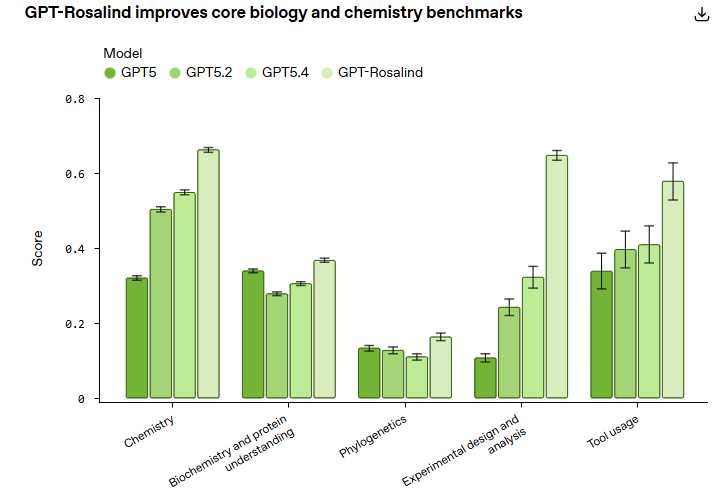
Some researchers express cautious optimism. "The model scored impressively on LABBench2 tests," notes a computational biologist at Johns Hopkins. "But real lab work involves messy, unpredictable variables that challenge even the smartest algorithms."
Key Points
- Specialized AI: GPT-Rosalind focuses exclusively on life sciences applications
- Faster discoveries: Aims to accelerate the typically slow drug development pipeline
- Scientific toolkit: Integrates with major research databases and analysis tools
- Industry impact: Initial partners represent major players in biotech and pharma
- Human-AI collaboration: Designed to assist rather than replace researchers
The model's true test will come as more scientists put it through its paces. If successful, we might see AI-assisted breakthroughs reaching patients years sooner than traditional methods allow.