PixVerse R1 Brings Virtual Worlds to Life with Real-Time 1080P Video

A New Era of Interactive Virtual Worlds Begins
Image

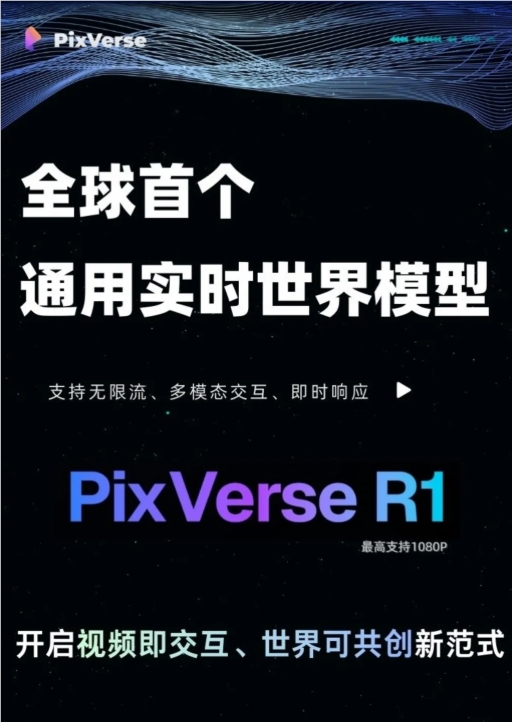
Imagine a digital world that responds to your every thought and action in real time, with visuals crisp enough to rival reality. That's exactly what Aishikeji has achieved with their revolutionary PixVerse R1 model, setting a new standard for interactive virtual experiences.

The Tech Behind the Magic

At its core, PixVerse R1 combines three groundbreaking technologies that work in harmony:

Omni, the model's computational powerhouse, seamlessly blends text, images, audio and video into one cohesive stream. Think of it as the digital equivalent of how our brains process multiple senses simultaneously - except here it's creating stunning 1080P virtual environments from scratch.

The system's autoregressive streaming generation acts like an endless memory bank. This solves one of the biggest headaches in digital content creation - maintaining consistency across long sequences. No more jarring scene transitions or logic gaps that pull you out of the experience.

Perhaps most impressive is the Instant Response Engine (IRE), which gives PixVerse R1 what developers are calling "neural reflexes." By dramatically reducing processing steps, this technology enables reactions so fast they feel instinctive - like a virtual world that anticipates your next move.

Changing How We Create and Play

The implications extend far beyond technical specs. PixVerse R1 essentially hands everyone keys to their own virtual universe:

  • Gamers can explore worlds that evolve organically based on their actions
  • Filmmakers gain tools to craft stories where audiences influence the narrative in real time
  • Streamers can transform passive viewers into active participants shaping the content as it unfolds

The model's "what you think is what you see" approach marks a seismic shift from pre-scripted digital experiences to truly responsive environments. It's currently available for public testing at realtime.pixverse.ai - though fair warning, you might lose track of time once you start experimenting.
Key Points:

  • First general-purpose real-time world model supporting 1080P video quality
  • Combines three innovative technologies for seamless interactive experiences
  • Enables user co-creation across gaming, film and live streaming
  • Available now for public testing at realtime.pixverse.ai
Enjoyed this article?

Subscribe to our newsletter for the latest AI news, product reviews, and project recommendations delivered to your inbox weekly.

Weekly digestFree foreverUnsubscribe anytime

Related Articles

News

How AI is Reshaping Gen Z Social Connections

Soul App's founder spearheaded a groundbreaking campus competition that brought together 4,700 students worldwide to reinvent social media through AI. The event showcased innovative AI agents designed specifically for Gen Z's social needs, marking Soul's strategic shift from content platform to creative incubator.

February 27, 2026
AI innovationGen Z techsocial media evolution
Inception Labs shakes up AI with Mercury2 - a diffusion model that thinks like an editor
News

Inception Labs shakes up AI with Mercury2 - a diffusion model that thinks like an editor

AI startup Inception Labs has unveiled Mercury2, a groundbreaking language model that ditches the standard Transformer architecture for diffusion models. Unlike conventional AI that writes word by word, Mercury2 edits entire passages simultaneously - think of it as having an AI assistant that can rewrite paragraphs instead of typing letters. Early tests show it's blisteringly fast, generating over 1,000 tokens per second while maintaining quality. With competitive pricing and specialized features for speed-sensitive applications, this could be the start of a new approach to AI text generation.

February 25, 2026
AI innovationDiffusion modelsNatural language processing
China's GLM-5 AI Model Breaks New Ground with Domestic Chip Support
News

China's GLM-5 AI Model Breaks New Ground with Domestic Chip Support

Zhipu Technology's GLM-5 AI model has made waves with its latest upgrades, now fully supporting seven major Chinese chip platforms. The model boasts a staggering 744 billion parameters and leads globally in programming agent capabilities. While user demand temporarily overwhelmed servers, the company has responded with compensation measures. Key innovations include a dynamic attention mechanism and new reinforcement learning algorithms that significantly boost performance.

February 23, 2026
AI innovationChinese techmachine learning
AI Lights Up Spring Festival Gala with Record-Breaking 1.9 Billion Interactions
News

AI Lights Up Spring Festival Gala with Record-Breaking 1.9 Billion Interactions

The 2026 Spring Festival Gala made history by integrating AI technology like never before. Doubao's AI-powered features enabled viewers to generate over 50 million festive profile pictures and 100 million digital greetings, while backstage, the Seedance 2.0 model transformed stage visuals with breathtaking precision. Behind the scenes, ByteDance's computing infrastructure handled an unprecedented 63.3 billion tokens per minute at peak moments.

February 17, 2026
AI innovationSpring Festival GalaDoubao
China's Spring Festival Gala Debuts Homegrown AI Video Tech
News

China's Spring Festival Gala Debuts Homegrown AI Video Tech

ByteDance's Li Liang revealed that this year's CCTV Spring Festival Gala will showcase Seedance 2.0, China's breakthrough AI video generation model. While still unable to create celebrity content, the technology promises to transform how audiences experience the annual cultural extravaganza. This marks a significant step forward for domestic AI applications in media.

February 16, 2026
AI innovationChinese techmedia evolution
Xiaomi's Robot Brain Breakthrough Goes Open Source
News

Xiaomi's Robot Brain Breakthrough Goes Open Source

Xiaomi has taken a bold step forward in robotics by open-sourcing its groundbreaking VLA model. This 4.7 billion-parameter 'brain' solves the frustrating lag between robot vision and movement, enabling real-time responses on everyday hardware. The innovative architecture combines language understanding with precise motion control, setting new benchmarks in simulated and real-world tests.

February 12, 2026
roboticsAI innovationopen source technology