Tencent's New Robot Brain Outsmarts Competitors in Key Tests
Tencent's Robot Control Model Sets New Performance Standards
Tencent Robotics X Lab has cracked a major challenge in artificial intelligence with its newly released HY-Embodied-0.5 model. This specialized system gives machines something most AI lacks: the ability to understand and interact with the physical world.
Breaking the Virtual Barrier
While today's AI can write poetry and analyze data, it often fails at basic physical tasks. "General vision-language models work great on screens but stumble in three-dimensional spaces," explains a Tencent researcher. The HY-Embodied-0.5 changes that through a complete architectural overhaul - not just tweaking existing models.
The team developed two versions:
- MoT-2B (4 billion parameters): Designed for real-time responses in robots
- MoE-32B (407 billion parameters): Built for complex reasoning tasks
How It Works
At its core, the system uses:
- A novel hybrid Transformer design that keeps visual and language processing separate
- HY-ViT2.0 visual encoder for high-detail environment analysis
- Specialized training on over 100 million physical interaction scenarios
"We've essentially given AI spatial common sense," the researcher notes. "It understands that pushing a box requires different force than lifting one."
Performance That Speaks Volumes
Rigorous testing showed remarkable results:
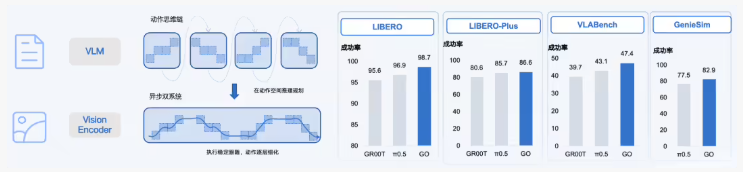
- Topped 16 of 22 standard evaluation benchmarks
- Outperformed similar-sized models like Qwen3-VL-4B
- Matched capabilities of Google's advanced Gemini3.0Pro in some areas
In practical warehouse tests, robots using the system showed:
- 40% better box stacking accuracy
- 35% faster packing speeds
- Fewer dropped objects than previous systems
What This Means for Robotics
This advancement could finally move intelligent robots from controlled labs to real-world environments. Early applications might include:
- Automated warehouses
- Disaster response drones
- Precision manufacturing
As one engineer put it: "We're not just teaching machines to think - we're teaching them to act."
Key Points
- Specialized Design: Built specifically for physical world interaction
- Proven Performance: Leads in 16 of 22 standard benchmarks
- Real-World Ready: Shows practical advantages in physical tasks
- Scalable: Offers both compact and high-power versions