GPT-5.2 Outshines Claude Opus in Browser-Building Marathon
AI Programming Showdown: GPT-5.2 Proves Its Engineering Mettle
Building a web browser from scratch isn't child's play - even for advanced AI systems. The challenge requires parsing HTML, rendering CSS layouts, and developing JavaScript virtual machines while maintaining perfect logical consistency across millions of lines of code.
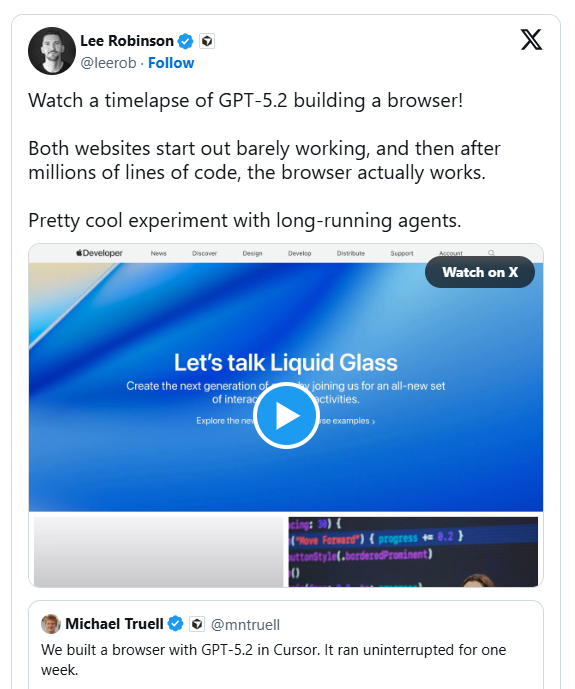
Recent internal testing by coding platform Cursor revealed striking differences between two leading AI models when pushed to their engineering limits. OpenAI's GPT-5.2 emerged as the clear winner against Anthropic's Claude Opus 4.5 in sustained programming tasks that spanned several weeks.
The Marathon Test
The experiment wasn't about writing quick code snippets but maintaining focus through an entire software development lifecycle:
- Continuous project advancement requiring architectural planning and module coordination
- Self-correction of early design flaws without human intervention
- Dependency management across multiple components
- Long-term goal retention without "mission drift"
"GPT-5.2 could reliably follow complex instruction chains," noted the Cursor team report, "with almost no deviation from original task intent during extended reasoning sessions."
Where Claude Stumbled
While Claude Opus 4.5 performed admirably in short bursts:
- It tended to prematurely terminate complex tasks
- Frequently sought simplified solutions rather than tackling full complexity
- More often handed control back to human developers when challenges mounted
The divergence highlights crucial differences in how current AI models handle "marathon" versus "sprint" programming challenges.
Beyond Browser Building
The testing didn't stop at browsers:
- GPT-5.2 successfully replicated a Windows 7 simulator
- Led migration of legacy systems containing over a million lines of code
- Demonstrated ability to plan architectures and debug systems autonomously
These achievements suggest AI is evolving from coding assistant to potential "digital engineer" capable of end-to-end software development.
The implications are profound - what traditionally took months of human effort might soon be handled autonomously by AI systems maintaining remarkable coherence throughout lengthy projects.
Key Points:
- GPT-5.2 shows unprecedented stamina for long-term programming tasks
- Maintains focus better than Claude Opus 4.5 during weeks-long projects
- Successfully built complete browsers and replicated operating environments
- Marks shift from coding assistant to potential autonomous engineer
- Now integrated into Cursor platform for developer use