China's Wenxin ERNIE 5.0 Makes Global AI Waves With Math Breakthrough
China's AI Contender Takes On Global Leaders
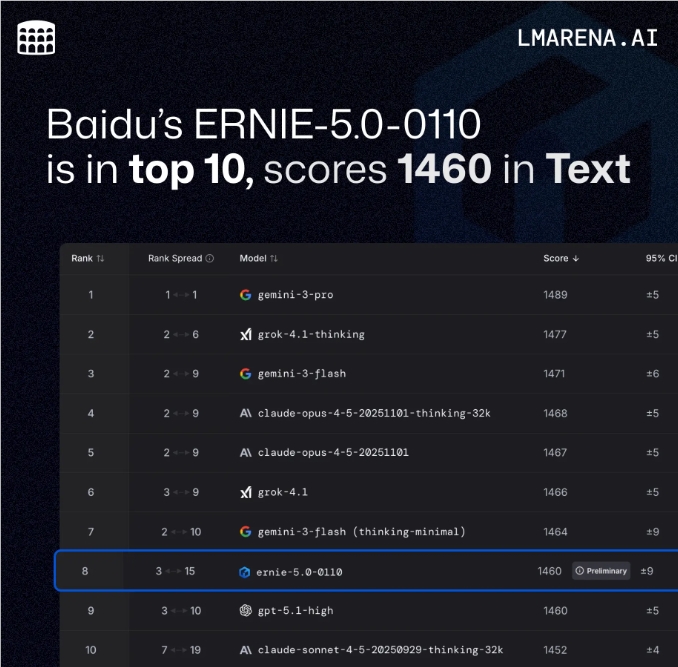
In a significant milestone for China's artificial intelligence sector, Baidu's Wenxin ERNIE 5.0 has claimed eighth place globally in the latest LMArena rankings with a score of 1460 - making it the only Chinese model to break into the prestigious top ten.

Math Whiz Performance Turns Heads
The real surprise came in mathematical reasoning, long considered a weak spot for domestic models. ERNIE 5.0 soared to second place worldwide in this category, trailing only OpenAI's upcoming GPT-5.2-High version that hasn't even hit the market yet.
"This isn't just about catching up," notes AI researcher Li Wei from Tsinghua University. "When your model can solve complex equations nearly as well as OpenAI's next-gen tech, you're playing in the big leagues."
Why LMArena Matters
Unlike narrower benchmarks, LMArena puts models through their paces across multiple dimensions:
- Natural language understanding
- Creative writing tasks
- Logical reasoning challenges
- Programming capabilities
The platform has gained respect for its rigorous testing methodology that mirrors real-world applications rather than academic exercises.
Behind the Breakthrough
Baidu didn't stumble into this success accidentally. The company has been methodically upgrading ERNIE's architecture:
- Knowledge enhancement - Expanding its factual database and contextual understanding
- Logical frameworks - Rewriting how the model approaches problem-solving
- Multimodal integration - Better connecting text analysis with other data types
The math performance jump specifically reflects improvements in formal reasoning systems - crucial for developing AI that doesn't just memorize but truly understands.
Key Points:
- Global ranking: Wenxin ERNIE 5.0 places 8th worldwide on LMArena (1460 pts)
- Math milestone: Second only to unreleased GPT-5.2-High in reasoning tasks
- Validation: Marks transition from "functional" to "competitive" Chinese AI
- Technical edge: Enhanced problem decomposition drives math capabilities