Aliyun Expands Qwen3-VL Models for Mobile AI Applications

Alibaba's Qwen3-VL Expands with Mobile-Optimized AI Models

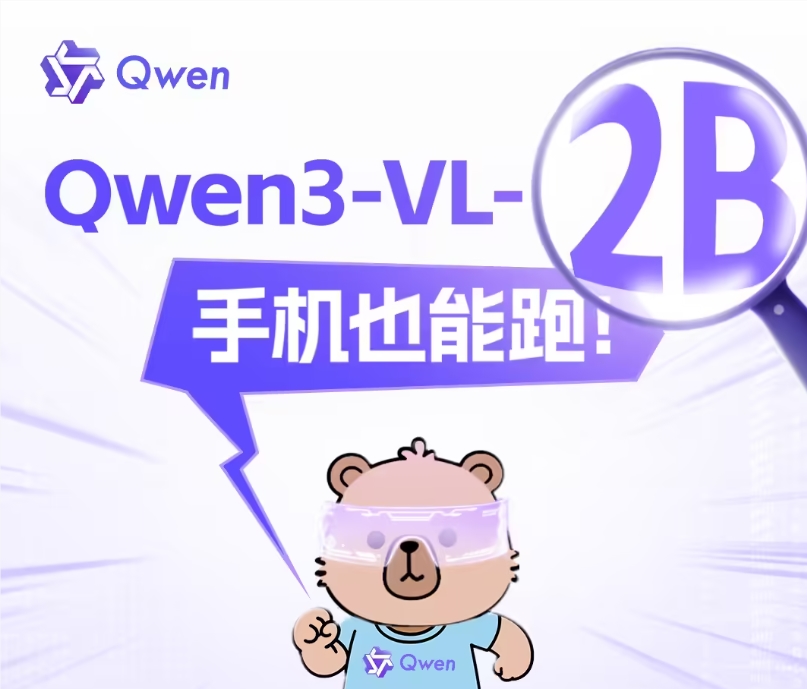
Alibaba Cloud's AI research division has announced significant expansions to its Qwen3-VL visual language model family, introducing two new parameter sizes designed to bridge the gap between mobile accessibility and high-performance AI.

New Model Variants

The newly launched 2B (2 billion parameter) and 32B (32 billion parameter) models represent strategic additions to Alibaba's growing AI portfolio. These developments follow increasing market demand for:

  • Edge-compatible lightweight models
  • High-accuracy visual reasoning systems
  • Scalable solutions across hardware platforms
Image

Specialized Capabilities

Instruct Model Features:

  • Rapid response times (<500ms latency)
  • Stable execution for dialog systems
  • Optimized for tool integration scenarios

Thinking Model Advantages:

  • Advanced long-chain reasoning capabilities
  • Complex visual comprehension functions
  • "Think while seeing" image analysis technology

The 32B variant demonstrates particular strength in benchmark comparisons, reportedly outperforming established models like GPT-5mini and Claude4Sonnet across multiple evaluation metrics.

Performance Benchmarks

Independent testing reveals:

  1. The Qwen3-VL-32B achieves comparable results to some 235B parameter models
  2. Exceptional scores on the OSWorld evaluation platform
  3. The compact 2B version maintains usable accuracy on resource-limited devices

The models are now accessible through popular platforms including ModelScope and Hugging Face, with Alibaba providing dedicated API endpoints for enterprise implementations.

Developer Implications

The introduction of these models addresses three critical industry needs:

  1. Mobile deployment feasibility
  2. Cost-effective inference solutions
  3. Specialized visual-language task handling "These expansions demonstrate our commitment to making advanced AI accessible across the hardware spectrum," noted Dr. Li Zhang, Alibaba Cloud's Head of AI Research.

The company has also released optimization toolkits specifically designed for Android and iOS integration, potentially opening new avenues for on-device AI applications.

Key Points:

🌟 Dual expansion: New 2B (lightweight) and 32B (high-performance) variants added 📱 Mobile optimization: Smartphone-compatible implementations available 🏆 Competitive edge: Outperforms several market alternatives in benchmarks 🛠️ Developer ready: Available on ModelScope and Hugging Face platforms
Enjoyed this article?

Subscribe to our newsletter for the latest AI news, product reviews, and project recommendations delivered to your inbox weekly.

Weekly digestFree foreverUnsubscribe anytime

Related Articles

DeepSeek's New OCR Tech Mimics Human Vision, Slashes Costs
News

DeepSeek's New OCR Tech Mimics Human Vision, Slashes Costs

Chinese AI firm DeepSeek has unveiled OCR2, a breakthrough visual encoder that processes documents like human eyes scan pages. By ditching rigid grid processing for flexible 'causal flow tokens,' the system cuts visual token usage by 80% while outperforming Gemini3Pro in benchmarks. The open-sourced technology could pave the way for truly unified multimodal AI.

February 2, 2026
ComputerVisionAIBreakthroughsDocumentAI
Google's Gemini 3 Flash Now Sees Like a Human Detective
News

Google's Gemini 3 Flash Now Sees Like a Human Detective

Google has upgraded its Gemini 3 Flash AI with groundbreaking 'Agentic Vision' technology that transforms how machines analyze images. Instead of just glancing at pictures, the AI now actively investigates them - zooming in on details, annotating elements, and reasoning like human experts. This breakthrough improves accuracy by 5-10% on complex visual tasks and will soon be available to everyday users through mobile assistants.

January 28, 2026
ComputerVisionGoogleAIImageAnalysis
Robots Can Now Grasp Glassware Thanks to Breakthrough Depth Perception Tech
News

Robots Can Now Grasp Glassware Thanks to Breakthrough Depth Perception Tech

Ant Group's Lingbo Technology has open-sourced LingBot-Depth, a revolutionary spatial perception model that helps robots handle transparent and reflective objects with unprecedented accuracy. Using advanced 'Masked Depth Modeling' technology, the system fills in missing depth data from stereo cameras, solving a longstanding challenge in robotics. Early tests show it outperforms existing solutions by up to 70% in accuracy.

January 27, 2026
RoboticsComputerVisionOpenSource
Kimi K2.5 Sneaks In with Major Visual and Tool Upgrades
News

Kimi K2.5 Sneaks In with Major Visual and Tool Upgrades

Moonshot AI has quietly rolled out Kimi K2.5, bringing significant improvements in visual analysis and tool integration. Users report impressive performance in tasks like converting images to 3D models and solving complex problems step-by-step. The tech community is buzzing with excitement, especially about potential open-source possibilities.

January 27, 2026
AIupdatesComputerVisionMoonshotAI
Samsung's Exynos 2600 Chip Brings AI to Your Pocket with Revolutionary Compression
News

Samsung's Exynos 2600 Chip Brings AI to Your Pocket with Revolutionary Compression

Samsung's upcoming Exynos 2600 chip is set to revolutionize mobile AI by shrinking models by an impressive 90% without sacrificing accuracy. Partnering with AI optimization specialist Nota, Samsung aims to enable complex generative AI tasks directly on your phone - no internet required. This breakthrough could transform how we interact with our devices daily.

December 30, 2025
MobileAIExynos2600EdgeComputing
Meta's Pixio Rewrites the Rules: Simple Approach Beats Complex AI in 3D Vision
News

Meta's Pixio Rewrites the Rules: Simple Approach Beats Complex AI in 3D Vision

Meta AI's new Pixio model proves simplicity can outperform complexity in computer vision. By enhancing an older masking technique and training on diverse web images, Pixio achieves better 3D reconstruction than larger models—all while avoiding benchmark 'cheating.' The breakthrough suggests we might have overcomplicated visual AI.

December 29, 2025
ComputerVisionMetaAI3DReconstruction