Robots Can Now Grasp Glassware Thanks to Breakthrough Depth Perception Tech

Robots Finally Master the Art of Handling Glass

Ever watched a robot fumble with a wine glass? That frustrating limitation may soon be history. Ant Group's Lingbo Technology just unveiled LingBot-Depth, an open-source spatial perception model that gives machines remarkably precise vision - especially for tricky transparent and reflective objects.

Seeing Through the Invisible

The breakthrough comes at an opportune time. As robots move from factories into homes and hospitals, their inability to reliably handle glassware, mirrors, and stainless steel equipment has been a persistent roadblock. Traditional depth cameras often fail when light passes through or bounces off shiny surfaces.
Image

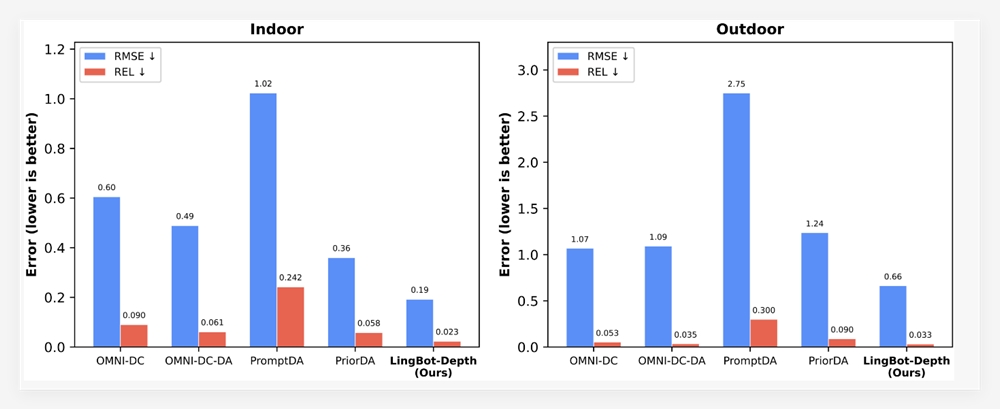
Caption: LingBot-Depth (far right) outperforms existing models in sparse depth completion tasks

"It's like giving robots X-ray vision," explains Dr. Wei Zhang, lead researcher on the project. "Where conventional systems see gaps or noise with glass objects, our model reconstructs the complete 3D shape by analyzing texture clues and contextual information."

The secret sauce? A novel approach called Masked Depth Modeling (MDM) that intelligently fills in missing depth data using color image cues. Paired with Orobote's Gemini330 stereo cameras, the system achieves what engineers previously thought impossible - accurate depth maps of transparent surfaces.

Putting Precision to the Test

In head-to-head comparisons against industry leaders:

  • Reduced indoor scene errors by 70% versus standard solutions
  • Cut sparse reconstruction errors nearly in half (47% improvement)
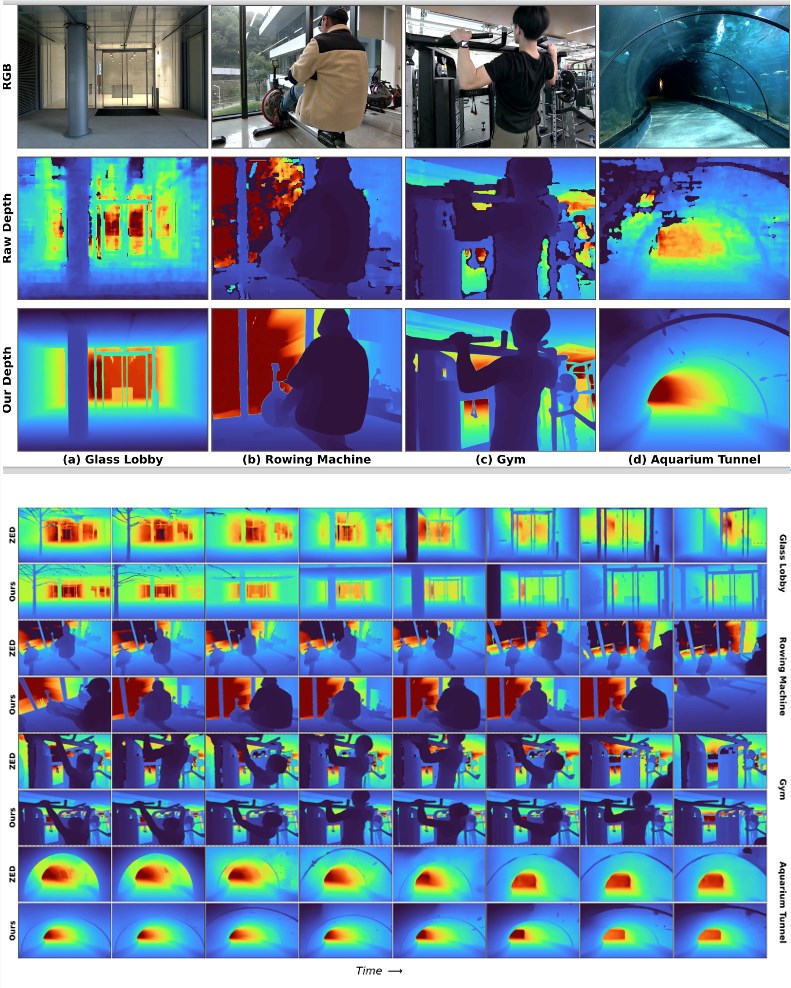
  • Maintained clarity even with strong backlighting and complex curves
Image

Caption: Top - LingBot-Depth reconstructs glass surfaces; Bottom - Outperforming ZED Stereo Depth

The implications stretch far beyond just handling fragile items. Autonomous vehicles could better detect wet roads or ice patches. Industrial robots might safely manipulate shiny machine parts without costly sensors.

Opening the Floodgates

In an unusual move for corporate research, Ant Lingbo is open-sourcing not just the model but also:

  • 2 million real-world depth datasets
  • 1 million simulated training samples
  • Full documentation for integration

The data treasure trove represents six months of intensive field collection across homes, factories, and laboratories worldwide.

The company also announced plans for next-gen Orobote cameras optimized specifically for LingBot-Depth processing - potentially bringing this advanced vision to consumer robotics sooner than expected.

Key Points:

  • Solves robotics' "glass problem" through innovative depth modeling
  • Outperforms existing solutions by up to 70% in accuracy tests
  • Massive dataset release accelerates industry adoption
  • Coming soon to specialized stereo cameras
  • Open-source approach could democratize advanced robotic vision

Enjoyed this article?

Subscribe to our newsletter for the latest AI news, product reviews, and project recommendations delivered to your inbox weekly.

Weekly digestFree foreverUnsubscribe anytime

Related Articles

Ant LingBot's New World Model Brings AI Training to Life
News

Ant LingBot's New World Model Brings AI Training to Life

The Ant Lingbo team has unveiled LingBot-World, an open-source interactive model that creates realistic digital environments for AI training. This breakthrough allows robots and autonomous systems to learn through virtual trial-and-error before facing real-world challenges. With features like 10-minute memory retention and real-time interaction at 16FPS, it's like giving AI a playground where the physics actually make sense.

January 29, 2026
AI TrainingRoboticsSimulation Technology
News

Tech Visionary Claims Robot AI Breakthroughs Could Win Nobel Prize

Yushu Technology founder Wang Xingxing boldly predicts that integrating large AI models with robotics could produce Nobel-worthy breakthroughs. The company prepares to launch two advanced robots - a humanoid model and industrial quadruped - equipped with cutting-edge spatial intelligence technology. Both products are slated for market release in mid-2026.

January 29, 2026
Artificial IntelligenceRoboticsEmerging Technology
News

Tesla Shifts Gears: Farewell to Model S/X as Fremont Goes All-In on Robots

Tesla's latest earnings call brought seismic changes - the iconic Model S and X are being phased out as the company doubles down on AI and robotics. Their Fremont factory will transform into an Optimus robot production hub, aiming for a staggering 1 million units annually. While automotive revenue dipped slightly in Q4 ($24.9 billion), energy sector growth (up 25%) and massive AI investments signal Tesla's bold pivot toward becoming a 'physical AI company.'

January 29, 2026
TeslaElectric VehiclesRobotics
News

Ant Group's Lingbo Tech Opens Doors with Powerful New AI Model

Lingbo Technology, an Ant Group subsidiary focused on embodied intelligence, has made waves by open-sourcing its LingBot-VLA model. This advanced system outperforms competitors in both real-world and simulated environments, showing particular strength in spatial perception and adaptability. The company isn't just sharing the model - they're releasing everything from training tools to evaluation datasets, potentially accelerating robotics development worldwide.

January 28, 2026
Artificial IntelligenceRoboticsOpen Source
Google's Gemini 3 Flash Now Sees Like a Human Detective
News

Google's Gemini 3 Flash Now Sees Like a Human Detective

Google has upgraded its Gemini 3 Flash AI with groundbreaking 'Agentic Vision' technology that transforms how machines analyze images. Instead of just glancing at pictures, the AI now actively investigates them - zooming in on details, annotating elements, and reasoning like human experts. This breakthrough improves accuracy by 5-10% on complex visual tasks and will soon be available to everyday users through mobile assistants.

January 28, 2026
ComputerVisionGoogleAIImageAnalysis
Ant Group's LingBot-VLA Goes Open-Source: A Leap Forward for Robot Intelligence
News

Ant Group's LingBot-VLA Goes Open-Source: A Leap Forward for Robot Intelligence

Ant Group's Lingbo Technology has fully open-sourced its embodied AI model LingBot-VLA, marking a significant step toward practical robot intelligence. The model demonstrates superior performance in real-world tasks, achieving higher success rates than competitors while requiring less training data. This release includes not just model weights but complete training tools, potentially accelerating AI adoption in physical world applications.

January 28, 2026
Artificial IntelligenceRoboticsOpen Source