Vision-RAG vs. Text-RAG: Enterprise Search Compared

Enterprise Search Technology: Vision-RAG Outperforms Text-RAG for Visual Documents

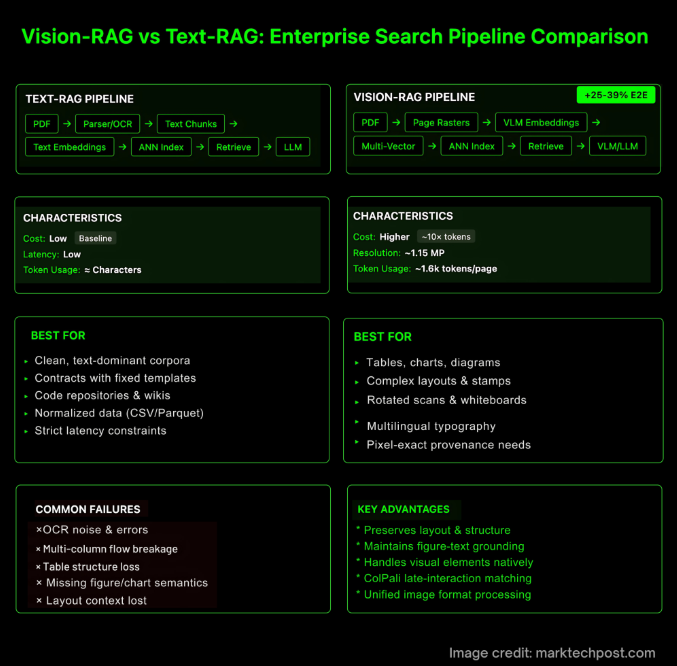
In today's data-driven business landscape, enterprises face mounting challenges in extracting actionable insights from complex documents. A breakthrough comparative study reveals Vision-RAG (Visual Retrieval-Augmented Generation) significantly outperforms traditional Text-RAG approaches when processing visually rich materials.
Image

The Limitations of Text-Based Approaches

Traditional Text-RAG systems rely on converting PDFs to text through OCR technology, often with critical drawbacks:

  • Layout information loss: Document structure and spatial relationships disappear
  • Table degradation: Complex data presentations become unstructured text
  • Chart misinterpretation: Visual data loses semantic meaning
  • OCR errors: Character recognition flaws compound through processing pipelines

"We observed up to 40% information degradation in technical manuals using text-only methods," noted the study's lead researcher.

The Vision-RAG Advantage

The emerging Vision-RAG paradigm addresses these limitations through:

  1. High-fidelity document imaging: Preserves original layouts as embedding inputs
  2. Multimodal processing: Combines visual and textual understanding via VLMs (Visual Language Models)
  3. Contextual awareness: Maintains relationships between text, charts, and diagrams
  4. High-resolution analysis: Crucial for technical documents with fine print or symbols

The study demonstrated particularly strong results with:

  • Financial reports (32% accuracy improvement)
  • Engineering schematics (39% better retrieval)
  • Scientific papers (28% higher precision)

Cost-Benefit Considerations

While Vision-RAG shows clear performance advantages, enterprises must weigh:

Factor Text-RAG Vision-RAG

The research team emphasizes that ROI justifies the investment for organizations handling complex documents: "The productivity gains from accurate technical documentation search typically offset costs within 9 months."

Implementation Best Practices

For enterprises adopting Vision-RAG solutions, experts recommend:

  1. Multimodal alignment: Ensure visual/text embeddings share vector space
  2. Specialized encoders: Use domain-trained models for technical fields
  3. Resolution prioritization: Minimum 300 DPI for engineering documents
  4. Hybrid approaches: Combine both methods based on document types
  5. Efficient retrieval: Implement chunking strategies to manage token costs "​​We've seen clients achieve optimal results by using Vision-RAG for R&D materials while maintaining Text-RAG for standard contracts," shared an industry consultant.​​​​​​​​​​​​​​​​​                   Key Points: - 🚀 Vision-RAG delivers 25-39% better accuracy than Text-RAG for visual documents - 🔍 High-resolution processing is critical for technical material accuracy - ⚖️ Higher implementation costs are offset by productivity gains within months - 🛠️ Hybrid deployment strategies optimize cost-performance ratios
Enjoyed this article?

Subscribe to our newsletter for the latest AI news, product reviews, and project recommendations delivered to your inbox weekly.

Weekly digestFree foreverUnsubscribe anytime

Related Articles

DeepSeek's New OCR Tech Mimics Human Vision, Slashes Costs
News

DeepSeek's New OCR Tech Mimics Human Vision, Slashes Costs

Chinese AI firm DeepSeek has unveiled OCR2, a breakthrough visual encoder that processes documents like human eyes scan pages. By ditching rigid grid processing for flexible 'causal flow tokens,' the system cuts visual token usage by 80% while outperforming Gemini3Pro in benchmarks. The open-sourced technology could pave the way for truly unified multimodal AI.

February 2, 2026
ComputerVisionAIBreakthroughsDocumentAI
News

ServiceNow and Anthropic Join Forces to Power Next-Gen Enterprise AI

ServiceNow is doubling down on AI partnerships, announcing a strategic collaboration with Anthropic just days after teaming up with OpenAI. The deal makes Anthropic's Claude models the default engine for ServiceNow's workflow tools, while also bringing AI-powered coding to its global workforce. ServiceNow's leadership sees no conflict in working with multiple AI providers, emphasizing customer choice as key to enterprise adoption.

January 29, 2026
ServiceNowAnthropicEnterpriseAI
Google's Gemini 3 Flash Now Sees Like a Human Detective
News

Google's Gemini 3 Flash Now Sees Like a Human Detective

Google has upgraded its Gemini 3 Flash AI with groundbreaking 'Agentic Vision' technology that transforms how machines analyze images. Instead of just glancing at pictures, the AI now actively investigates them - zooming in on details, annotating elements, and reasoning like human experts. This breakthrough improves accuracy by 5-10% on complex visual tasks and will soon be available to everyday users through mobile assistants.

January 28, 2026
ComputerVisionGoogleAIImageAnalysis
Robots Can Now Grasp Glassware Thanks to Breakthrough Depth Perception Tech
News

Robots Can Now Grasp Glassware Thanks to Breakthrough Depth Perception Tech

Ant Group's Lingbo Technology has open-sourced LingBot-Depth, a revolutionary spatial perception model that helps robots handle transparent and reflective objects with unprecedented accuracy. Using advanced 'Masked Depth Modeling' technology, the system fills in missing depth data from stereo cameras, solving a longstanding challenge in robotics. Early tests show it outperforms existing solutions by up to 70% in accuracy.

January 27, 2026
RoboticsComputerVisionOpenSource
Kimi K2.5 Sneaks In with Major Visual and Tool Upgrades
News

Kimi K2.5 Sneaks In with Major Visual and Tool Upgrades

Moonshot AI has quietly rolled out Kimi K2.5, bringing significant improvements in visual analysis and tool integration. Users report impressive performance in tasks like converting images to 3D models and solving complex problems step-by-step. The tech community is buzzing with excitement, especially about potential open-source possibilities.

January 27, 2026
AIupdatesComputerVisionMoonshotAI
Meta's Pixio Rewrites the Rules: Simple Approach Beats Complex AI in 3D Vision
News

Meta's Pixio Rewrites the Rules: Simple Approach Beats Complex AI in 3D Vision

Meta AI's new Pixio model proves simplicity can outperform complexity in computer vision. By enhancing an older masking technique and training on diverse web images, Pixio achieves better 3D reconstruction than larger models—all while avoiding benchmark 'cheating.' The breakthrough suggests we might have overcomplicated visual AI.

December 29, 2025
ComputerVisionMetaAI3DReconstruction