Perplexity's BrowseSafe Shields AI Browsers from Hidden Web Threats

Perplexity Fortifies AI Browsers Against Web-Based Attacks

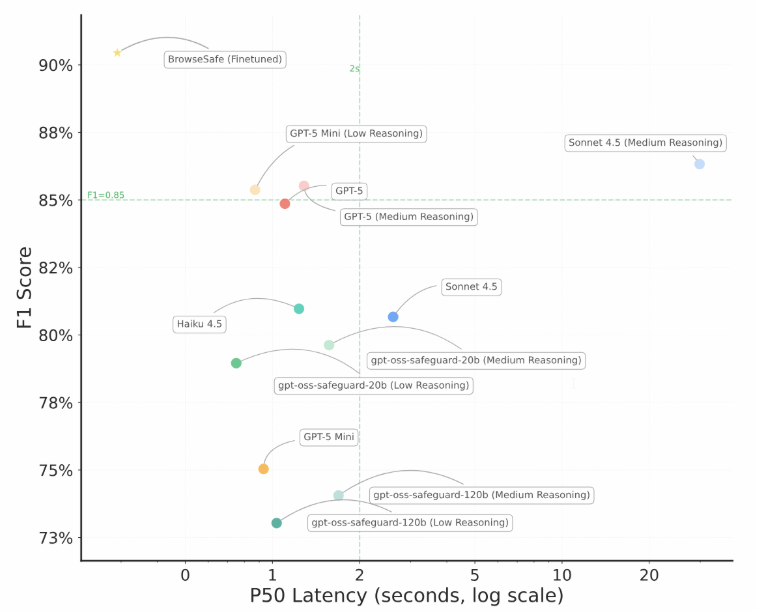
In a move to secure the growing ecosystem of AI-powered browsers, Perplexity has launched BrowseSafe - a defense system specifically designed to protect automated agents from hidden web threats. The technology boasts an impressive 91% success rate in catching prompt injection attacks, significantly outperforming existing solutions like PromptGuard-2 (35%) and even advanced models like GPT-5 (85%).
Image

Why AI Browsers Need Special Protection

The rise of AI browser agents has opened new frontiers in productivity - and new vulnerabilities. Earlier this year, Perplexity's own Comet browser demonstrated how AI agents could authenticate and interact with sensitive services like banking portals and corporate systems. This powerful access comes with risks: attackers can now plant malicious code within ordinary-looking web pages, tricking agents into revealing confidential data or performing unauthorized actions.

"We're seeing attack methods evolve faster than traditional defenses can keep up," explains a Perplexity security researcher. "Standard benchmarks don't account for the sophisticated ways hackers hide dangerous instructions in today's complex web environments."

Building a Smarter Safety Net

Perplexity's solution analyzes threats across three critical dimensions:

  • Attack type (from direct prompts to subtle social engineering)
  • Injection strategy (how malicious content gets embedded)
  • Language style (including multilingual approaches)

The system particularly focuses on "hard-to-detect" content that appears harmless at first glance but contains dangerous triggers. Using a hybrid architecture that combines speed with deep analysis, BrowseSafe scans pages in real-time without slowing down the browsing experience.

Current Limitations and Future Directions

While effective against most threats, the system shows some gaps:

  • Detection rates drop to 76% for multilingual attacks
  • HTML comments prove easier to scan than visible page elements
  • About 10% of sophisticated attacks still slip through defenses

Perplexity has taken the unusual step of making its benchmark data and research publicly available. "Security is a collective challenge," notes their technical paper. "By sharing our framework, we hope to accelerate industry-wide improvements in AI agent protection."

Key Points:

🔹 91% detection rate surpasses current market solutions
🔹 Specialized protection for AI browser privilege escalation risks
🔹 Three-tier defense combines speed with deep language analysis
🔹 Publicly released benchmarks aim to advance industry standards

Enjoyed this article?

Subscribe to our newsletter for the latest AI news, product reviews, and project recommendations delivered to your inbox weekly.

Weekly digestFree foreverUnsubscribe anytime

Related Articles

Microsoft Sounds Alarm on OpenClaw AI Security Risks
News

Microsoft Sounds Alarm on OpenClaw AI Security Risks

Microsoft warns enterprises against deploying its OpenClaw AI assistant on standard workstations due to serious security vulnerabilities. The autonomous agent's high-privilege access makes it susceptible to indirect prompt injections and skill-based malware attacks. Recent findings reveal over 42,000 exposed control panels globally, prompting Microsoft to recommend strict isolation protocols.

February 24, 2026
AI SecurityMicrosoftEnterprise Technology
Douyin Assistant Denies Security Flaws Amid Online Controversy
News

Douyin Assistant Denies Security Flaws Amid Online Controversy

ByteDance's Douyin Assistant team has responded to recent online rumors about security vulnerabilities, calling them 'malicious hype' and 'black PR.' The company states it hasn't received any formal vulnerability reports and maintains its product complies with cybersecurity regulations. While acknowledging circulating demonstration videos, Douyin emphasizes these require active user participation and says it's already upgraded protective measures.

February 27, 2026
Douyin AssistantCybersecurityAI Controversy
Google's AI Crackdown Leaves Email Automation Users in the Cold
News

Google's AI Crackdown Leaves Email Automation Users in the Cold

Google has escalated its battle against AI-powered email automation, with users of tools like OpenClaw reporting complete account suspensions. The tech giant isn't just restricting access to Gmail - entire Google accounts are being wiped out, taking years of stored data with them. Security experts warn that AI agents' unnatural behavior patterns and some users' attempts to bypass paid features have crossed Google's red lines. While developers scramble for solutions, affected users face the harsh reality of permanently lost emails, photos, and documents.

February 25, 2026
GoogleEmail AutomationAI Security
Firefox Fights Back: New Version Lets Users Block AI Features With One Click
News

Firefox Fights Back: New Version Lets Users Block AI Features With One Click

In a bold move against the AI integration trend, Mozilla's Firefox 148 introduces an 'AI kill switch' giving users full control. The update also fixes productivity bugs and expands translation features, while marking the end of support for older Windows systems. It's a refreshing stance in today's AI-dominated browser wars.

February 24, 2026
FirefoxBrowser TechnologyAI Privacy
Anthropic's Claude Code Security: A Game-Changer for Developers Fighting Cyber Threats
News

Anthropic's Claude Code Security: A Game-Changer for Developers Fighting Cyber Threats

Anthropic has unveiled Claude Code Security, an AI-powered tool that's shaking up cybersecurity. Unlike traditional scanners, it thinks like a seasoned security engineer, spotting complex vulnerabilities others miss. Currently in limited preview for enterprises, this tool could redefine how developers protect their code.

February 23, 2026
CybersecurityAI ToolsDeveloper Tools
Google Gemini Hit by Massive AI Model Hack Attempt
News

Google Gemini Hit by Massive AI Model Hack Attempt

Google revealed its Gemini AI chatbot suffered a sophisticated attack where hackers bombarded it with over 100,000 prompts to extract its core algorithms. Security experts warn this 'model distillation' technique could become widespread, threatening corporate AI secrets. The incident highlights growing vulnerabilities as businesses increasingly rely on customized AI systems.

February 15, 2026
AI SecurityGoogle GeminiCyber Threats