SenseTime's New AI Model Outperforms GPT-5 in Spatial Intelligence

SenseTime Breaks New Ground with Spatial Intelligence AI

In a move that could reshape how artificial intelligence interacts with physical spaces, Chinese tech giant SenseTime has launched its SenseNova-SI model series - and the results are turning heads across the industry. These open-source models aren't just keeping pace with global leaders; they're setting new benchmarks.
Image

Closing the Spatial Gap

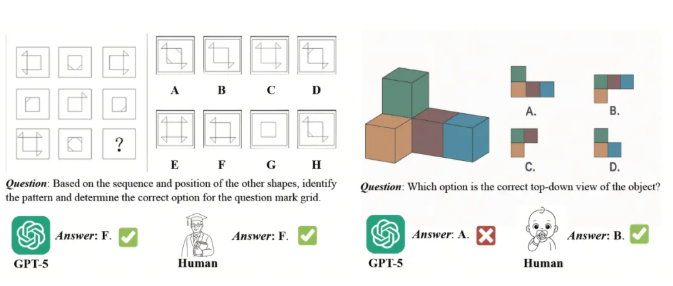
While current AI models excel at language tasks and logical reasoning, they've consistently struggled with spatial understanding - that crucial ability to comprehend and navigate three-dimensional environments. "We recognized this as a fundamental limitation," explains Dr. Li Wei, SenseTime's lead researcher on the project. "True embodied intelligence needs to understand space as humans do."

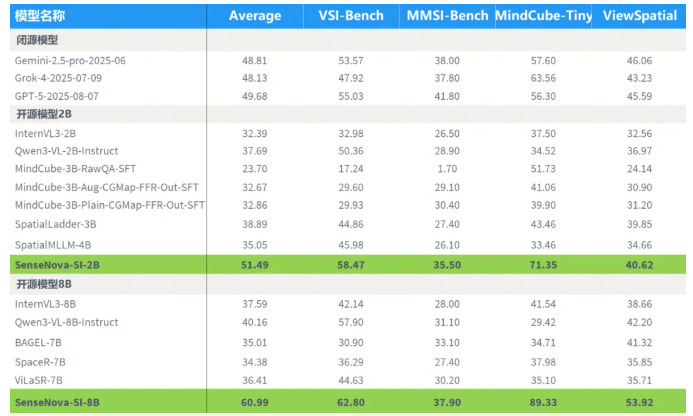
The solution? A systematic training approach leveraging massive datasets specifically designed to enhance spatial cognition. The results speak for themselves: the flagship SenseNova-SI-8B model achieved an impressive 60.99 average score on spatial intelligence benchmarks, outperforming both open-source competitors like Qwen3-VL-8B and proprietary systems including OpenAI's GPT-5.
Image

More Than Just Numbers

What makes this breakthrough particularly noteworthy isn't just the superior performance metrics - it's how SenseTime achieved them. Their methodology focuses on six core aspects of spatial intelligence:

  • Measurement: Precise distance and size estimation
  • Reconstruction: Building mental models of environments
  • Relationships: Understanding how objects interact spatially
  • Perspective: Interpreting scenes from different viewpoints
  • Deformation: Recognizing altered or distorted spaces
  • Reasoning: Drawing logical conclusions about spatial arrangements

The implications extend far beyond academic benchmarks. Autonomous vehicles could navigate complex urban environments more safely. Robotics systems might manipulate objects with human-like precision. Even augmented reality applications could see dramatic improvements.

Setting New Standards

Alongside the model release, SenseTime introduced EASI (Evolutionary Assessment for Spatial Intelligence), an open evaluation platform designed to establish consistent metrics for measuring spatial understanding in AI systems.

The company has made both their models and evaluation tools publicly available through GitHub (https://github.com/EvolvingLMMs-Lab/EASI), signaling a commitment to advancing the field collectively rather than through proprietary silos.

The rapid progress suggests we may be approaching a tipping point where AI systems can understand and interact with physical spaces nearly as well as they process language - potentially opening doors to applications we've only begun to imagine.
Enjoyed this article?

Subscribe to our newsletter for the latest AI news, product reviews, and project recommendations delivered to your inbox weekly.

Weekly digestFree foreverUnsubscribe anytime

Related Articles

Zhipu and Huawei Unveil Breakthrough AI Image Model Powered Entirely by Domestic Tech
News

Zhipu and Huawei Unveil Breakthrough AI Image Model Powered Entirely by Domestic Tech

Chinese AI firm Zhipu has partnered with Huawei to launch GLM-Image, a groundbreaking multimodal model that's entirely trained on domestic hardware. This innovative system combines text and image generation capabilities, excelling particularly at Chinese character rendering and complex visual tasks. Available now as open-source software, it promises to make advanced AI image creation more accessible.

January 14, 2026
AI InnovationDomestic TechnologyComputer Vision
Tencent's WeDLM Turbocharges AI Reasoning With Diffusion Model Breakthrough
News

Tencent's WeDLM Turbocharges AI Reasoning With Diffusion Model Breakthrough

Tencent's WeChat AI team has unveiled WeDLM, a novel diffusion language model that dramatically speeds up text generation while maintaining quality. By cleverly blending diffusion models with attention mechanisms, this innovation delivers processing speeds up to 10 times faster than current models in certain tasks. Early tests show particular promise for applications requiring quick responses like customer service and real-time Q&A.

January 13, 2026
AI InnovationNatural Language ProcessingTencent Technologies
News

Apple's Safari Design Chief Jumps Ship to AI Browser Startup

Apple's Safari design leader Marco Triverio has joined The Browser Company, marking another high-profile departure from Apple's design team. Triverio, who shaped Safari's privacy controls and navigation features, will reunite with former Apple designer Charlie Deets at the AI-focused startup. The move signals growing competition for top tech talent as companies race to dominate the emerging AI browser market.

January 8, 2026
Tech TalentBrowser WarsAI Innovation
News

UGreen's Smart Home Revolution: AI Cloud, Security & Power at CES 2026

At CES 2026, UGreen unveiled a trio of smart home innovations that could redefine how we live with technology. Their new AI-powered private cloud acts as a digital butler for your files, while smart security cameras now anticipate problems before they happen. The crowning touch? A 300W charger that can power an entire family's devices simultaneously - finally solving our cable clutter woes.

January 7, 2026
Smart Home TechCES 2026AI Innovation
CloudCC AI Revolutionizes Auto After-Sales with 300% Faster Response
News

CloudCC AI Revolutionizes Auto After-Sales with 300% Faster Response

CloudCC's AI platform has made waves by slashing automotive after-sales response times by 300%, earning a spot on the prestigious Global Enterprise AI Vendor Map. The system combines NLP and knowledge graphs to transform service efficiency, while China's enterprise AI market surges past 18 billion yuan. From instant fault diagnosis to automated maintenance plans, this technology is redefining what's possible in customer service.

January 7, 2026
AI InnovationAutomotive TechEnterprise Solutions
NVIDIA Takes the Wheel: Open-Source AI Model Accelerates Self-Driving Future
News

NVIDIA Takes the Wheel: Open-Source AI Model Accelerates Self-Driving Future

At CES 2026, NVIDIA's CEO Jensen Huang unveiled Alpamayo, the company's groundbreaking open-source AI model for autonomous vehicles. This move could democratize self-driving technology while challenging Chinese automakers' dominance. The release includes simulation tools and extensive driving data, signaling NVIDIA's push to reclaim leadership in automotive AI.

January 6, 2026
Autonomous VehiclesAI InnovationNVIDIA