Sakana AI's Tiny Plugin Could Revolutionize How AI Handles Massive Documents

Sakana AI Cracks the Code on AI Memory Limitations
Image

Imagine feeding War and Peace to an AI model in less time than it takes to sneeze. That's essentially what Sakana AI's new technology achieves. The Tokyo startup's breakthrough could finally solve one of artificial intelligence's most persistent headaches: how to handle massive documents without breaking the bank or slowing to a crawl.

The Memory Dilemma Solved

For years, developers faced an impossible choice when working with large documents:

  • Option A: Jam everything into the chat window and watch response times plummet while memory usage soars
  • Option B: Spend thousands fine-tuning specialized models for each new task

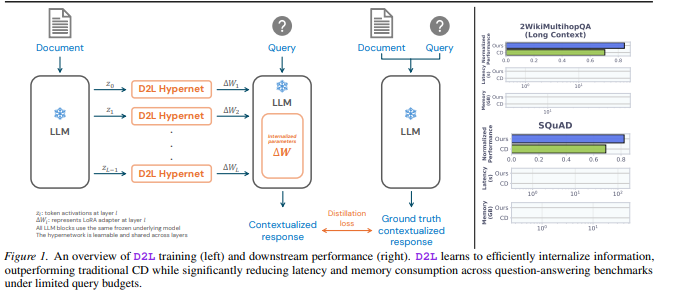
Sakana's solution? A clever pre-training approach that generates ultra-lightweight plugins called LoRAs (Low-Rank Adaptations). These tiny add-ons - some smaller than your average smartphone photo - give existing models new capabilities without expensive retraining.

Doc-to-LoRA: Shrinking Gigabytes to Megabytes

The star of Sakana's show is Doc-to-LoRA (D2L), which performs what can only be described as digital alchemy:

  • Memory Miracle: Processes a 100,000-word document using just 50MB of VRAM instead of the usual 12GB+
  • Speed Demon: Completes in under a second what traditionally took nearly two minutes
  • Capacity Boost: Handles texts four times longer than standard model limits while maintaining impressive accuracy

"It's like giving your model photographic memory," explains one researcher familiar with the technology. "Except instead of remembering everything verbatim, it extracts and stores only the most useful patterns."

Text-to-LoRA: Plain English Power-Ups

The companion Text-to-LoRA (T2L) system lets users customize AI behavior using everyday language. Want your model better at math competitions? Just tell it "help me solve complex math problems" and T2L generates a specialized performance booster.

Surprisingly, these automatically generated plugins sometimes outperform purpose-built models. In testing, T2L-enhanced systems solved logic puzzles more accurately than dedicated math AIs.

Unexpected Bonus: Teaching Text Models to 'See'

Perhaps most astonishing is D2L's accidental superpower - cross-modal learning. Researchers discovered they could trick pure text models into recognizing images by mapping visual data into LoRA parameters. The result? A language model that had never seen pictures before suddenly classified images with 75% accuracy.

This happy accident suggests LoRA technology might bridge gaps between different types of AI systems, potentially paving the way for more versatile artificial intelligence.

The implications are profound:

  • Small businesses could afford customized AI assistants
  • Researchers could rapidly prototype specialized models
  • Consumers might someday personalize their chatbots as easily as installing smartphone apps

The era where only tech giants could afford tailored AI may be ending.

Enjoyed this article?

Subscribe to our newsletter for the latest AI news, product reviews, and project recommendations delivered to your inbox weekly.

Weekly digestFree foreverUnsubscribe anytime

Related Articles

Google's Gemini 3.1 Pro Outshines Competitors With Breakthrough Reasoning Skills
News

Google's Gemini 3.1 Pro Outshines Competitors With Breakthrough Reasoning Skills

Google has unveiled Gemini 3.1 Pro, its most advanced AI model yet, showcasing remarkable improvements in logical reasoning and problem-solving. The new architecture delivers more than double the performance of its predecessor in critical tests, even surpassing GPT-5.2 in some benchmarks. Beyond raw power, Gemini 3.1 Pro introduces innovative multimodal capabilities, handling ultra-long contexts and generating visual representations of complex concepts.

February 24, 2026
AI InnovationGoogle TechMachine Learning
Google's Gemini 3.1 Pro Doubles Down on AI Reasoning Power
News

Google's Gemini 3.1 Pro Doubles Down on AI Reasoning Power

Google has unveiled Gemini 3.1 Pro, its latest AI model that dramatically improves reasoning capabilities. Benchmarks show it outperforms its predecessor by more than double in logical processing tests. The tech giant is making the model widely available through multiple platforms, offering enhanced features for premium subscribers.

February 20, 2026
AI InnovationGoogle TechMachine Learning
Google Phases Out Gemini 3 Pro - Developers Face Tight Migration Deadline
News

Google Phases Out Gemini 3 Pro - Developers Face Tight Migration Deadline

Google has announced the sunset of its Gemini 3 Pro Preview model, setting a March 9 cutoff date. While the tech giant touts improvements in the new 3.1 version, some developers lament losing the predecessor's creative flair. The transition comes with risks - those who miss the deadline may face service disruptions. Many are now scrambling to adapt their prompts to maintain quality output with the updated model.

February 28, 2026
Google AIDeveloper ToolsMachine Learning
Chinese AI Models Outpace US Competitors in Global Adoption
News

Chinese AI Models Outpace US Competitors in Global Adoption

In a surprising shift, Chinese AI models have overtaken their US counterparts in global usage for the first time. Platforms like MiniMax and Moonshot AI are leading the charge, with Chinese models accounting for over 5 trillion weekly tokens - nearly double American offerings. This milestone reflects China's growing influence in artificial intelligence development.

February 27, 2026
AI CompetitionChinese TechMachine Learning
Moonshot AI's Kimi K2.5 Achieves Remarkable Profitability Milestone
News

Moonshot AI's Kimi K2.5 Achieves Remarkable Profitability Milestone

Moonshot AI's latest model, Kimi K2.5, has stunned the tech world by generating more revenue in its first 20 days than all of 2025 combined. The breakthrough comes primarily from overseas users and developers embracing its API services, propelling the company's valuation past $10 billion. Founder Yang Zhilin confirms the company is well-funded with no immediate IPO plans.

February 24, 2026
Artificial IntelligenceTech StartupsMachine Learning
News

Chinese AI Models Capture Global Spotlight During Lunar New Year

Chinese artificial intelligence models made waves internationally during the 2026 Spring Festival, capturing over 60% market share on OpenRouter's developer platform. Three domestic models - MiniMax M2.5, Kimi K2.5, and Zhipu GLM-5 - dominated the rankings by offering superior coding and automation capabilities at remarkably low costs. Their success highlights China's growing influence in AI productivity tools.

February 24, 2026
Artificial IntelligenceChinese TechDeveloper Tools