Meta's New Tool Spots Sneaky GPU Failures Before They Crash AI Training

Meta Tackles Silent GPU Failures That Sabotage AI Training

As artificial intelligence models grow exponentially larger, the GPU clusters powering them have become some of the most complex - and temperamental - computing systems ever built. Meta's AI research team recently unveiled a solution to one of the industry's trickiest problems: silent hardware failures that can derail weeks of expensive training runs.
Image

The Hidden Threat in AI Infrastructure

Imagine spending $2 million training an AI model, only to discover halfway through that one malfunctioning graphics card contaminated your results. That's exactly what happens with "silent failures" - GPUs that appear operational but deliver degraded performance. Unlike web servers where you can simply add more capacity, AI training is vulnerable to these subtle hardware issues.

"A single problematic GPU can act like poison spreading through an entire cluster," explains Meta's technical documentation. "The gradients become corrupted, and you might not realize until days or weeks of computation are wasted."

How GCM Works Its Magic

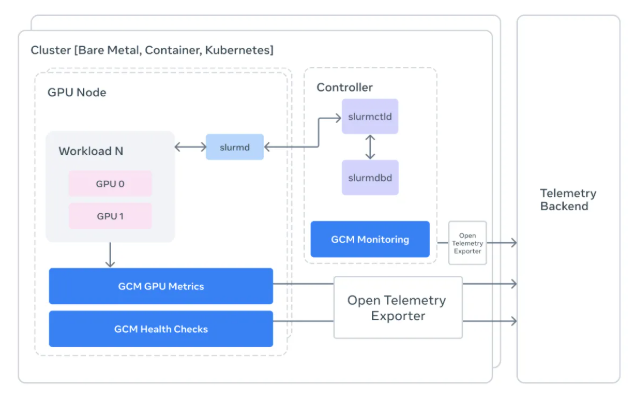
The newly open-sourced GPU Cluster Monitoring (GCM) toolkit serves as a translator between raw hardware data and the engineers who need actionable insights. Deeply integrated with the popular Slurm scheduler, it provides:

  • Task-level visibility: Engineers can now trace power fluctuations or errors back to specific jobs rather than guessing which node might be causing trouble.
  • Automated diagnostics: The system runs comprehensive checks before and after each task using NVIDIA's DCGM tools.
  • Intuitive dashboards: Complex telemetry data gets converted into easy-to-read OpenTelemetry formats viewable in Grafana.

"Before GCM, spotting these issues was like finding a needle in a haystack," says one Meta engineer familiar with the project. "Now we get what amounts to a daily physical exam for every GPU in our fleet."

Why This Matters Beyond Meta

The timing couldn't be better as companies race to train ever-larger models:

  1. Training runs now commonly involve thousands of GPUs working for weeks straight.
  2. The cost of interrupted training grows exponentially with model size.
  3. Traditional monitoring tools weren't designed for these unique workloads.

By open-sourcing GCM, Meta provides smaller organizations access to monitoring capabilities previously limited to tech giants. Early adopters report catching hardware issues up to 80% faster than with conventional methods.

Key Points:

  • 🕵️‍♂️ Detects stealthy failures: Catches GPUs that appear functional but underperform
  • 🔗 Job-aware monitoring: Links hardware metrics directly to specific training tasks
  • 💰 Saves millions: Prevents costly wasted computation from corrupted training runs
  • 🚀 Open-source advantage: Makes enterprise-grade monitoring accessible to all
Enjoyed this article?

Subscribe to our newsletter for the latest AI news, product reviews, and project recommendations delivered to your inbox weekly.

Weekly digestFree foreverUnsubscribe anytime

Related Articles

News

China Unveils Massive 30,000-Card AI Supercluster

China has taken a giant leap in AI computing power with the launch of its first 30,000-card supercluster at Zhengzhou's National Supercomputing Internet hub. This massive computing pool, developed by Sunway in record time, supports trillion-parameter models and promises revolutionary breakthroughs across scientific fields. The system's open architecture makes it surprisingly accessible while offering unprecedented scalability.

February 6, 2026
AI infrastructurehigh-performance computingChina tech
News

a16z Bets Big on AI's Backbone With $1.7 Billion Infrastructure Fund

Silicon Valley heavyweight Andreessen Horowitz is doubling down on AI's foundational technologies, earmarking $1.7 billion from its latest fundraise specifically for infrastructure plays. The move signals a strategic shift toward powering the next wave of artificial intelligence innovation rather than just chasing applications. With past investments in OpenAI and ElevenLabs, a16z aims to control the 'pipes' of AI development - from computing power to talent pipelines.

February 5, 2026
venture capitalAI infrastructureSilicon Valley
News

AI Traffic Gets Smarter: How Large Model Gateways Are Streamlining Enterprise Tech

As businesses adopt multiple AI tools, managing different models has become chaotic. Enter the Large Model Gateway - a traffic cop for AI systems that simplifies access while cutting costs. One company slashed expenses by creating a centralized 'model marketplace' with unified APIs. This innovation could reshape how enterprises deploy AI across departments.

February 3, 2026
AI infrastructureEnterprise technologyMachine learning ops
News

Meta Bets Big on Fiber Optics With $6B Corning Deal

Meta is making a massive $6 billion investment in fiber optic cables from Corning to power its AI infrastructure. The deal, stretching through 2030, comes as tech giants scramble to build capacity for AI workloads. Corning is expanding its North Carolina factory to become the world's largest fiber optic production site, responding to surging demand from Meta and other AI leaders like NVIDIA and Google.

January 28, 2026
MetaAI infrastructurefiber optics
News

Nadella Warns: AI's Hunger for Power Could Reshape Global Economies

Microsoft CEO Satya Nadella made waves at Davos by framing AI development as an energy race. He argued that computing power has become a tangible commodity, with electricity costs determining which nations will lead the AI revolution. Microsoft plans $8 billion in data center investments, prioritizing regions with cheap renewable energy. But Nadella cautioned that without real-world benefits, public enthusiasm for AI could quickly fade.

January 21, 2026
AI infrastructureenergy economicstech policy
News

Microsoft snaps up Osmos to supercharge its AI data game

Microsoft has acquired AI data engineering startup Osmos in a strategic move to bolster its Azure and Fabric platforms. The deal targets Snowflake and Databricks' territory by automating messy data preparation - a critical bottleneck in AI development. Osmos' technology can clean and organize enterprise data in hours instead of weeks, giving Microsoft an edge in the increasingly competitive AI infrastructure space.

January 6, 2026
MicrosoftAI infrastructuredata engineering