
Tech Giants Team Up to Revolutionize AI Data Centers with Light-Speed Connections

The Future of AI Computing Just Got Brighter

Imagine trying to drink a milkshake through a coffee stirrer - that's essentially the challenge today's AI data centers face with traditional copper wire connections. As artificial intelligence models grow exponentially more complex, the physical limitations of electrical signals are becoming impossible to ignore.

Lighting the Way Forward

Ayar Labs, pioneers in chip-level optical technology, have teamed up with hardware specialists Wiwynn to completely rethink how AI racks communicate. Their approach replaces sluggish electrical signals with light-speed optical connections that:

  • Move data faster - Think highway vs. country lane for information transfer between processors
  • Sip rather than guzzle power - Cutting energy waste from signal loss could significantly reduce data center electricity bills
  • Pack more into less space - Optical fibers are thinner than human hair yet carry vastly more data

"We're not just tweaking the existing system," explains an Ayar Labs spokesperson. "This is about building infrastructure capable of handling tomorrow's AI demands today."

From Lab Bench to Data Center Floor

The collaboration goes beyond theoretical advantages, tackling real-world hurdles like:

Keeping cool under pressure - High-performance chips paired with optical components generate serious heat. Wiwynn brings their expertise in liquid cooling systems to prevent meltdowns.

Making fiber manageable - Ever tried untangling Christmas lights? Now imagine doing it with hundreds of delicate optical fibers crammed into a server rack. The teams are developing smarter organization solutions.

Mass production ready - Cutting-edge tech means little if you can't manufacture it reliably at scale. Standardized processes aim to turn prototypes into products.

The first fruits of this partnership will debut at OFC 2026 later this month, featuring complete rack designs combining high-voltage power delivery with advanced cooling systems.

Key Points:

  • Optical connections promise 10x+ bandwidth over copper wires
  • Energy savings could make data centers more sustainable
  • Solution addresses both performance and practical deployment challenges
  • Working prototypes expected by March 2026
Enjoyed this article?

Subscribe to our newsletter for the latest AI news, product reviews, and project recommendations delivered to your inbox weekly.

Weekly digestFree foreverUnsubscribe anytime

Related Articles

News

From Detention Centers to Data Camps: The Controversial Shift in Worker Housing

As America's AI data center boom creates demand for temporary worker housing, controversial private operators are pivoting from immigration detention to construction camps. Target Hospitality, which runs Texas detention facilities accused of poor conditions, secured a $132 million contract building modular communities for data center workers. While these camps offer gyms and steakhouses, critics question whether operators with questionable human rights records should oversee worker accommodations.

March 9, 2026
AI infrastructureworker housinglabor ethics
Meta's New Tool Spots Sneaky GPU Failures Before They Crash AI Training
News

Meta's New Tool Spots Sneaky GPU Failures Before They Crash AI Training

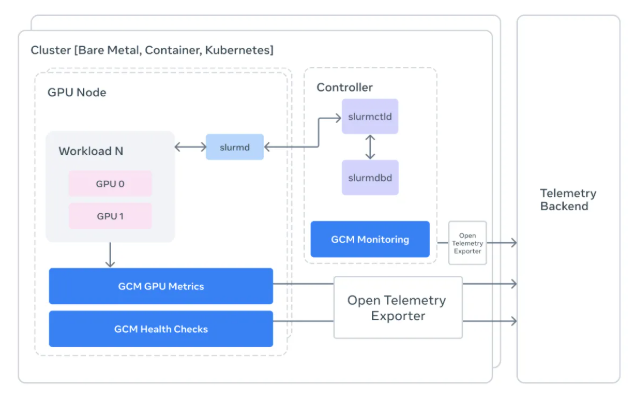
Meta has released an open-source toolkit called GCM that helps detect subtle hardware failures in massive GPU clusters used for AI training. Unlike traditional server monitoring, GCM can pinpoint performance drops in individual GPUs that might otherwise go unnoticed but could ruin weeks of computational work. The tool integrates with popular scheduling systems and provides detailed health reports, potentially saving companies millions in wasted computing resources.

February 25, 2026
AI infrastructureGPU monitoringMeta research
News

China Unveils Massive 30,000-Card AI Supercluster

China has taken a giant leap in AI computing power with the launch of its first 30,000-card supercluster at Zhengzhou's National Supercomputing Internet hub. This massive computing pool, developed by Sunway in record time, supports trillion-parameter models and promises revolutionary breakthroughs across scientific fields. The system's open architecture makes it surprisingly accessible while offering unprecedented scalability.

February 6, 2026
AI infrastructurehigh-performance computingChina tech
News

a16z Bets Big on AI's Backbone With $1.7 Billion Infrastructure Fund

Silicon Valley heavyweight Andreessen Horowitz is doubling down on AI's foundational technologies, earmarking $1.7 billion from its latest fundraise specifically for infrastructure plays. The move signals a strategic shift toward powering the next wave of artificial intelligence innovation rather than just chasing applications. With past investments in OpenAI and ElevenLabs, a16z aims to control the 'pipes' of AI development - from computing power to talent pipelines.

February 5, 2026
venture capitalAI infrastructureSilicon Valley
News

AI Traffic Gets Smarter: How Large Model Gateways Are Streamlining Enterprise Tech

As businesses adopt multiple AI tools, managing different models has become chaotic. Enter the Large Model Gateway - a traffic cop for AI systems that simplifies access while cutting costs. One company slashed expenses by creating a centralized 'model marketplace' with unified APIs. This innovation could reshape how enterprises deploy AI across departments.

February 3, 2026
AI infrastructureEnterprise technologyMachine learning ops
News

Meta Bets Big on Fiber Optics With $6B Corning Deal

Meta is making a massive $6 billion investment in fiber optic cables from Corning to power its AI infrastructure. The deal, stretching through 2030, comes as tech giants scramble to build capacity for AI workloads. Corning is expanding its North Carolina factory to become the world's largest fiber optic production site, responding to surging demand from Meta and other AI leaders like NVIDIA and Google.

January 28, 2026
MetaAI infrastructurefiber optics