Medal Spins Off AI Lab General Intuition with $137M Seed Round

Medal Spins Off AI Lab General Intuition with $137M Seed Round

Game video-sharing platform Medal has launched a new AI research division, General Intuition, backed by a $137.7 million seed round led by Khosla Ventures and General Catalyst, with participation from Raine. The startup aims to harness Medal's extensive library of gaming videos—2 billion clips annually from 10 million monthly active users—to train foundational AI models focused on spatiotemporal reasoning, the ability to understand how objects move through space and time.

Why Gaming Data Matters

General Intuition CEO Pim de Witte argues that Medal’s dataset outperforms alternatives like Twitch or YouTube for AI training. Player-uploaded clips often capture extreme scenarios—either highly positive or negative outcomes—providing "edge cases" critical for robust model training. "You get a selection bias that precisely points to the type of data you really want," de Witte explained.

The lab’s proprietary models can navigate untrained environments using only visual input, mimicking human gameplay. This approach has potential applications in robotics (e.g., drones, autonomous vehicles) since many physical systems are controlled via interfaces similar to gaming controllers.

Strategic Differentiation

Unlike competitors such as DeepMind or World Labs, which monetize world models directly, General Intuition avoids copyright conflicts by focusing on non-commercial applications:

  • Gaming: Developing adaptive NPCs that adjust difficulty dynamically.
  • Search-and-rescue: Training drones to operate in GPS-denied environments.

The company also plans to generate synthetic worlds for agent training and enable AI navigation of unfamiliar physical spaces.

Investor Confidence in Spatial Intelligence

The funding reflects growing interest in spatial intelligence, a niche distinct from text- or image-based AI. De Witte and Lightspeed Ventures partner Moritz Baier-Lentz argue that spatiotemporal reasoning is pivotal for achieving artificial general intelligence (AGI). "Large language models lack fundamental intuition about how the physical world works," de Witte noted.

Key Points:

  • $137.7M seed round led by Khosla Ventures and General Catalyst.
  • Focus on spatiotemporal reasoning using Medal’s gaming video dataset.
  • Applications include adaptive NPCs, rescue drones, and AGI development.
  • Avoids direct competition with game developers to sidestep copyright issues.
Enjoyed this article?

Subscribe to our newsletter for the latest AI news, product reviews, and project recommendations delivered to your inbox weekly.

Weekly digestFree foreverUnsubscribe anytime

Related Articles

StepStellar's New AI Research Model Delivers Top Performance at Fraction of Cost
News

StepStellar's New AI Research Model Delivers Top Performance at Fraction of Cost

StepStellar has unveiled Step-DeepResearch, a groundbreaking AI model that rivals premium commercial offerings while costing just 10% as much. With 32 billion parameters, this open-source solution excels at autonomous research and report generation through its innovative 'atomic capabilities' approach. Early tests show it outperforming many competitors despite its leaner architecture.

December 29, 2025
AIResearchCostEffectiveTechOpenSourceAI
News

Alibaba's AI Breakthrough Takes Top Honors at NeurIPS 2025

Alibaba's Tongyi Qianwen team has claimed one of just four Best Paper Awards at NeurIPS 2025, standing out among 20,000 submissions with their innovative 'attention gating' technique. Their approach acts like a security checkpoint for AI models, filtering irrelevant data before processing to boost both efficiency and accuracy. The breakthrough has already been incorporated into Alibaba's upcoming Qwen3-Next model.

November 28, 2025
NeurIPS2025AIResearchMachineLearning
Alibaba's Qwen3-VL Outperforms Rivals in Spatial Reasoning Tests
News

Alibaba's Qwen3-VL Outperforms Rivals in Spatial Reasoning Tests

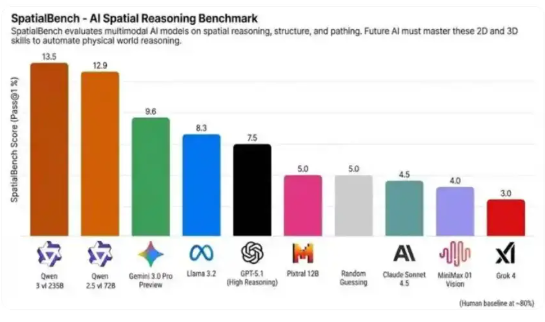
Alibaba's Qwen3-VL vision model has taken the lead in spatial reasoning benchmarks, scoring 13.5 points on SpatialBench - significantly ahead of competitors like Gemini and GPT-5.1. The model introduces innovative features like 3D detection upgrades and visual programming capabilities, with practical applications already being tested in logistics and smart ports. While still far from human performance (80 points), this advancement marks important progress toward more spatially-aware AI systems.

November 26, 2025
ComputerVisionAIResearchSpatialComputing
AntBaiLing Unveils Efficient AI Model Ring-mini-sparse-2.0-exp
News

AntBaiLing Unveils Efficient AI Model Ring-mini-sparse-2.0-exp

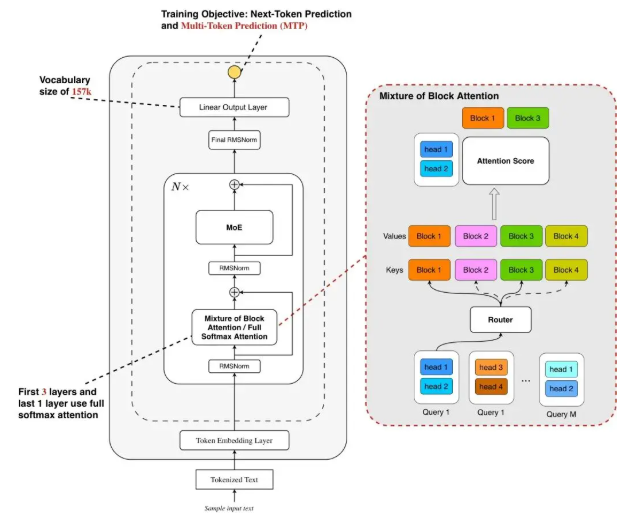
The AntBaiLing team has open-sourced Ring-mini-sparse-2.0-exp, a high-performance inference model optimized for long-sequence processing. Featuring a novel sparse attention mechanism and Mixture of Experts architecture, it triples throughput while maintaining state-of-the-art benchmark results.

October 27, 2025
AIResearchMachineLearningNaturalLanguageProcessing
Opera Neon Introduces AI-Powered Research Agent ODRA
News

Opera Neon Introduces AI-Powered Research Agent ODRA

Opera has unveiled ODRA, a new AI research agent for its Neon browser, marking a significant step in building an AI ecosystem. The feature leverages parallel processing for efficient query resolution and joins three existing agents in Opera's suite.

October 24, 2025
OperaNeonAIResearchBrowserTechnology
Alibaba's Qwen Upgrades Deep Research Tool for Multimodal AI Output
News

Alibaba's Qwen Upgrades Deep Research Tool for Multimodal AI Output

Alibaba's Qwen team has unveiled a major upgrade to its Deep Research tool, enabling one-click generation of reports, interactive web pages, and podcasts. Powered by proprietary AI models, the feature offers seamless content creation without infrastructure setup.

October 23, 2025
AIResearchMultimodalAIContentGeneration