Alibaba's Qwen3-VL Outperforms Rivals in Spatial Reasoning Tests

Alibaba's AI Model Breaks New Ground in Spatial Understanding

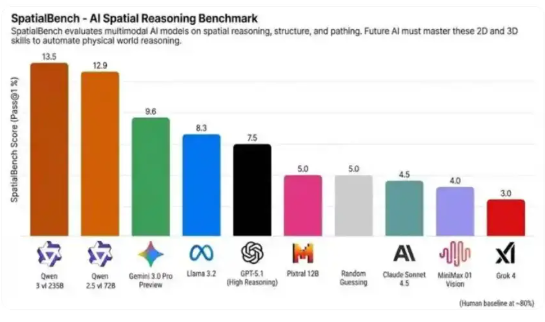
Alibaba's Qwen vision models have claimed the top spots in SpatialBench, a rigorous benchmark testing AI spatial reasoning capabilities. The newer Qwen3-VL scored an impressive 13.5 points, while its predecessor Qwen2.5-VL followed closely with 12.9 points - both significantly outperforming competing models from Google and OpenAI.
Image

What Makes SpatialBench Special?

The SpatialBench evaluates how well AI systems handle real-world spatial challenges - from interpreting engineering diagrams to understanding molecular structures. Often called the "litmus test for embodied intelligence," it pushes models beyond simple image recognition into true spatial comprehension.

Why Qwen3-VL Stands Out

The latest version brings several groundbreaking improvements:

  • Enhanced 3D Perception: By adding rotated bounding box outputs and depth estimation, the model achieves an 18% accuracy boost in cluttered environments where objects partially obscure each other.
  • Sketch-to-Code Functionality: Users can now draw rough diagrams or upload short videos that the system converts directly into working Python code using OpenCV - essentially turning visual ideas into executable programs.
  • Flexible Scaling Options: Available in sizes ranging from compact 2B versions up to massive 235B configurations, allowing different applications to choose their ideal balance of power and efficiency.

Practical Applications Already Underway

Alibaba Cloud reports that early implementations show promising results:

  • Logistics robots using Qwen3-VL achieve spatial positioning accurate within 2 centimeters
  • AR assembly systems demonstrate improved part alignment
  • Smart port operations benefit from enhanced container tracking

The company plans to release an end-to-end "vision-action" model by 2026 that could give robots real-time visual coordination abilities.

Availability Timeline

The previous generation (Qwen2.5-VL) is already open source, while Qwen3-VL's code and tools should become publicly available by mid-2025 through Alibaba's forthcoming Qwen App.

Key Points:

  • Alibaba's Qwen models lead in spatial reasoning benchmarks
  • New features enable better 3D understanding and visual programming
  • Practical deployments show centimeter-level accuracy
  • Open source release planned for 2025
Enjoyed this article?

Subscribe to our newsletter for the latest AI news, product reviews, and project recommendations delivered to your inbox weekly.

Weekly digestFree foreverUnsubscribe anytime

Related Articles

News

Altman Backs AI Startup Teaching Machines to See the World Like Humans

OpenAI CEO Sam Altman has placed a major bet on World Labs, a startup founded by AI pioneer Fei-Fei Li that's developing spatial intelligence for artificial intelligence. The company recently crossed the $1 billion valuation mark with Altman's backing. Their ambitious goal? To give AI systems the same three-dimensional understanding of the physical world that comes naturally to humans - a capability current language models sorely lack.

February 9, 2026
ArtificialIntelligenceSpatialComputingTechInvestments
DeepSeek's New OCR Tech Mimics Human Vision, Slashes Costs
News

DeepSeek's New OCR Tech Mimics Human Vision, Slashes Costs

Chinese AI firm DeepSeek has unveiled OCR2, a breakthrough visual encoder that processes documents like human eyes scan pages. By ditching rigid grid processing for flexible 'causal flow tokens,' the system cuts visual token usage by 80% while outperforming Gemini3Pro in benchmarks. The open-sourced technology could pave the way for truly unified multimodal AI.

February 2, 2026
ComputerVisionAIBreakthroughsDocumentAI
Google's Gemini 3 Flash Now Sees Like a Human Detective
News

Google's Gemini 3 Flash Now Sees Like a Human Detective

Google has upgraded its Gemini 3 Flash AI with groundbreaking 'Agentic Vision' technology that transforms how machines analyze images. Instead of just glancing at pictures, the AI now actively investigates them - zooming in on details, annotating elements, and reasoning like human experts. This breakthrough improves accuracy by 5-10% on complex visual tasks and will soon be available to everyday users through mobile assistants.

January 28, 2026
ComputerVisionGoogleAIImageAnalysis
Robots Can Now Grasp Glassware Thanks to Breakthrough Depth Perception Tech
News

Robots Can Now Grasp Glassware Thanks to Breakthrough Depth Perception Tech

Ant Group's Lingbo Technology has open-sourced LingBot-Depth, a revolutionary spatial perception model that helps robots handle transparent and reflective objects with unprecedented accuracy. Using advanced 'Masked Depth Modeling' technology, the system fills in missing depth data from stereo cameras, solving a longstanding challenge in robotics. Early tests show it outperforms existing solutions by up to 70% in accuracy.

January 27, 2026
RoboticsComputerVisionOpenSource
Kimi K2.5 Sneaks In with Major Visual and Tool Upgrades
News

Kimi K2.5 Sneaks In with Major Visual and Tool Upgrades

Moonshot AI has quietly rolled out Kimi K2.5, bringing significant improvements in visual analysis and tool integration. Users report impressive performance in tasks like converting images to 3D models and solving complex problems step-by-step. The tech community is buzzing with excitement, especially about potential open-source possibilities.

January 27, 2026
AIupdatesComputerVisionMoonshotAI
Shanghai Researchers Unveil Specialized AI for Optics Breakthroughs
News

Shanghai Researchers Unveil Specialized AI for Optics Breakthroughs

Shanghai Jiao Tong University has developed Optics GPT, a specialized AI model tailored for optical research. Unlike general-purpose AI systems, this tool acts like a virtual optics expert, understanding complex principles and assisting scientists with design and diagnostics. The lightweight 8B-parameter model outperforms larger general AIs in optical physics, quantum optics, and engineering applications while ensuring data privacy.

January 26, 2026
AIResearchOpticalTechnologyScientificInnovation