Liquid AI's LFM2-8B-A1B Boosts Mobile AI Efficiency
Liquid AI Unveils Breakthrough Edge AI Model
Liquid AI has launched LFM2-8B-A1B, a revolutionary Mixture-of-Experts (MoE) model that challenges conventional wisdom about edge AI capabilities. With an innovative sparse activation mechanism, this model maintains high performance while dramatically reducing computational requirements.
Technical Innovation
The LFM2-8B-A1B features:
- 8.3 billion total parameters with only 1.5 billion activated per token
- Hybrid architecture combining 18 gate short convolution blocks and 6 group query attention blocks
- Sparse MoE feedforward networks with 32 experts per layer (top-4 activation)
- Supports 32K context length and multiple languages including English, Chinese, and Spanish
The model's normalized sigmoid router with adaptive bias achieves remarkable load balancing - a critical advancement for edge deployment.
Training and Performance Metrics
Pre-trained on approximately 12 trillion tokens, the model demonstrates capabilities rivaling traditional 3-4B parameter dense models:
Benchmark Highlights:
- Knowledge: MMLU-Pro score of 37.4 (+11.5 from previous version)
- Mathematics: GSM8K 84.4, MATH500 74.2
- Multilingual: MGSM 72.4, MMMLU 55.3
- Coding: HumanEval+ 69.5, LiveCodeBench v6 21.0
The model excels in multi-turn dialogue, creative writing, and retrieval-augmented generation tasks.
Deployment Advantages
The LFM2-8B-A1B shows significant speed improvements:
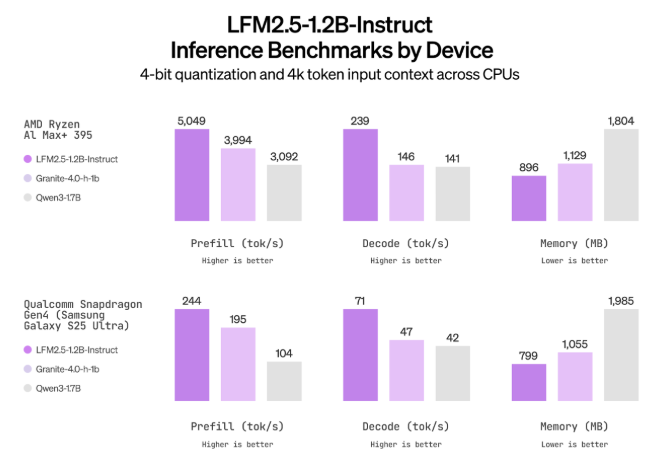
- 5x faster decoding than comparable models on mobile processors
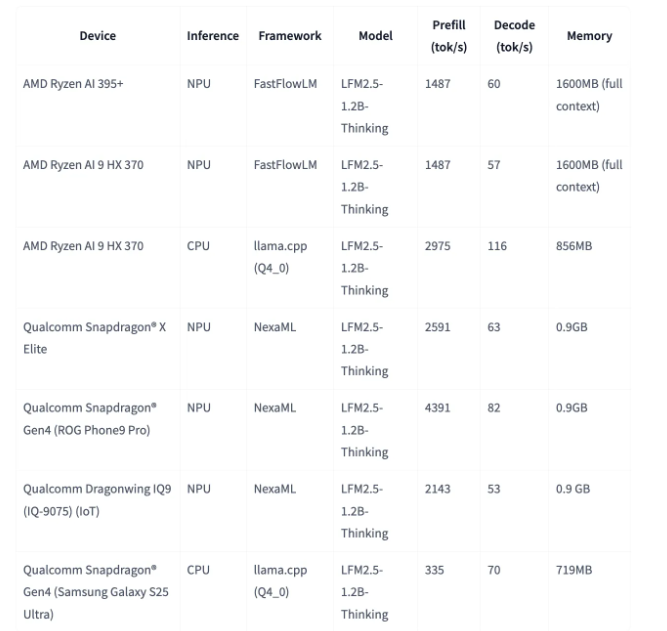
- Optimized for AMD Ryzen AI9HX370 and Samsung Galaxy S24 Ultra
- Supports int4 quantization (∼4.7GB) and FP16 (∼16.7GB) variants
- Compatible with major frameworks including llama.cpp and vLLM
The open-source release under the LFM Open License v1.0 includes weights on Hugging Face and Colab fine-tuning notebooks.
Key Points:
✔️ Revolutionary sparse activation reduces compute requirements by ∼80% ✔️ Matches performance of traditional dense models twice its size ✔️ Optimized for real-time interaction on resource-limited devices ✔️ Open-source availability accelerates edge AI adoption ✔️ Demonstrates viability of small-scale MoE architectures