IBM Unveils Granite4.0Nano Series for Edge AI

IBM Introduces Compact AI Models for Edge Computing

IBM's AI team has unveiled the Granite4.0Nano series, a family of small-scale artificial intelligence models specifically designed for local and edge inference applications. This release marks a significant step in bringing powerful AI capabilities to resource-constrained environments while maintaining enterprise-grade control and open-source accessibility.

Model Architecture and Features

The series comprises eight distinct models offered in two primary sizes: 350 million and approximately 1 billion parameters. These models employ an innovative hybrid architecture that combines State Space Models (SSM) with traditional transformer layers, offering a balance between efficiency and performance.
Image

Notable variants include:

  • Granite4.0H1B: Hybrid SSM architecture with ~1.5B parameters
  • Granite4.0H350M: Hybrid approach with 350M parameters
  • Transformer-only versions for maximum compatibility

The hybrid design alternates between SSM and transformer layers, providing significant advantages in memory efficiency compared to pure transformer models while maintaining the versatility of transformer modules.

Training and Performance

IBM maintained rigorous training standards for these compact models, utilizing the same methodology employed for their larger Granite4.0 counterparts. The models were trained on an extensive dataset exceeding 15 trillion tokens, followed by specialized instruction tuning to enhance:

  • Tool usage capabilities
  • Instruction following accuracy
  • General task performance

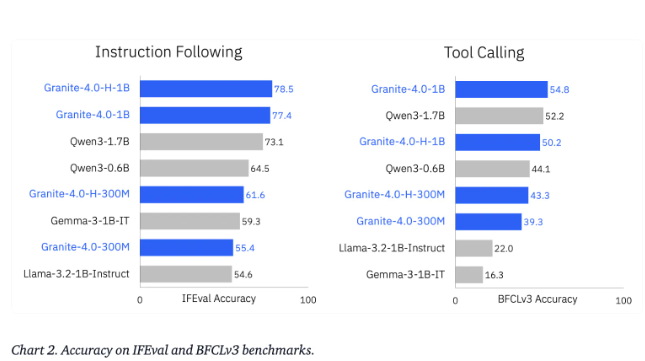
Comparative benchmarks against competing models like Qwen, Gemma, and LiquidAI LFM demonstrate Granite4.0Nano's superior performance in:

  • General knowledge tasks
  • Mathematical computations
  • Coding applications
  • Security-related functions The series also excels in agent tasks, as evidenced by strong showings on the IFEval and Berkeley function call leaderboard version 3.

Enterprise-Grade Deployment

All Granite4.0Nano models come with:

  • Apache2.0 license for open-source use
  • ISO42001 certification for quality assurance
  • Cryptographic signatures for traceability

The models support deployment across various environments including:

  • Edge devices
  • Local servers
  • Browser-based applications Through popular runtime platforms such as:
  • vLLM
  • llama.cpp
  • MLX

Developers can access these models through Hugging Face and IBM's watsonx.ai platform, enabling seamless integration into existing workflows.

Key Points:

🔹 IBM's Granite4.0Nano series offers eight compact AI models for edge computing (350M to 1B parameters) 🔹 Hybrid SSM-transformer architecture provides memory efficiency without sacrificing capability 🔹 Trained on >15 trillion tokens with instruction tuning for enhanced performance 🔹 Enterprise-ready with ISO certification and cryptographic signatures 🔹 Available under Apache2.0 license with multi-platform runtime support

Enjoyed this article?

Subscribe to our newsletter for the latest AI news, product reviews, and project recommendations delivered to your inbox weekly.

Weekly digestFree foreverUnsubscribe anytime

Related Articles

News

China's Healthcare AI Race Heats Up as Baichuan Outperforms GPT-5.2

The global healthcare AI landscape is witnessing intense competition in 2026, with Chinese models like Baichuan-M3 demonstrating surprising strength against international giants. While OpenAI's ChatGPT Health and Google's MedGemma1.5 make waves globally, domestic players are leveraging local advantages in policy compliance and Chinese medical data to gain ground. Industry analysts highlight ten promising Chinese contenders across different specialties, from comprehensive platforms to niche imaging experts, signaling a new era where practical applications trump pure technological prowess.

February 10, 2026
HealthcareAIMedicalTechnologyChinaTech
SpotDraft's Legal AI Soars After Qualcomm Backing
News

SpotDraft's Legal AI Soars After Qualcomm Backing

Legal tech startup SpotDraft just doubled its valuation to $400 million following Qualcomm's strategic investment. Their breakthrough? AI that reviews contracts offline - solving privacy concerns for sensitive industries. With clients like Panasonic and processing over a million contracts annually, SpotDraft is redefining legal tech with its 'AI close to files' approach.

January 27, 2026
LegalTechEdgeAIQualcomm
News

AI Architecture Debate: Mistral Claims Influence Over DeepSeek's Design

A tech controversy erupted when Mistral CEO Arthur Mensch suggested China's DeepSeek-V3 model borrowed from their architecture. The claim sparked scrutiny as developers noted near-simultaneous paper releases and fundamental design differences. Interestingly, some argue Mistral's later models actually adopted DeepSeek innovations, flipping the narrative.

January 26, 2026
AIArchitectureMistralDeepSeek
Tiny AI Brain Fits in Your Pocket: Liquid AI's Breakthrough Model Runs on Phones
News

Tiny AI Brain Fits in Your Pocket: Liquid AI's Breakthrough Model Runs on Phones

Liquid AI has squeezed powerful reasoning capabilities into smartphones with its new LFM2.5-1.2B-Thinking model. This compact 1.2 billion parameter AI runs on just 900MB of memory, bringing data-center-level smarts to mobile devices. Unlike chatbots, it specializes in complex logic and math, mimicking human problem-solving by showing its work before delivering answers.

January 21, 2026
EdgeAIMobileComputingAIBreakthroughs
News

China Takes Lead in Open AI Development, Stanford Study Reveals

A groundbreaking Stanford analysis shows China has overtaken the U.S. in open-weight AI development, with Alibaba's Qwen models leading global downloads. While Chinese tech giants and startups drive innovation, security concerns linger as these models gain international adoption.

January 12, 2026
ArtificialIntelligenceChinaTechOpenSourceAI
Liquid AI's Tiny Powerhouses Bring Big AI to Small Devices
News

Liquid AI's Tiny Powerhouses Bring Big AI to Small Devices

Liquid AI has unveiled its LFM2.5 series - compact yet powerful AI models designed specifically for edge devices. These pint-sized performers pack surprising capabilities, from multilingual text processing to vision and audio understanding, all while running efficiently on local hardware. The open-source models already outperform competitors in benchmark tests, signaling a shift toward more accessible on-device AI.

January 7, 2026
EdgeAISmallLanguageModelsOnDeviceAI