Breakthrough in Robot Vision: AI Now Understands 3D Space Better
Breakthrough in Robot Vision: AI Now Understands 3D Space Better
In a significant advancement for robotics, researchers have developed Evo-0, a novel visual-language action model that dramatically improves artificial intelligence's ability to understand and navigate three-dimensional spaces. This breakthrough comes from a collaborative effort between Shanghai Jiao Tong University and the University of Cambridge.
The Challenge of 3D Understanding
Traditional visual-language models (VLMs) have primarily relied on 2D image and text data for training, limiting their ability to interpret real-world three-dimensional environments accurately. This limitation has been a persistent hurdle in robotics, particularly for tasks requiring precise spatial awareness.
How Evo-0 Works
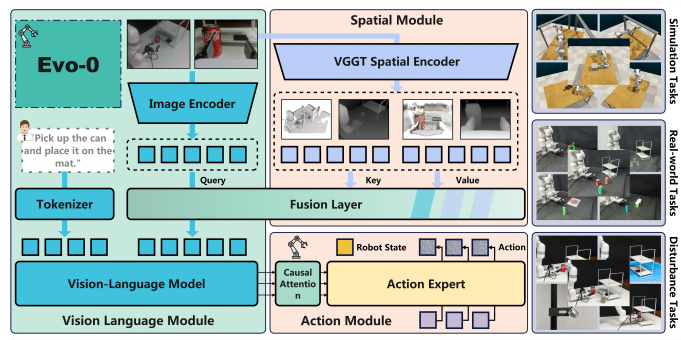
The Evo-0 model introduces an innovative approach by incorporating:
- A visual geometric base model (VGGT) to extract 3D structural information from multi-view RGB images
- t3^D tokens containing geometric information like depth context and spatial relationships
- A cross-attention fusion module that combines 2D visual tokens with 3D tokens
This architecture allows robots to better understand spatial layouts and object relationships without requiring additional sensors or explicit depth input.
Performance Improvements
The results speak volumes:
- 15% higher success rate than baseline models in fine manipulation tasks
- 31% improvement on open VLA benchmarks (openvla-oft)
- 28.88% average improvement in real-world spatial tasks including:
- Target centering
- Hole insertion
- Dense grasping operations
The model particularly excels at understanding and controlling complex spatial relationships.
Practical Applications and Future Potential
The implications of this technology extend across multiple domains:
- Industrial automation systems requiring precise manipulation
- Service robots navigating complex environments
- Autonomous systems performing delicate operations The research team emphasizes that Evo-0 provides "a new feasible path for future general robot strategies" through its clever integration of spatial information.
The academic community has taken note of this advancement, recognizing its potential to bridge the gap between theoretical AI capabilities and practical robotic applications.
Key Points:
- Evo-0 represents a significant leap forward in AI's ability to understand 3D space.
- The model achieves this without requiring additional sensors or hardware modifications.
- Performance improvements range from 15% to 31% depending on task complexity.
- Real-world applications include industrial automation and service robotics.
- The technology maintains training efficiency while improving deployment flexibility.