Apple's SlowFast-LLaVA Model Excels in Long Video Analysis
Apple's SlowFast-LLaVA Model Sets New Benchmark in Video Understanding
Apple's research team has introduced SlowFast-LLaVA, a groundbreaking model adaptation that demonstrates superior performance in long video analysis tasks. According to recent reports, this innovation surpasses even larger models in efficiency and accuracy, providing a robust solution for processing extended video content.
Dual-Stream Architecture: The Key to Efficiency
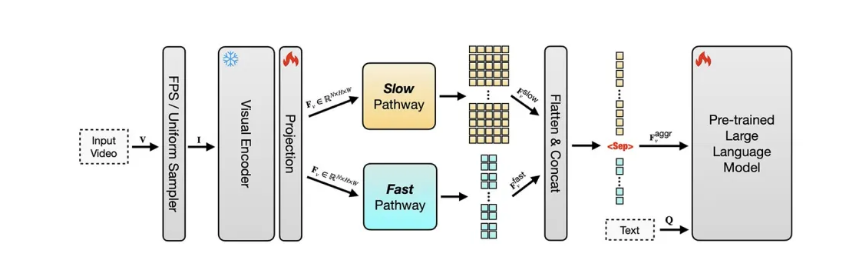
The model's success lies in its dual-stream architecture, which addresses common challenges like information redundancy and context window overflow.
- Slow Stream: Operates at a low frame rate to capture static details and background information.
- Fast Stream: Tracks rapid action changes at a high frame rate.
This collaborative approach optimizes processing efficiency while maintaining high accuracy.
Performance Metrics: Outperforming Larger Models
In benchmark tests, SlowFast-LLaVA achieved remarkable results across multiple parameter scales:
- 1B parameter version: Scored 56.6 on General VideoQA (LongVideoBench).
- 7B parameter version: Achieved 71.5 on Long-Form Video Understanding tasks.
The model also excels in image understanding tasks, including knowledge reasoning and OCR, showcasing its versatility.
Limitations and Future Improvements
Despite its achievements, the model currently supports a maximum input of 128 frames, which may lead to missed key information in longer videos. Apple's team has committed to refining memory optimization techniques to enhance performance further.
Open-Source Contribution
The model is trained on publicly available datasets and has been open-sourced, providing the AI community with a powerful tool for advancing long video understanding technologies.
Key Points:
- Dual-stream design optimizes video processing efficiency.
- Outperforms larger models in benchmark tests.
- Open-source availability fosters community innovation.
- Current limitations include a 128-frame input cap.
- Future updates will focus on memory optimization.