Apple Unveils Manzano: Dual-Purpose AI Image Model

Apple's Manzano Bridges Image Understanding and Generation

Apple has unveiled Manzano, a new artificial intelligence model specializing in image processing with dual capabilities for both image understanding and generation. This development positions Apple's research as competitive with leading commercial AI systems from OpenAI and Google.

Technical Breakthrough

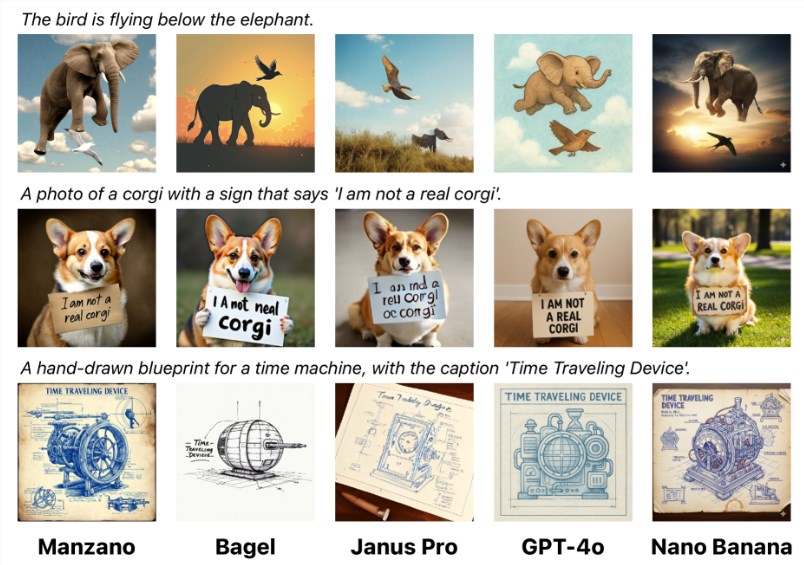
The innovation addresses a persistent challenge in open-source models, which typically excel at either analysis or creation but struggle with both. Apple's research paper demonstrates Manzano's ability to handle complex prompts comparably to GPT-4o and Google's "Nano Banana" (Gemini 2.5 Flash Image Generation).
Image

Hybrid Architecture

Manzano employs a hybrid image tokenizer that outputs:

  • Continuous tokens: Represent images using floating-point numbers for understanding
  • Discrete tokens: Divide images into fixed categories for generation

This architecture reduces conflicts common in traditional models by deriving both token types from the same encoder.

Scalable Design

The system features three core components:

  1. Hybrid tokenizer
  2. Unified language model
  3. Independent image decoder (available in 90M, 175M, and 352M parameter versions)

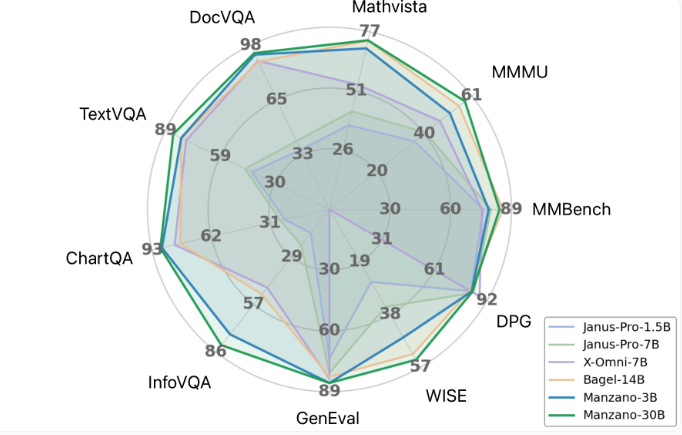
The largest configuration supports resolutions up to 2048 pixels, with testing showing performance improvements as parameter counts increase from 300 million to 3 billion.
Image

Performance Benchmarks

Apple reports strong results across multiple tests, particularly in:

  • Chart analysis
  • Document interpretation
  • Text-heavy image tasks The model also handles creative functions including:
  • Style transfer
  • Image inpainting/expansion
  • Depth estimation
  • Prompt-based editing

The modular design suggests potential for broader multimodal AI applications beyond current capabilities.

The full research paper is available at: https://arxiv.org/abs/2509.16197

Key Points:

🌟 Dual capability - Simultaneous image understanding/generation 🔍 Commercial-grade performance - Comparable to GPT-4o and Gemini systems ⚙️ Hybrid tokenizer - Reduces conflicts between analysis/creation functions 📈 Scalable architecture - Three decoder sizes supporting up to 2048px resolution
Enjoyed this article?

Subscribe to our newsletter for the latest AI news, product reviews, and project recommendations delivered to your inbox weekly.

Weekly digestFree foreverUnsubscribe anytime

Related Articles

DeepSeek's New OCR Tech Mimics Human Vision, Slashes Costs
News

DeepSeek's New OCR Tech Mimics Human Vision, Slashes Costs

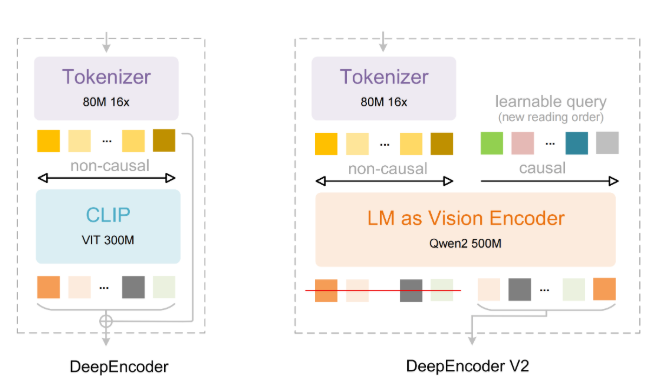
Chinese AI firm DeepSeek has unveiled OCR2, a breakthrough visual encoder that processes documents like human eyes scan pages. By ditching rigid grid processing for flexible 'causal flow tokens,' the system cuts visual token usage by 80% while outperforming Gemini3Pro in benchmarks. The open-sourced technology could pave the way for truly unified multimodal AI.

February 2, 2026
ComputerVisionAIBreakthroughsDocumentAI
Google's Gemini 3 Flash Now Sees Like a Human Detective
News

Google's Gemini 3 Flash Now Sees Like a Human Detective

Google has upgraded its Gemini 3 Flash AI with groundbreaking 'Agentic Vision' technology that transforms how machines analyze images. Instead of just glancing at pictures, the AI now actively investigates them - zooming in on details, annotating elements, and reasoning like human experts. This breakthrough improves accuracy by 5-10% on complex visual tasks and will soon be available to everyday users through mobile assistants.

January 28, 2026
ComputerVisionGoogleAIImageAnalysis
Robots Can Now Grasp Glassware Thanks to Breakthrough Depth Perception Tech
News

Robots Can Now Grasp Glassware Thanks to Breakthrough Depth Perception Tech

Ant Group's Lingbo Technology has open-sourced LingBot-Depth, a revolutionary spatial perception model that helps robots handle transparent and reflective objects with unprecedented accuracy. Using advanced 'Masked Depth Modeling' technology, the system fills in missing depth data from stereo cameras, solving a longstanding challenge in robotics. Early tests show it outperforms existing solutions by up to 70% in accuracy.

January 27, 2026
RoboticsComputerVisionOpenSource
Kimi K2.5 Sneaks In with Major Visual and Tool Upgrades
News

Kimi K2.5 Sneaks In with Major Visual and Tool Upgrades

Moonshot AI has quietly rolled out Kimi K2.5, bringing significant improvements in visual analysis and tool integration. Users report impressive performance in tasks like converting images to 3D models and solving complex problems step-by-step. The tech community is buzzing with excitement, especially about potential open-source possibilities.

January 27, 2026
AIupdatesComputerVisionMoonshotAI
News

Apple Denies AI Test Rumors for Chinese iPhones, Warns of Security Risks

Recent claims about Chinese iPhone users receiving AI test prompts have been debunked by Apple. The company confirms its AI features aren't yet available in mainland China and warns against using third-party tools to force activation, which could compromise user security. Experts suggest any apparent test notifications might be remnants from previous unofficial attempts to access the features.

January 4, 2026
AppleAIiPhoneSecurityTechRumors
Meta's Pixio Rewrites the Rules: Simple Approach Beats Complex AI in 3D Vision
News

Meta's Pixio Rewrites the Rules: Simple Approach Beats Complex AI in 3D Vision

Meta AI's new Pixio model proves simplicity can outperform complexity in computer vision. By enhancing an older masking technique and training on diverse web images, Pixio achieves better 3D reconstruction than larger models—all while avoiding benchmark 'cheating.' The breakthrough suggests we might have overcomplicated visual AI.

December 29, 2025
ComputerVisionMetaAI3DReconstruction