Ant Group's New AI Shield Protects Open-Source Agents from Digital Threats

Ant Group Fortifies AI Agents with New Security Plugin

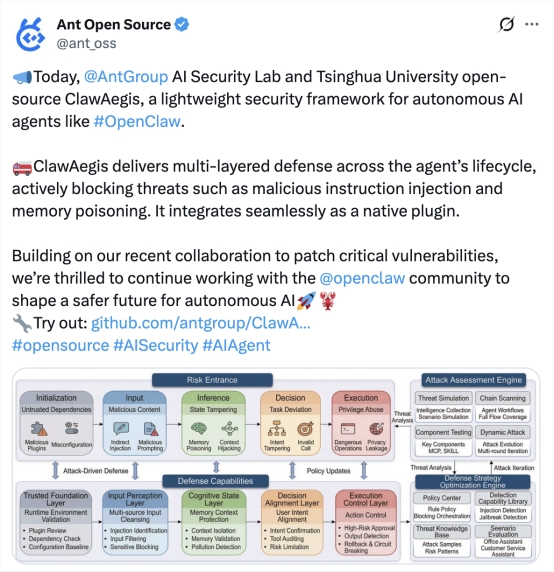
In a move that could reshape how we protect intelligent systems, Ant Group's AI Security Lab and Tsinghua University have released ClawAegis - a comprehensive security solution for OpenClaw-type agents. The open-source plugin, launched April 2, provides what developers are calling "digital armor" for autonomous AI systems.

The Growing Threat to AI Agents

As OpenClaw and similar frameworks gain popularity, their vulnerabilities are becoming alarmingly apparent. Imagine an AI assistant that suddenly starts leaking sensitive data or executing dangerous commands - these aren't theoretical risks anymore. From the moment an agent boots up to its final operation, threats lurk at every stage:

  • Initialization: Malicious code can slip in during setup
  • User Input: Hackers might inject harmful instructions
  • Model Reasoning: The AI's decision-making process can be manipulated
  • Service Execution: Even approved actions might have unintended consequences
Image

How ClawAegis Fights Back

The new security plugin operates like a digital immune system, constantly monitoring for threats across five critical stages. Its multi-layered defense can:

  • Detect suspicious activity in real-time
  • Block unauthorized access attempts
  • Protect sensitive files and skills from tampering
  • Alert operators about potential breaches

What makes ClawAegis stand out is its lightweight design. Unlike bulky security suites that slow systems down, this plugin integrates seamlessly with OpenClaw frameworks. It activates precisely when needed, providing robust protection without unnecessary overhead.

Built for Real-World Use

The team behind ClawAegis understands that one-size-fits-all solutions don't work in cybersecurity. That's why they've included customizable risk management options:

  • Security teams can fine-tune threat responses
  • Regular users benefit from automatic protections
  • Developers get tools to create specialized defenses

The release follows Ant Group's recent efforts to patch vulnerabilities in OpenClaw. Looking ahead, the partners plan continuous updates, working with the open-source community to build what they call "a new standard for trustworthy AI."

Key Points:

  • First-of-its-kind security solution covering all agent lifecycle stages
  • Lightweight design won't slow down your AI operations
  • Customizable protections for different user needs
  • Open-source approach encourages community improvements
  • Ongoing development promises future enhancements
Enjoyed this article?

Subscribe to our newsletter for the latest AI news, product reviews, and project recommendations delivered to your inbox weekly.

Weekly digestFree foreverUnsubscribe anytime

Related Articles

News

Mercor's Open-Source Project Hit by Hackers, Exposing AI Security Risks

AI unicorn Mercor has confirmed a security breach affecting its widely-used LiteLLM open-source project. Hackers injected malicious code into the system, impacting thousands of businesses that rely on the tool. The attack, linked to TeamPCP, comes as ransom group Lapsus$ claims to have stolen internal company data. While Mercor has taken swift action to contain the damage, the incident highlights growing concerns about vulnerabilities in AI infrastructure.

April 1, 2026
AI SecurityCybersecurityOpen-Source Risks
Claude Code's Security Flaw: When Too Many Commands Overwhelm AI Defenses
News

Claude Code's Security Flaw: When Too Many Commands Overwhelm AI Defenses

A newly discovered vulnerability in Anthropic's Claude Code tool reveals how hackers can bypass its security measures simply by flooding it with commands. When the system receives more than 50 sub-commands at once, its automatic rejection mechanism fails, potentially exposing users to dangerous operations. Security experts warn this flaw could be particularly risky in automated development environments where permission checks might be skipped.

April 2, 2026
AI SecurityAnthropicSoftware Vulnerabilities
ClawHub's China Mirror Site Goes Live - AI Developers Rejoice!
News

ClawHub's China Mirror Site Goes Live - AI Developers Rejoice!

ClawHub, the popular 'npm for AI Agents,' has launched its official Chinese mirror site, bringing faster access and better stability for domestic developers. The new mirror at https://mirror-cn.clawhub.com solves previous network latency issues, making it easier than ever to share and discover AI skills. Sponsored by ByteDance's VolcanoEngine, this move signals growing localization in the AI Agent ecosystem.

April 1, 2026
AI DevelopmentOpen SourceMachine Learning
Claude Code Leak: How a Simple Mistake Exposed AI's Dirty Secret
News

Claude Code Leak: How a Simple Mistake Exposed AI's Dirty Secret

Anthropic's Claude Code source code leaked not due to a sophisticated hack, but because of an embarrassing human error - an un-obfuscated MAP file accidentally included in production. While developers celebrated the unexpected windfall, Anthropic scrambled to contain the damage with DMCA takedowns and promised automation improvements. The incident highlights the ironic vulnerability of AI tools to basic human mistakes in their own deployment processes.

April 1, 2026
AI SecurityClaude CodeAnthropic
Anthropic's Code Leak Exposes AI Secrets and Surprise Features
News

Anthropic's Code Leak Exposes AI Secrets and Surprise Features

AI company Anthropic is facing a major security breach after accidentally exposing 500,000 lines of source code for its Claude Code tool. The leak revealed not just technical secrets, but also unreleased features like digital pets and 'dreaming' AI capabilities. While the company scrambled to contain the damage, the incident raises serious questions about AI safety practices in the fast-moving tech industry.

April 1, 2026
AI SecurityAnthropicCode Leak
News

Anthropic's Safety Reputation Takes a Hit After Back-to-Back Data Leaks

Anthropic, the AI company that built its reputation on safety, has suffered two major security breaches in just one week. First came the accidental release of 3,000 internal documents, followed by an even more damaging leak of over 512,000 lines of source code due to a packaging error. These incidents have raised serious questions about the company's internal controls while inadvertently revealing the strength of its Claude Code technology - so impressive it reportedly pushed OpenAI to temporarily shelve its Sora video tool.

April 1, 2026
AI SecurityData BreachTech Competition