Ant Group's dInfer Boosts Diffusion Model Speed 10x

Ant Group Unveils Groundbreaking dInfer Framework

Ant Group has officially released dInfer, the industry's first high-performance inference framework specifically designed for diffusion language models. This open-source innovation achieves unprecedented speeds—10.7 times faster than NVIDIA's Fast-dLLM—while maintaining comparable performance metrics.

Benchmark Performance

In standardized tests:

  • Achieved 1011 tokens/second on HumanEval code generation tasks (single inference)
  • Delivered 681 tokens/second average speed vs Fast-dLLM's 63.6 tokens/sec (8x H800 GPUs)
  • Outpaced autoregressive model Qwen2.5-3B by 2.5x when running on vLLM framework
Image

Technical Breakthroughs

Diffusion language models treat text generation as a denoising process, offering:

  • High parallelism capabilities
  • Global context awareness
  • Flexible structural design

However, previous implementations faced critical limitations:

  1. Prohibitive computational costs
  2. KV cache inefficiencies
  3. Parallel decoding challenges

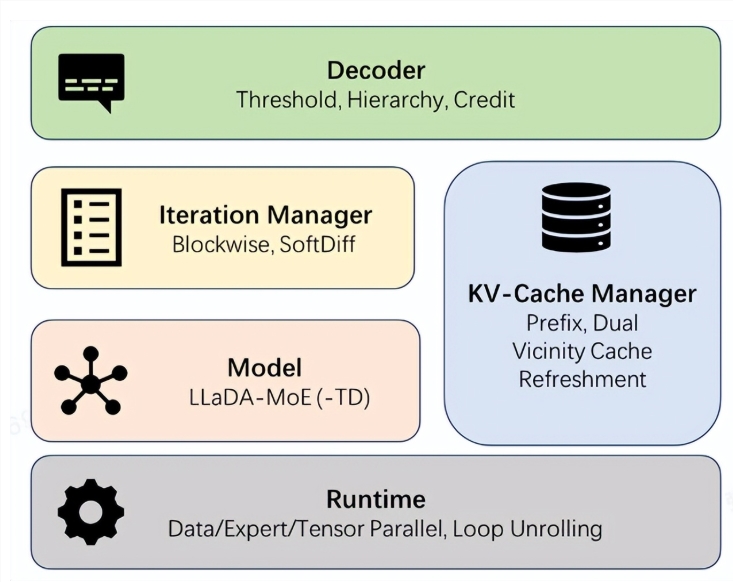
dInfer addresses these through four modular components:

  1. Model access layer
  2. KV cache manager
  3. Diffusion iteration controller
  4. Adaptive decoding strategies

The LEGO-like architecture allows developers to optimize each component independently while maintaining standardized evaluation protocols.

Industry Implications

The framework bridges cutting-edge research with practical deployment scenarios:

  • Enables real-time applications previously constrained by speed limitations
  • Opens new possibilities for AGI development pathways
  • Provides measurable performance advantages over autoregressive approaches

"This release represents more than just a speed improvement," stated an Ant Group spokesperson. "It's about creating an ecosystem where diffusion models can realize their full potential alongside traditional architectures."

The company invites global researchers to collaborate on further optimizing the framework through its open-source platform.

Key Points:

  • 10x speed boost over existing solutions
  • First diffusion model to surpass autoregressive benchmarks
  • Modular design enables targeted optimizations
  • Potential game-changer for AGI development timelines
Enjoyed this article?

Subscribe to our newsletter for the latest AI news, product reviews, and project recommendations delivered to your inbox weekly.

Weekly digestFree foreverUnsubscribe anytime

Related Articles

News

Ant Group's AI Hiring Spree: Tech Roles Dominate as Company Doubles Down on Artificial Intelligence

Ant Group has kicked off its 2026 campus recruitment with a strong focus on AI talent. A staggering 85% of openings are technical roles, with 70% specifically targeting artificial intelligence fields like large language models and data intelligence. The financial tech giant is breaking traditional hiring barriers through its special AI Talent Program, while expanding its search globally from Hangzhou to San Francisco. This move comes as Ant's AI-native products like AI Pay and Ant Afu surpass one billion users each.

March 10, 2026
Ant GroupAI RecruitmentFintech
News

Alibaba Denies Qwen Team Exodus Rumors, Vows Continued AI Innovation

Alibaba has firmly dismissed online rumors about mass resignations in its Qwen AI model team. The tech giant confirmed the team remains intact and focused on advancing artificial general intelligence (AGI) through open-source development. Contrary to speculation, Alibaba emphasized its commitment to technological breakthroughs over commercial metrics, while actively recruiting global AI talent.

March 6, 2026
ArtificialIntelligenceTechIndustryChinaTech
News

Altman's Vision: Why Artists May Hold the Key to AGI Breakthroughs

OpenAI's Sam Altman suggests that developing true artificial general intelligence requires more than just coding skills. He argues that people with strong aesthetic judgment - entrepreneurs, artists, and those with unconventional backgrounds - can spot the most promising directions in AI research. This echoes Steve Jobs' philosophy that technology needs humanities to create truly great products. OpenAI is already adjusting its hiring practices accordingly.

February 27, 2026
AGIOpenAITechPhilosophy
Ant Digital Plants Flag in Malaysia Amid AI Expansion Wave
News

Ant Digital Plants Flag in Malaysia Amid AI Expansion Wave

Chinese fintech giant Ant Group is making strategic moves abroad as global demand for AI solutions surges. Its digital arm Ant Digital recently launched an operations hub in Malaysia to strengthen regional services. Meanwhile, the company continues innovating domestically with new enterprise AI offerings. This comes amid explosive growth across the AI sector, with major players like Palantir and OpenAI reporting staggering revenue increases.

February 26, 2026
AI expansionAnt GroupDigital finance
News

AI's Learning Gap: Why Machines Can't Grow from Failure Like Humans

A former OpenAI researcher reveals a critical flaw in today's AI systems: they can't learn from mistakes. Jerry Tworek, who helped develop key models at OpenAI, explains why this inability to adapt threatens progress toward true artificial general intelligence. Unlike humans who evolve through trial and error, current AI hits a wall when facing unfamiliar challenges - forcing experts to rethink fundamental architectures.

February 3, 2026
Artificial IntelligenceMachine LearningAGI
Ant Group Bets Big on AI with New Credit Incentive Program
News

Ant Group Bets Big on AI with New Credit Incentive Program

Ant Group is doubling down on artificial intelligence with its newly launched 'AI Credit' program, offering additional incentives for teams making pioneering contributions in AI. CEO Han Xinyi calls recent achievements 'small victories' while pushing for full-scale AI adoption across payment, finance, and healthcare sectors - areas Ant sees as crucial for its next decade of growth.

February 2, 2026
Ant GroupAI incentivesfinancial technology