OLMo 2 32B: Open-Source AI Model Challenges GPT-3.5 Turbo

The Allen Institute for Artificial Intelligence (AI2) has unveiled OLMo 2 32B, a groundbreaking open-source large language model (LLM) that challenges the dominance of proprietary models like GPT-3.5 Turbo. With 32 billion parameters, OLMo 2 32B not only matches but surpasses its competitors in several academic benchmarks, marking a significant milestone in the democratization of AI.

A Fully Open-Source Model

One of the most notable features of OLMo 2 32B is its complete transparency. AI2 has released all associated data, code, weights, and detailed training processes, setting a new standard for openness in AI development. This stands in stark contrast to the closed-door policies of many proprietary models, which often withhold critical details.

AI2's decision to make OLMo 2 32B fully open-source aims to foster global collaboration and innovation. By providing researchers with access to the model's inner workings, the institute hopes to accelerate advancements in the field and demonstrate that high-performance AI can be developed without secrecy.

Performance That Rivals Proprietary Models

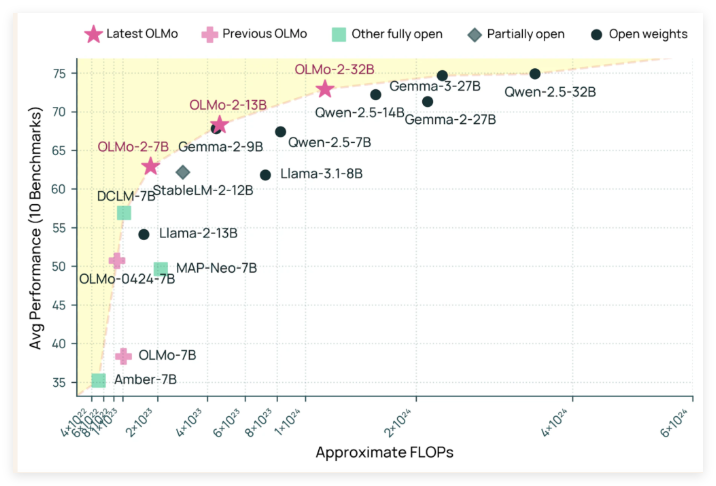
OLMo 2 32B's 32 billion parameters represent a significant scale-up from its predecessors, enabling it to achieve remarkable performance. In benchmark tests, it has outperformed both GPT-3.5 Turbo and GPT-4o mini, proving that open-source models can compete with those developed by well-funded organizations.

The model's success is attributed to its refined training process, which is divided into two main stages: pre-training and mid-training. During pre-training, OLMo 2 32B processed an extensive dataset of approximately 3.9 trillion tokens from diverse sources, including DCLM, Dolma, Starcoder, and Proof Pile II. This phase provided the model with a broad foundation of knowledge.

Mid-training focused on the Dolmino dataset, a high-quality collection of 843 billion tokens covering educational, mathematical, and academic content. This targeted approach enhanced the model's understanding in specialized domains, ensuring robust and nuanced language capabilities.
Image

Efficiency in Training and Resource Use

Beyond its superior performance, OLMo 2 32B demonstrates exceptional training efficiency. It achieves results comparable to leading open-weight models while using only about one-third of the computational resources required by models like Qwen2.532B. This efficiency underscores AI2's commitment to developing resource-conscious AI solutions.

The implications of this efficiency are profound. By reducing the computational burden, OLMo 2 32B makes advanced AI more accessible to researchers and developers with limited resources. This could pave the way for more inclusive innovation in the field.

A Milestone for Open AI Development

The release of OLMo 2 32B represents more than just a new model; it signifies a shift toward open and accessible AI development. By offering a high-performance alternative to proprietary models, AI2 challenges the notion that only large corporations can lead in AI innovation.

The model's success also highlights the importance of meticulous design and efficient training methods. As more researchers build upon OLMo 2 32B's foundation, the potential for breakthroughs in artificial intelligence grows exponentially.

Looking Ahead

The introduction of OLMo 2 32B is expected to invigorate AI research by lowering barriers to entry and promoting collaboration. For organizations clinging to proprietary models, this development serves as a reminder that openness may be key to long-term success in an increasingly competitive landscape.

Key Points

  1. OLMo 2 32B is a fully open-source LLM with 32 billion parameters, developed by the Allen Institute for AI.
  2. It outperforms GPT-3.5 Turbo and GPT-4o mini in benchmark tests.
  3. The model was trained on diverse datasets totaling nearly 4 trillion tokens, with a focus on specialized domains during mid-training.
  4. OLMo 2 32B achieves high performance using significantly fewer computational resources than comparable models.
  5. Its release marks a major step toward democratizing access to advanced AI technologies.

Enjoyed this article?

Subscribe to our newsletter for the latest AI news, product reviews, and project recommendations delivered to your inbox weekly.

Weekly digestFree foreverUnsubscribe anytime

Related Articles

India's Alpie AI Model Makes Waves - But Is It Truly Homegrown?
News

India's Alpie AI Model Makes Waves - But Is It Truly Homegrown?

A new AI contender from India called Alpie is turning heads with performance that rivals giants like GPT-4o and Claude3.5 in math and coding tests. However, technical analysis reveals it's actually built on a Chinese open-source model, raising questions about innovation versus optimization. What makes Alpie special is its ability to run efficiently on consumer hardware, potentially democratizing AI access for smaller developers.

January 15, 2026
AIMachine LearningIndia Tech
News

ByteDance's AI Models Reach New Heights with Doubao 1.8 and Seedance Pro

ByteDance's Volcanic Engine unveiled major upgrades at its FORCE conference, introducing Doubao Large Model 1.8 and Seedance 1.5 Pro video generation model. These advancements showcase impressive performance metrics, including processing over 50 trillion tokens daily - topping China's charts and ranking third globally. Alongside these technical leaps, ByteDance launched an 'AI Cost-Saving Plan' to make enterprise adoption more affordable, signaling their push toward widespread industrial application.

December 18, 2025
Artificial IntelligenceByteDanceLarge Language Models
News

Tencent Shakes Up AI Strategy with Major Restructuring and OpenAI Veteran at Helm

Tencent is making bold moves in the AI race, completely restructuring its research divisions and bringing in top talent from OpenAI. The Chinese tech giant has created three new core departments focused on infrastructure, data systems, and computing platforms. Leading this transformation is Vince Yao, a former OpenAI researcher who contributed to key projects like Operator. Meanwhile, Tencent's Huan Yuan model continues rapid development, with a new 'world model' just launched. As domestic tech giants like ByteDance and Alibaba also push forward with AI initiatives, the battle for supremacy in China's AI landscape is heating up.

December 18, 2025
TencentAI RestructuringLarge Language Models
Tencent Overhauls AI Strategy with New Departments Focused on Large Models
News

Tencent Overhauls AI Strategy with New Departments Focused on Large Models

Tencent is shaking up its AI research structure by creating specialized departments dedicated to infrastructure and data processing for large language models. The tech giant appointed Vincesyao as Chief AI Scientist to lead these efforts, signaling a major push to strengthen its position in the competitive AI landscape. These changes aim to streamline development from computing foundations to practical applications.

December 17, 2025
TencentArtificial IntelligenceCorporate Restructuring
Ant Group's LLaDA2.0: A 100B-Parameter Leap in AI Language Models
News

Ant Group's LLaDA2.0: A 100B-Parameter Leap in AI Language Models

Ant Group has unveiled LLaDA2.0, a groundbreaking 100-billion-parameter diffusion language model that challenges conventional wisdom about scaling limitations. This innovative technology not only delivers faster processing speeds but also excels in complex tasks like code generation. By open-sourcing the model, Ant is inviting developers worldwide to explore its potential while pushing the boundaries of what diffusion models can achieve.

December 12, 2025
LLaDA2.0Diffusion ModelsAI Innovation
China's AI Titans Race Toward Hong Kong Stock Market Debut
News

China's AI Titans Race Toward Hong Kong Stock Market Debut

Three Chinese AI powerhouses—MiniMax, Zhipu AI, and Moonshot AI—are locked in a quiet battle to become China's first publicly traded large language model company. Sources indicate MiniMax may lead the pack with a potential early 2026 IPO, while Zhipu shifts its listing plans from mainland China to Hong Kong. Meanwhile, Moonshot AI banks on its technical edge despite trailing in user numbers. The listings could reshape China's competitive AI landscape.

December 12, 2025
Artificial IntelligenceIPOChinese Tech