
India's Alpie AI Model Makes Waves - But Is It Truly Homegrown?

India's AI Dark Horse Surprises the Tech World

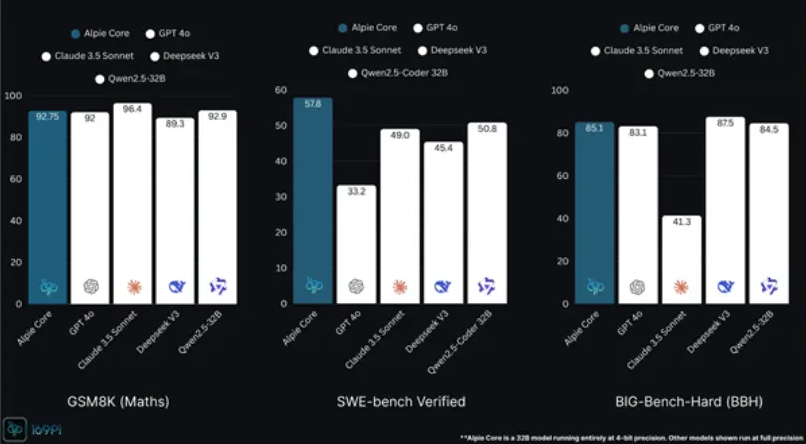
Move over ChatGPT - there's a new player making waves in artificial intelligence. The Alpie model from Indian company 169PI has been climbing international rankings with some surprising results. In mathematical reasoning (GSM8K) and software engineering (SWE) benchmarks, this relatively small 32-billion-parameter model has gone toe-to-toe with industry heavyweights.
Image

Performance That Turns Heads

Alpie's test scores tell an impressive story. On the GSM8K math benchmark, it not only surpassed China's DeepSeek V3 but matched OpenAI's flagship GPT-4o. For coding tasks in the SWE evaluation, it actually outperformed Anthropic's Claude3.5 - no small feat for what appears to be a lightweight model.

"These results would be remarkable if achieved through original research," notes AI researcher Dr. Priya Kumar. "But when you look under the hood, the picture gets more complicated."

The Open-Source Secret Sauce

Technical analysis reveals Alpie isn't entirely an Indian innovation. The model builds upon DeepSeek-R1-Distill-Qwen-32B, a Chinese open-source foundation. Through a process called quantization (reducing numerical precision from 16-bit to 4-bit), the Indian team created a version that runs efficiently on consumer GPUs with just 16-24GB of memory.

This optimization comes with real benefits:

  • 75% less VRAM required compared to standard implementations
  • Inference costs slashed to about 10% of GPT-4o's
  • Accessibility for small developers without expensive hardware

"Calling it just a 'shell' misses the point," argues 169PI CTO Rajiv Mehta. "We've taken existing technology and made it practical for real-world use at scale."

The Bigger Picture for AI Development

The Alpie story highlights growing trends in global AI:

  1. The strategic value of open-source foundations
  2. Optimization as legitimate innovation
  3. Regional specialization in the AI ecosystem

While some criticize derivative work, others see smart adaptation of available resources. "Not every country needs to reinvent the wheel," suggests tech analyst Neha Patel. "India playing to its strengths in optimization and deployment makes sense."

Key Points:

  • Benchmark standout: Alpie competes with top models in math/coding tasks despite smaller size
  • Technical heritage: Built via quantization of Chinese open-source model DeepSeek
  • Practical advantages: Runs efficiently on consumer hardware at fraction of typical costs
  • Development debate: Raises questions about innovation vs optimization in global AI race

Enjoyed this article?

Subscribe to our newsletter for the latest AI news, product reviews, and project recommendations delivered to your inbox weekly.

Weekly digestFree foreverUnsubscribe anytime

Related Articles

AI Cracks Erdős' Toughest Puzzles: Mathematicians Stunned by GPT5.2's Breakthroughs
News

AI Cracks Erdős' Toughest Puzzles: Mathematicians Stunned by GPT5.2's Breakthroughs

In an unprecedented feat, GPT5.2 has solved 11 of Paul Erdős' legendary unsolved mathematical problems in just two weeks, verified by formal proof tools. The breakthrough has top mathematicians like Terry Tao taking notice, with Harvard's Noam Elkies building on AI-generated solutions. This marks a turning point where artificial intelligence isn't just assisting human researchers - it's making autonomous discoveries at the frontiers of pure mathematics.

January 15, 2026
Artificial IntelligenceMathematicsGPT5
DeepSeek-V4 Set to Revolutionize Code Generation This February
News

DeepSeek-V4 Set to Revolutionize Code Generation This February

DeepSeek is gearing up to launch its powerful new AI model, DeepSeek-V4, around Chinese New Year. The update promises major leaps in code generation and handling complex programming tasks, potentially outperforming competitors like Claude and GPT series. Developers can expect more organized responses and better reasoning capabilities from this innovative tool.

January 12, 2026
AI DevelopmentProgramming ToolsMachine Learning
Mugen3D Turns Single Photos Into Stunning 3D Worlds
News

Mugen3D Turns Single Photos Into Stunning 3D Worlds

A groundbreaking AI tool called Mugen3D is transforming how we create 3D content. Using advanced 3D Gaussian Splatting technology, it can generate remarkably realistic models from just one image - capturing textures, lighting, and materials with astonishing accuracy. This innovation promises to democratize 3D creation across industries from gaming to e-commerce.

January 12, 2026
AIComputerGraphicsDigitalCreation
Alibaba's Qwen Dominates AI Landscape With Record Downloads
News

Alibaba's Qwen Dominates AI Landscape With Record Downloads

Alibaba's Qwen large language model has surged ahead in global adoption, amassing over 700 million downloads—more than the combined totals of Meta, OpenAI and other major competitors. Its comprehensive open-source approach and versatile applications have propelled Chinese AI development to new heights on the international stage.

January 9, 2026
Artificial IntelligenceOpen SourceTech Innovation
News

Qualcomm and Google Join Forces to Revolutionize Car Tech with AI

Qualcomm and Google are teaming up to tackle one of the automotive industry's biggest headaches: fragmented in-car systems. Their new 'Automotive AI Agent' combines Qualcomm's Snapdragon Digital Chassis with Google's Android Automotive OS, promising smoother development and smarter features like facial recognition. The partnership also introduces cloud-based development tools that could cut R&D time significantly. This collaboration marks a major step toward more unified, intelligent vehicle systems.

January 9, 2026
automotive-techAIsmart-cars
Meta's Spatial Lingo Turns Your Living Room Into a Language Classroom
News

Meta's Spatial Lingo Turns Your Living Room Into a Language Classroom

Meta has unveiled Spatial Lingo, an innovative open-source Unity app that transforms everyday objects into language learning tools. Using mixed reality technology, the app guides users through vocabulary practice with items in their immediate environment. Developers can explore Meta's SDKs through practical examples while creating engaging educational experiences. The project showcases how AR can make language learning more immersive and contextually relevant.

January 8, 2026
Augmented RealityLanguage LearningMeta