Ant Group's LLaDA2.0: A 100B-Parameter Leap in AI Language Models

Ant Group Breaks New Ground with Open-Source LLaDA2.0

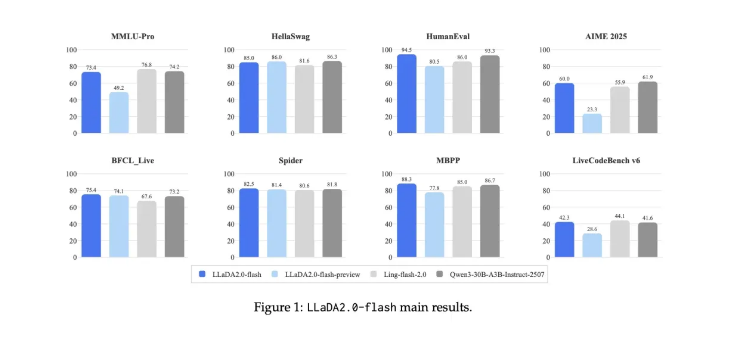
In a move that's shaking up the AI community, Ant Group's Technology Research Institute has released LLaDA2.0 - the industry's first 100-billion-parameter discrete diffusion language model (dLLM). This isn't just another incremental update; it represents a fundamental shift in how we think about scaling diffusion models for language processing.
Image

What Makes LLaDA2.0 Special?

The model comes in two flavors: a compact 16B (mini) version and the heavyweight 100B (flash) variant. The larger model particularly shines when tackling complex challenges like code generation and instruction execution - tasks where most models typically stumble.

"We've cracked the code on scaling diffusion models," explains an Ant Group spokesperson. "Our Warmup-Stable-Decay (WSD) pre-training strategy allows LLaDA2.0 to build on existing autoregressive model knowledge rather than starting from scratch - saving both time and resources."

Speed That Turns Heads

Here's where things get exciting for developers:

  • Lightning-fast processing at 535 tokens per second
  • 2.1x faster than comparable autoregressive models
  • Achieved through innovative KV Cache reuse and block-level parallel decoding

The team didn't stop there. They've further optimized performance using complementary masking and confidence-aware parallel training (CAP) techniques during post-training.

Real-World Performance That Delivers

Early tests show LLaDA2.0 excels where it matters most:

  • Code generation with superior structural planning
  • Complex agent calls that require nuanced understanding
  • Long-text tasks demanding sustained coherence

The model demonstrates remarkable adaptability across diverse applications - from technical programming scenarios to creative writing exercises.

What This Means for AI's Future

This release does more than just introduce another large language model. It fundamentally changes our understanding of what diffusion models can achieve at scale. Ant Group's decision to open-source LLaDA2.0 invites global collaboration, potentially accelerating innovation across the AI landscape.

The company has already hinted at future developments, including plans to:

  • Expand parameter scales even further
  • Integrate reinforcement learning techniques
  • Explore new thinking paradigms for generative AI

The model is now available for exploration at https://huggingface.co/collections/inclusionAI/llada-20.

Key Points:

  • Industry first: 100B-parameter discrete diffusion language model
  • Speed demon: Processes 535 tokens per second (2.1x faster than competitors)
  • Code whisperer: Excels at complex programming tasks
  • Open invitation: Available now on Hugging Face for developers worldwide
Enjoyed this article?

Subscribe to our newsletter for the latest AI news, product reviews, and project recommendations delivered to your inbox weekly.

Weekly digestFree foreverUnsubscribe anytime

Related Articles

Google Gemini Now Creates Interactive 3D Worlds Right Before Your Eyes
News

Google Gemini Now Creates Interactive 3D Worlds Right Before Your Eyes

Google's Gemini AI just got a major upgrade that brings learning to life. Instead of flat text explanations, it now generates fully interactive 3D models and physics simulations. Ask about planetary orbits or pendulum motions, and watch as the system creates dynamic, adjustable visualizations that respond to your inputs in real time. This breakthrough transforms abstract concepts into tangible, hands-on experiences - making complex physics as intuitive as playing with building blocks.

April 10, 2026
AI InnovationInteractive Learning3D Modeling
DeepSeek V4 Arrives Next Month: A Trillion-Parameter Powerhouse Built for China's AI Future
News

DeepSeek V4 Arrives Next Month: A Trillion-Parameter Powerhouse Built for China's AI Future

China's AI landscape is about to get a major upgrade. DeepSeek founder Liang Wenfeng has confirmed their next-generation V4 model will launch in late April 2026, packing trillion-parameter scale and breakthrough compatibility with domestic chips like Huawei's Ascend. This isn't just another model release - it's a strategic move that's already shaking up China's computing market, with tech giants stockpiling AI chips in anticipation. The model's 'Fast' and 'Expert' modes currently in testing hint at its versatile capabilities, from quick searches to complex problem-solving.

April 10, 2026
AI InnovationChina TechDeepSeek
ByteDance's Seeduplex Lets AI Listen and Talk Like Humans
News

ByteDance's Seeduplex Lets AI Listen and Talk Like Humans

ByteDance has unveiled Seeduplex, a breakthrough voice AI that processes speech simultaneously rather than taking turns. Now live on Douyin, this full-duplex technology cuts interruptions by 40% and understands users even in noisy environments. It's like having a conversation with someone who never misses a beat.

April 9, 2026
Voice AIByteDanceAI Innovation
Zhiyuan's GO-2 Model Bridges the Gap Between Robot Thought and Action
News

Zhiyuan's GO-2 Model Bridges the Gap Between Robot Thought and Action

Zhiyuan Robotics has unveiled its groundbreaking GO-2 embodied AI model, introducing an innovative 'Action Chain-of-Thought' approach that enables robots to not just think but reliably execute tasks. With a unique dual-system architecture and impressive benchmark results, this technology promises to revolutionize how robots transition from theoretical understanding to practical application in real-world scenarios.

April 9, 2026
Zhiyuan RoboticsEmbodied AIRobot Intelligence
News

Bezos Bets Big on Industrial AI with Secret Prometheus Project

Jeff Bezos is making waves in the AI space with his covert 'Project Prometheus,' which aims to bridge artificial intelligence with the physical world. The initiative recently poached top talent from OpenAI's xAI and is pursuing an ambitious dual strategy of technological innovation and massive capital deployment. Unlike text-focused AI systems, Prometheus seeks to develop models that understand physical laws, potentially transforming heavy industries through a combination of specialized data training and unprecedented funding.

April 9, 2026
Artificial IntelligenceJeff BezosIndustrial Tech
Microsoft's Harrier Model Breaks Language Barriers with Open-Source Release
News

Microsoft's Harrier Model Breaks Language Barriers with Open-Source Release

Microsoft's Bing team has open-sourced its powerful Harrier multilingual embedding model, supporting over 100 languages. Trained on 2 billion examples plus GPT-5 synthetic data, this technology promises to revolutionize search and AI applications. Developers can now access three model sizes on Hugging Face, with integration planned for Bing and next-gen AI services.

April 8, 2026
MicrosoftNatural Language ProcessingOpen Source AI