Microsoft's Rho-alpha Brings Robots Closer to Human-Like Abilities

Microsoft's New AI Model Makes Robots More Human Than Ever

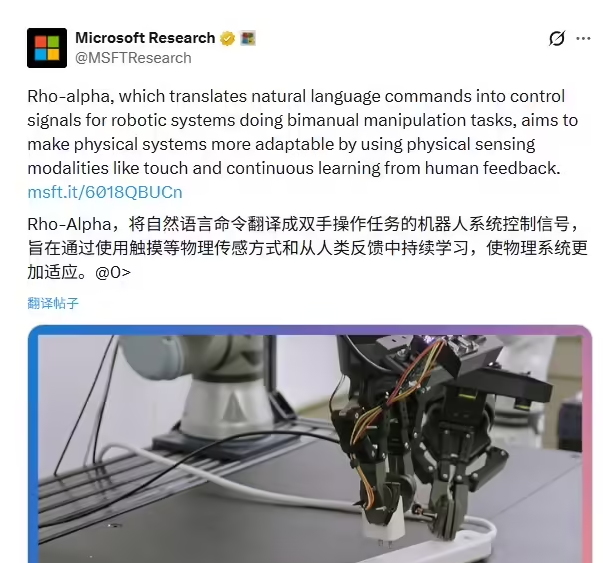
Robotics is undergoing a quiet revolution, moving beyond factory assembly lines into our unpredictable daily lives. At the forefront of this shift is Microsoft's newly released Rho-alpha model - an AI breakthrough that's giving machines something resembling human intuition.
Image

Understanding Like Humans Do

The most striking feature? You can simply talk to these robots. Gone are the days of programming every movement through complex code. Tell a Rho-alpha powered robot "Carefully pick up the fragile vase" and it understands - adjusting its grip strength accordingly while maintaining balance.

But language is just part of the equation. For the first time, Microsoft has successfully integrated tactile perception into its AI systems. When gripping objects, robots now receive constant touch feedback, allowing micro-adjustments we usually associate with human dexterity.

Learning From Mistakes

The system doesn't just follow orders - it learns from them. During operation, if a robot struggles with a task, human operators can physically demonstrate corrections using specialized 3D input devices. These adjustments feed directly into Azure-powered simulations, creating an accelerated learning loop that improves performance exponentially.

"We're moving beyond pre-programmed behaviors," explains Dr. Elena Rodriguez from Microsoft Research. "Rho-alpha allows robots to develop what we might call 'common sense' through experience - much like humans do."

The Future Feels Different

Looking ahead, Microsoft plans to incorporate additional sensory inputs like force perception and temperature sensitivity. The implications span industries:

  • Elderly care robots that can safely assist with daily tasks
  • Disaster response machines adapting to chaotic environments
  • Manufacturing assistants that learn new techniques on the job

The line between programmed machine and intelligent assistant continues to blur.

Key Points:

  • Natural communication: Control robots through everyday speech without specialized programming knowledge
  • Touch-sensitive: Tactile feedback enables delicate object handling previously impossible for machines
  • Always improving: Real-time corrections feed into an evolving system that gets smarter with use
Enjoyed this article?

Subscribe to our newsletter for the latest AI news, product reviews, and project recommendations delivered to your inbox weekly.

Weekly digestFree foreverUnsubscribe anytime

Related Articles

Musk's Davos Surprise: Tesla Robots Could Be in Homes by 2027
News

Musk's Davos Surprise: Tesla Robots Could Be in Homes by 2027

Elon Musk made waves at Davos by announcing Tesla's Optimus robots will hit consumer markets in 2027. The billionaire envisions these humanoid helpers tackling household chores, from childcare to eldercare. While Musk predicts a robot revolution, industry experts caution about production challenges and the need for real-world testing before mass adoption becomes reality.

January 23, 2026
TeslaRoboticsElonMusk
News

Kimi's Efficiency Breakthrough: How a Chinese AI Startup Outperformed with Just 1% of U.S. Lab Resources

At Davos 2026, Moonshot AI's Zhang Yuting revealed how her team developed world-class AI models using only 1% of the computing resources consumed by top U.S. labs. The secret? A relentless focus on efficiency and engineering smarts rather than brute computing power. This unexpected success story challenges the prevailing 'compute supremacy' mindset in AI development and shows what's possible when innovation meets necessity.

January 23, 2026
AI InnovationMoonshot AIEfficient Computing
News

China's Kimi AI Stuns Davos With Efficiency Breakthrough

At Davos 2026, Moonshot AI's Kimi revealed its open-source models outperform U.S. competitors using just 1% of their computing power. President Zhang Yuting showcased how engineering-first thinking enabled this leap, focusing on practical deployment over raw power. The announcement signals China's growing AI prowess through efficiency rather than resource dominance.

January 22, 2026
AI InnovationComputing EfficiencyChina Tech
News

China's AI Narrows Gap with West to Just 6 Months, Says DeepMind Chief

At Davos 2026, DeepMind CEO Demis Hassabis revealed China's AI capabilities now trail Western counterparts by just six months—a significant narrowing from previous estimates. While praising Chinese achievements like the impressive DeepSeek R1 model, Hassabis noted the country still lags in breakthrough innovations. The discussion also touched on relaxed U.S. chip export policies and Google's push into embodied intelligence research.

January 21, 2026
Artificial IntelligenceDeepMindChina Tech
Robots Get Nervous Too: Ethernovia Raises $90M to Build AI's Fastest Nerve Network
News

Robots Get Nervous Too: Ethernovia Raises $90M to Build AI's Fastest Nerve Network

Silicon Valley startup Ethernovia just secured $90 million to develop what could become the nervous system for next-gen robots and self-driving cars. Their breakthrough? Lightning-fast ethernet chips that process sensor data faster than ever before. With backers like Porsche and Qualcomm jumping in, this funding signals a major shift - investors are now betting big on the physical hardware that makes advanced AI actually work in the real world.

January 21, 2026
AI HardwareRoboticsAutonomous Vehicles
News

Unitree Robotics Secures Humanoid Robot Patent Amid Market Expansion

Chinese robotics firm Unitree Robotics has been granted a design patent for its versatile humanoid robot, signaling its push into commercialization. The patent highlights modular design features adaptable for industrial, domestic, and even space applications. Backed by major investors including Sequoia Capital China, the company has boosted its registered capital to 360 million yuan as it positions itself in the growing humanoid robotics market.

January 20, 2026
RoboticsTech InnovationArtificial Intelligence