Inception Labs shakes up AI with Mercury2 - a diffusion model that thinks like an editor

A New Approach to AI Language Models

Artificial intelligence startup Inception Labs has taken a bold step away from industry norms with its newly released Mercury2 model. What makes this system special isn't just its performance - it's how fundamentally different its underlying technology works compared to most language models we use today.

Image

Thinking Differently About Text Generation

While nearly all major language models rely on Transformer architecture (the technology behind ChatGPT and similar systems), Mercury2 takes inspiration from diffusion models - the same approach that powers many image generation tools. This isn't just swapping one technical solution for another; it changes how the AI processes information.

Imagine traditional AI writing like someone typing letter by letter on a keyboard. Mercury2 works more like an experienced editor reviewing an entire manuscript at once. Instead of generating text sequentially, it can evaluate and optimize multiple sections simultaneously.

"This parallel processing gives Mercury2 significant advantages," explains Dr. Elena Torres, Chief Scientist at Inception Labs. "When handling complex reasoning tasks or long documents, our model maintains context across the entire text rather than getting stuck in linear progression."
Image

Speed That Turns Heads

The performance numbers tell an impressive story:

  • Generates 1,009 tokens per second on NVIDIA Blackwell GPUs
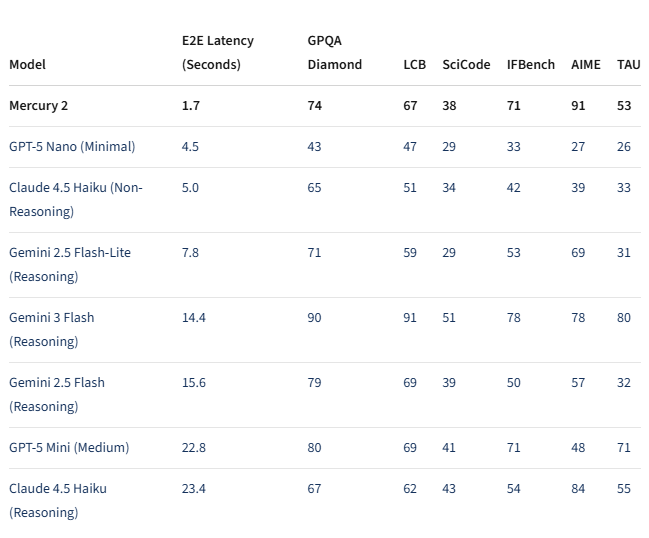
  • Responds in just 1.7 seconds end-to-end latency
  • Outpaces competitors like Google's Gemini3Flash (8x faster) and Anthropic's Claude Haiku4.5

The speed doesn't come at the cost of quality either. In benchmark tests including GPQA Diamond and AIME (standard measures for reasoning ability), Mercury2 holds its own against today's top lightweight models.

Built For Business Needs

Inception Labs clearly designed Mercury2 with practical applications in mind:

  • Cost-effective: Pricing comes in at about 25% of comparable services
  • Enterprise-ready: Supports 128,000 token contexts and tool calling functions
  • Specialized: Particularly suited for voice assistants, search systems, and coding tools where response time is critical

The API is already available for developers to test drive these capabilities firsthand.

Key Points:

  • 🌀 Architecture revolution: Swaps Transformers for diffusion models enabling parallel text optimization
  • Blazing speed: Processes over 1K tokens/second with sub-2-second response times
  • 💰 Budget-friendly: Disruptive pricing at quarter the cost of competitors
Enjoyed this article?

Subscribe to our newsletter for the latest AI news, product reviews, and project recommendations delivered to your inbox weekly.

Weekly digestFree foreverUnsubscribe anytime

Related Articles

Claude Sonnet 4.6 Breaks New Ground with Million-Token Capacity
News

Claude Sonnet 4.6 Breaks New Ground with Million-Token Capacity

Anthropic's latest AI model, Claude Sonnet 4.6, delivers flagship-level performance without the premium price tag. The standout feature? A groundbreaking one-million-token context window that lets it digest entire codebases or lengthy documents in one go. Developers are already praising its enhanced programming skills and tool-calling abilities, making it a powerful ally for complex tasks.

February 24, 2026
AI advancementsNatural language processingDeveloper tools
China's GLM-5 AI Model Breaks New Ground with Domestic Chip Support
News

China's GLM-5 AI Model Breaks New Ground with Domestic Chip Support

Zhipu Technology's GLM-5 AI model has made waves with its latest upgrades, now fully supporting seven major Chinese chip platforms. The model boasts a staggering 744 billion parameters and leads globally in programming agent capabilities. While user demand temporarily overwhelmed servers, the company has responded with compensation measures. Key innovations include a dynamic attention mechanism and new reinforcement learning algorithms that significantly boost performance.

February 23, 2026
AI innovationChinese techmachine learning
AI Lights Up Spring Festival Gala with Record-Breaking 1.9 Billion Interactions
News

AI Lights Up Spring Festival Gala with Record-Breaking 1.9 Billion Interactions

The 2026 Spring Festival Gala made history by integrating AI technology like never before. Doubao's AI-powered features enabled viewers to generate over 50 million festive profile pictures and 100 million digital greetings, while backstage, the Seedance 2.0 model transformed stage visuals with breathtaking precision. Behind the scenes, ByteDance's computing infrastructure handled an unprecedented 63.3 billion tokens per minute at peak moments.

February 17, 2026
AI innovationSpring Festival GalaDoubao
China's Spring Festival Gala Debuts Homegrown AI Video Tech
News

China's Spring Festival Gala Debuts Homegrown AI Video Tech

ByteDance's Li Liang revealed that this year's CCTV Spring Festival Gala will showcase Seedance 2.0, China's breakthrough AI video generation model. While still unable to create celebrity content, the technology promises to transform how audiences experience the annual cultural extravaganza. This marks a significant step forward for domestic AI applications in media.

February 16, 2026
AI innovationChinese techmedia evolution
Xiaomi's Robot Brain Breakthrough Goes Open Source
News

Xiaomi's Robot Brain Breakthrough Goes Open Source

Xiaomi has taken a bold step forward in robotics by open-sourcing its groundbreaking VLA model. This 4.7 billion-parameter 'brain' solves the frustrating lag between robot vision and movement, enabling real-time responses on everyday hardware. The innovative architecture combines language understanding with precise motion control, setting new benchmarks in simulated and real-world tests.

February 12, 2026
roboticsAI innovationopen source technology
News

iFLYTEK's New Medical AI Outperforms GPT-5.2 in Key Healthcare Tasks

China's iFLYTEK has unveiled its Spark Medical Large Model X2, a specialized AI that surpasses leading models like GPT-5.2 in medical report interpretation and health analysis. This homegrown technology marks significant progress in applying domestic AI to healthcare, transforming from simple consultation tools to comprehensive health management systems. The model has already received certification from Shanghai's medical AI testing center.

February 12, 2026
medical AIiFLYTEKhealthcare technology