Allen AI's SERA: Open-source coding assistant starts at $400

Allen AI Democratizes AI Coding Assistance with SERA Launch

Artificial intelligence research lab Allen AI has taken a significant step toward making professional-grade coding assistance widely available with its new open-source SERA model family. Priced surprisingly low—with entry-level training costs of just $400—this technology could transform how businesses integrate AI into their development processes.

Performance That Turns Heads

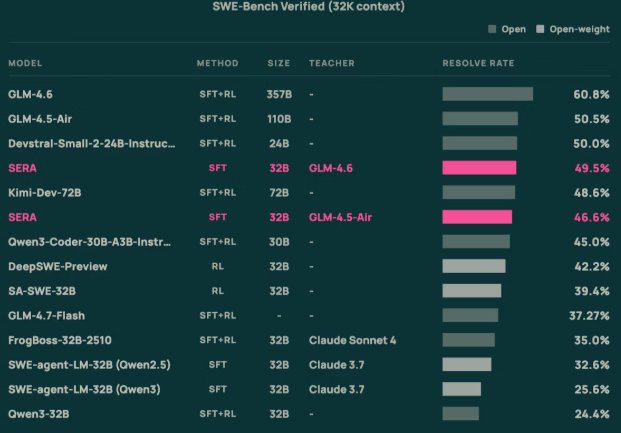
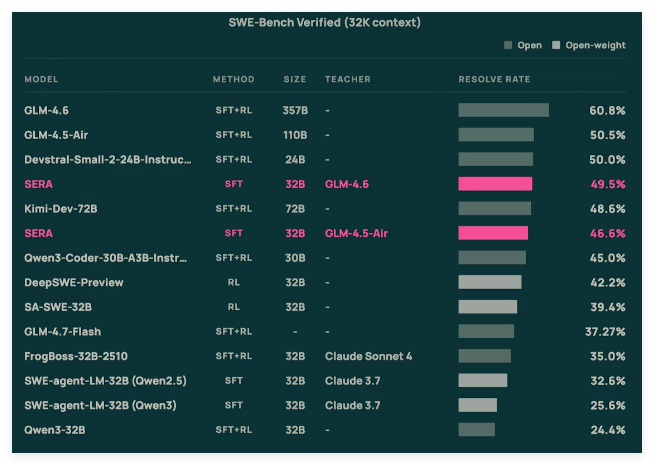
In rigorous benchmark testing (SWE-Bench-Test Verified with 64K context), SERA's flagship SERA-32B model solved 54.2% of programming challenges. This impressive result not only surpasses most open-source alternatives but even competes with premium commercial offerings in specific scenarios.
Image

Breaking Down Cost Barriers

The economics behind SERA might be its most revolutionary aspect:

  • Budget-friendly entry point: Developers can achieve baseline functionality after just 40 GPU days of training ($400 investment)
  • Enterprise-grade performance: For $12,000 in training costs, companies can match top-tier commercial model capabilities
  • Technical breakthrough: The "Soft-verified Generation" method eliminates the need for perfect training data, making adaptation to proprietary codebases far more practical

Designed for Real-World Implementation

Allen AI prioritized usability in SERA's design:

"We wanted to remove every possible friction point," explains the development team. The models integrate seamlessly with Claude Code, requiring minimal setup—just two lines of code get developers started.

The complete SERA package—including models, source code, and training guides—is now available on Hugging Face under the permissive Apache 2.0 license. This open approach enables everything from garage startups to Fortune 500 companies to build customized coding assistants tailored to their specific technical stacks and business needs.

The release signals a potential shift in the AI-assisted development landscape, where powerful tools become accessible beyond well-funded tech giants.

Key Points:

  • Affordable entry: Professional-grade coding assistance starting at $400 training cost
  • Competitive performance: Matches commercial models in benchmark tests (54.2% problem-solving rate)
  • Practical innovation: "Soft-verified Generation" works with imperfect/private datasets
  • Easy integration: Works with Claude Code via simple two-line implementation
Enjoyed this article?

Subscribe to our newsletter for the latest AI news, product reviews, and project recommendations delivered to your inbox weekly.

Weekly digestFree foreverUnsubscribe anytime

Related Articles

Ant Lingbo's New AI Model Brings Virtual Worlds to Life
News

Ant Lingbo's New AI Model Brings Virtual Worlds to Life

Ant Lingbo Technology has unveiled LingBot-World, an open-source AI model that creates stunningly realistic virtual environments. Matching Google's Genie3 in quality, this breakthrough enables seamless interactions lasting up to 10 minutes without distortion. From gaming to autonomous vehicle training, developers now have a powerful tool for building dynamic digital worlds that respond instantly to user commands.

January 29, 2026
AI innovationvirtual worldsmachine learning
Ant Group's Robotics Leap: Open-Source AI Model Boosts Robot Intelligence
News

Ant Group's Robotics Leap: Open-Source AI Model Boosts Robot Intelligence

Ant Group's Lingbo Technology has made its embodied intelligence model LingBot-VLA fully open-source, marking a significant advancement in robotics. The model demonstrates remarkable cross-platform adaptability and training efficiency, outperforming existing frameworks. Alongside this release, their new LingBot-Depth spatial perception model enhances 3D environmental understanding for robots and autonomous vehicles. These developments could accelerate smart robotics adoption across industries.

January 28, 2026
roboticsAI innovationAnt Group
Allen AI's SERA: Your $400 Private Coding Assistant
News

Allen AI's SERA: Your $400 Private Coding Assistant

Allen AI has unveiled SERA, a game-changing open-source programming assistant that brings AI-powered coding support within reach of small teams. For just $400 in fine-tuning costs, developers can now adapt this tool to their private codebases. The flagship SERA-32B model already outperforms many competitors, solving over half of programming challenges in recent benchmarks. What makes this release special? It demolishes the cost barrier typically associated with custom AI solutions while delivering professional-grade performance.

January 28, 2026
AI programmingSERA-32BAllen AI
News

Robots Get a Sense of Touch with Groundbreaking New Dataset

A major leap forward in robotics arrived this week with the release of Baihu-VTouch, the world's first cross-body visual-tactile dataset. Developed collaboratively by China's National-Local Co-built Humanoid Robot Innovation Center and multiple research teams, this treasure trove contains over 60,000 minutes of real robot interaction data. What makes it special? The dataset captures not just what robots see, but how objects feel - enabling machines to develop human-like tactile sensitivity across different hardware platforms.

January 27, 2026
roboticsAI researchtactile sensing
Robots Get a Sense of Touch: Groundbreaking Dataset Bridges Vision and Feeling
News

Robots Get a Sense of Touch: Groundbreaking Dataset Bridges Vision and Feeling

Scientists have unveiled Baihu-VTouch, the world's most comprehensive dataset combining robotic vision and touch. This collection spans over 60,000 minutes of interactions across various robot types, capturing delicate contact details with remarkable precision. The breakthrough could revolutionize how robots handle delicate tasks - imagine machines that can actually 'feel' what they're doing.

January 26, 2026
roboticsAI researchtactile sensors
News

AI's Surprising Struggle: Why Six-Year-Olds Outsmart Top Models

A groundbreaking study reveals that even advanced AI models like Gemini 3 Pro Preview fall short of a six-year-old's visual reasoning skills. Researchers identified four key areas where silicon brains stumble, from missing fine details to struggling with spatial imagination. This challenges our assumptions about AI superiority and raises questions about the future of embodied intelligence.

January 23, 2026
AI limitationsvisual reasoningcognitive development