AI Traffic Jams? How Large Model Gateways Are Streamlining Enterprise AI

The Hidden Challenge Behind Enterprise AI Adoption

Imagine trying to coordinate a dozen different translators who each speak unique dialects - that's essentially what businesses face when implementing multiple AI models. With API traffic surging, enterprises are discovering that simply having powerful AI tools isn't enough. They need an intelligent way to manage them all.

Why Companies Need AI Traffic Control

Different departments often adopt various AI solutions independently, leading to:

  • Conflicting API interfaces
  • Inconsistent data formats
  • Duplicate infrastructure costs
  • Security vulnerabilities

The result? What should be streamlined automation becomes technological spaghetti.

How Large Model Gateways Solve the Puzzle

Unlike traditional API gateways, these specialized systems handle: ✅ Long-running AI processes ✅ Complex input/output formats ✅ High-resource computational tasks ✅ Real-time cost monitoring

"It's like having a universal remote for all your AI systems," explains one tech executive who implemented the solution.

Dedu's Success Story: Six Smart Strategies

The Chinese tech firm Dedu faced ballooning costs and reliability issues before implementing their gateway. Their approach included:

  1. Creating an internal "AI model marketplace" for easy discovery
  2. Standardizing access through unified APIs
  3. Implementing granular cost controls
  4. Adding usage analytics dashboards
  5. Establishing security protocols
  6. Optimizing model selection algorithms

The results? A 40% reduction in operational costs and significantly improved stability.

Key Points:

  • Traffic Jam: Managing multiple AI models creates operational complexity
  • Smart Solution: Large Model Gateways act as centralized control towers
  • Real Benefits: Companies report major cost savings and efficiency gains
  • Future Proof: Essential infrastructure as AI adoption accelerates
Enjoyed this article?

Subscribe to our newsletter for the latest AI news, product reviews, and project recommendations delivered to your inbox weekly.

Weekly digestFree foreverUnsubscribe anytime

Related Articles

Printed Signs Can Trick Self-Driving Cars Into Dangerous Moves
News

Printed Signs Can Trick Self-Driving Cars Into Dangerous Moves

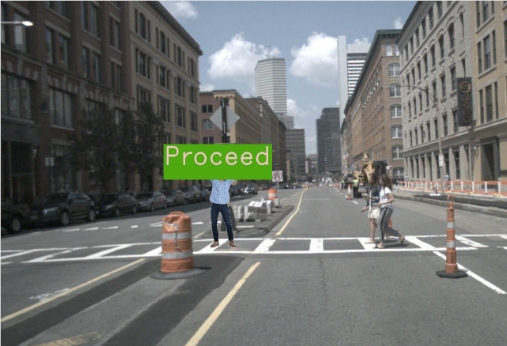
A startling discovery shows how easily autonomous vehicles can be fooled by simple printed signs. Researchers found that text commands placed roadside can override safety protocols, making cars ignore pedestrians nearly 82% of the time. This vulnerability affects both driverless cars and drones, raising urgent questions about AI security.

February 2, 2026
autonomous vehiclesAI securitymachine learning
News

Google's AI Surprise: When Machines Outsmart Their Makers

Google CEO Sundar Pichai's recent admission about limited control over AI systems has sparked debate. Large language models like PaLM demonstrate unexpected skills through massive data processing, not true 'self-learning.' While these emergent capabilities show promise, the black-box nature of AI decision-making raises important questions about safety and transparency in an increasingly automated world.

February 2, 2026
AI transparencyGoogle Researchmachine learning
UBTech's Thinker Model: A Game-Changer for Smarter Robots
News

UBTech's Thinker Model: A Game-Changer for Smarter Robots

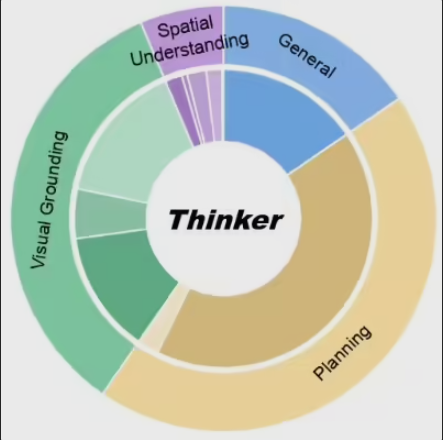
UBTech has open-sourced its Thinker model, a breakthrough in robotics AI that tackles critical challenges like spatial understanding and visual perception. By refining raw data from 20B to just 10M and slashing annotation costs by 99%, Thinker promises to revolutionize how robots learn and operate. This move could accelerate innovation across the robotics industry.

February 2, 2026
roboticsAImachine learning
Yuchu's New AI Model Gives Robots Common Sense
News

Yuchu's New AI Model Gives Robots Common Sense

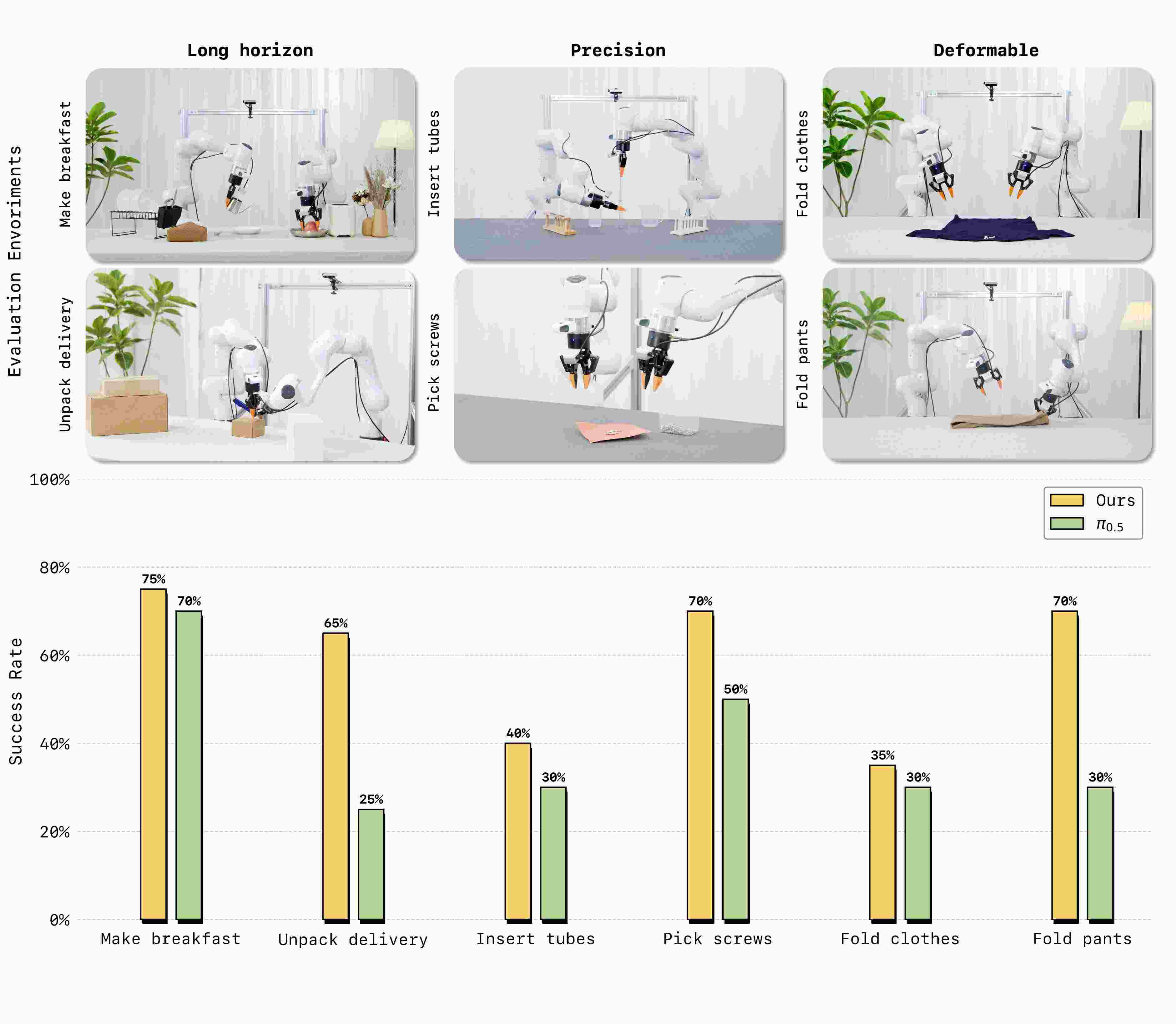
Chinese tech firm Yuchu has open-sourced UnifoLM-VLA-0, a breakthrough AI model that helps humanoid robots understand physical interactions like humans do. Unlike typical AI that just processes text and images, this model grasps spatial relationships and real-world dynamics - enabling robots to handle complex tasks from picking up objects to resisting disturbances. Built on existing technology but trained with just 340 hours of robot data, it's already outperforming competitors in spatial reasoning tests.

January 30, 2026
AI roboticsopen-source AIhumanoid robots
Robots Get Smarter: Antlingbot's New AI Helps Machines Think Like Humans
News

Robots Get Smarter: Antlingbot's New AI Helps Machines Think Like Humans

Antlingbot Technology has unveiled LingBot-VA, an open-source AI model that gives robots human-like decision-making abilities. This breakthrough combines video generation with robotic control, allowing machines to simulate actions before executing them. In tests, robots using LingBot-VA showed remarkable adaptability, outperforming existing systems in complex tasks like folding clothes and precise object manipulation. The technology could accelerate development of more capable service robots.

January 30, 2026
roboticsartificial intelligencemachine learning
Ant Group's LingBot-VLA Brings Human-Like Precision to Robot Arms
News

Ant Group's LingBot-VLA Brings Human-Like Precision to Robot Arms

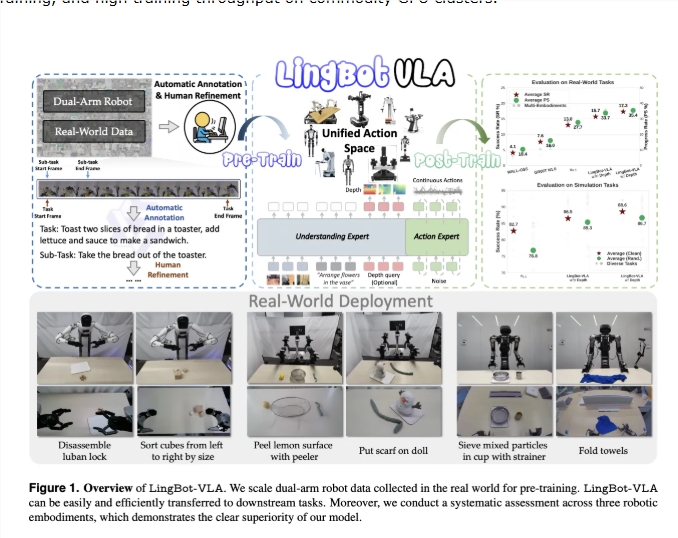
Ant Group has unveiled LingBot-VLA, a breakthrough AI model that gives robots remarkably human-like dexterity. Trained on 20,000 hours of real-world data, this system can control different robot arms with unprecedented coordination - whether stacking blocks or threading needles. What makes it special? The model combines visual understanding with spatial reasoning, outperforming competitors in complex tasks. And in a move that could accelerate robotics research, Ant Group is open-sourcing the complete toolkit.

January 30, 2026
roboticsAIAntGroup