Ant Group's LingBot-VLA Brings Human-Like Precision to Robot Arms

Ant Group's Robot Arms Get an AI Brain Upgrade

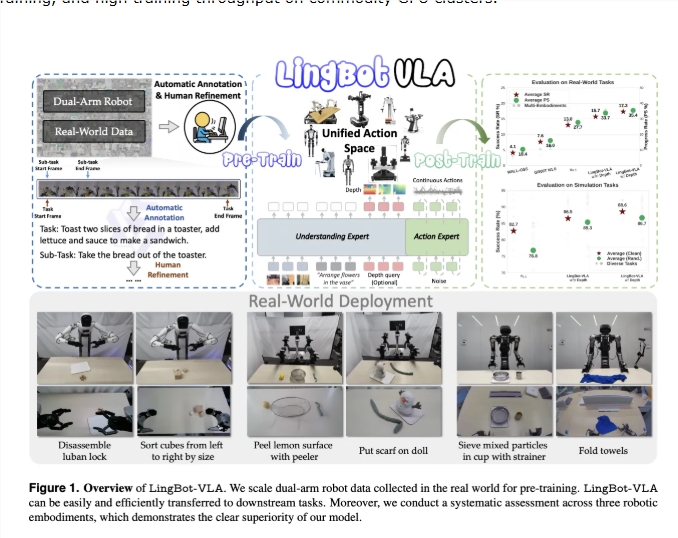
In a significant leap for robotic dexterity, Ant Group has introduced LingBot-VLA - an artificial intelligence system that brings human-like precision to mechanical arms. This isn't just another incremental improvement; it's potentially transformative for factories, warehouses, and any space where robots need to handle objects with care.
Image

Teaching Robots the Art of Touch

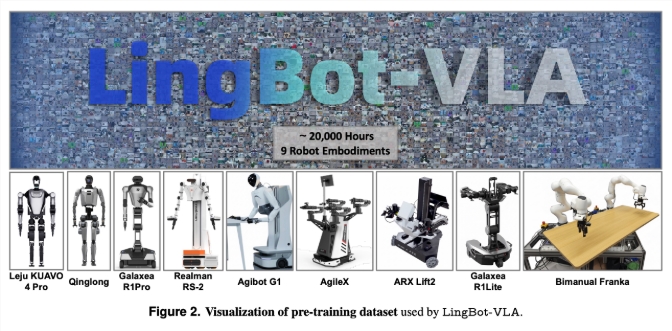
The secret sauce? Massive real-world training. Researchers collected approximately 20,000 hours of remote operation data across nine different dual-arm robots - equivalent to someone practicing non-stop for over two years. These weren't just simple movements either; the dataset captures the nuanced sequences needed for complex tasks.

"Imagine trying to teach someone ballet through YouTube videos," explains Dr. Li Wei, lead researcher on the project. "That's essentially what we've done with robots - but instead of dance steps, we're teaching them how two arms can work in perfect harmony."

How It Works: Seeing, Understanding, Acting

LingBot-VLA combines three crucial capabilities:

  1. Visual perception through Qwen2.5-VL that processes multiple camera angles simultaneously
  2. Language understanding to interpret instructions like "gently place the cube on top"
  3. Action prediction using conditional flow matching for smooth, continuous movements

The system even compensates for missing depth sensor data thanks to its built-in spatial reasoning module - think of it like giving robots an innate sense of how far objects are without constantly measuring.
Image

Real-World Performance That Surprises Experts

In benchmark tests involving 100 challenging tasks:

  • Achieved 17.3% success rate (significantly higher than competitors)
  • Adapted to new robots with just 80 demonstrations
  • Showed particular skill in delicate operations like inserting pegs and folding cloth

The implications are substantial for industries relying on precise automation. Where current systems often struggle with unpredictable real-world conditions, LingBot-VLA demonstrates unusual adaptability.

Opening the Floodgates for Robotics Research

In an unexpected move that could accelerate innovation across the field:

  • Full training toolkit now open source
  • Optimized for GPU clusters (1.5-2.8x faster training than alternatives)
  • Complete model weights available to researchers worldwide

This democratization of advanced robotics AI might just lower barriers enough to see a surge in practical applications - from assisted living facilities to disaster response robots.

Key Points:

  • Dual-arm coordination: Enables complex manipulation tasks beyond single-arm capabilities
  • Rapid adaptation: Learns new robots quickly with minimal demonstration data
  • Depth perception: Maintains spatial awareness even without sensors
  • Open ecosystem: Public release could spur widespread adoption and innovation
Enjoyed this article?

Subscribe to our newsletter for the latest AI news, product reviews, and project recommendations delivered to your inbox weekly.

Weekly digestFree foreverUnsubscribe anytime

Related Articles

Robots Get Smarter: Antlingbot's New AI Helps Machines Think Like Humans
News

Robots Get Smarter: Antlingbot's New AI Helps Machines Think Like Humans

Antlingbot Technology has unveiled LingBot-VA, an open-source AI model that gives robots human-like decision-making abilities. This breakthrough combines video generation with robotic control, allowing machines to simulate actions before executing them. In tests, robots using LingBot-VA showed remarkable adaptability, outperforming existing systems in complex tasks like folding clothes and precise object manipulation. The technology could accelerate development of more capable service robots.

January 30, 2026
roboticsartificial intelligencemachine learning
Yuchu's New AI Model Gives Robots Common Sense
News

Yuchu's New AI Model Gives Robots Common Sense

Chinese tech firm Yuchu has open-sourced UnifoLM-VLA-0, a breakthrough AI model that helps humanoid robots understand physical interactions like humans do. Unlike typical AI that just processes text and images, this model grasps spatial relationships and real-world dynamics - enabling robots to handle complex tasks from picking up objects to resisting disturbances. Built on existing technology but trained with just 340 hours of robot data, it's already outperforming competitors in spatial reasoning tests.

January 30, 2026
AI roboticsopen-source AIhumanoid robots
News

OpenMind's Robot App Store Aims to Make Robots More Versatile

OpenMind has launched a dedicated app store for robots, bridging the gap between advanced hardware and adaptable software. The platform allows operators to update robot capabilities like smartphone apps, with initial focus areas including mobility, social interaction, and privacy. Already compatible with robots from 10 manufacturers, the store has garnered support from industry leaders Ubtech and Fourier among others.

January 29, 2026
roboticsOpenMindAI applications
News

Tesla Shifts Gears: Farewell to Model S/X as Fremont Goes All-In on Robots

Tesla's latest earnings call brought seismic changes - the iconic Model S and X are being phased out as the company doubles down on AI and robotics. Their Fremont factory will transform into an Optimus robot production hub, aiming for a staggering 1 million units annually. While automotive revenue dipped slightly in Q4 ($24.9 billion), energy sector growth (up 25%) and massive AI investments signal Tesla's bold pivot toward becoming a 'physical AI company.'

January 29, 2026
TeslaElectric VehiclesRobotics
News

Waabi Accelerates Into Robotaxi Race With $1B Boost From Uber

Autonomous vehicle pioneer Waabi just shifted into high gear, securing a massive $1 billion investment round backed by Uber. The funding catapults the Toronto-based startup from trucking into the competitive robotaxi arena, with plans to deploy 25,000 driverless cabs on Uber's platform. What sets Waabi apart? Their AI learns primarily in simulation rather than through endless real-world testing - potentially rewriting the rulebook for self-driving tech.

January 29, 2026
Autonomous VehiclesWaabiUber
Ant Lingbo's New AI Model Brings Virtual Worlds to Life
News

Ant Lingbo's New AI Model Brings Virtual Worlds to Life

Ant Lingbo Technology has unveiled LingBot-World, an open-source AI model that creates stunningly realistic virtual environments. Matching Google's Genie3 in quality, this breakthrough enables seamless interactions lasting up to 10 minutes without distortion. From gaming to autonomous vehicle training, developers now have a powerful tool for building dynamic digital worlds that respond instantly to user commands.

January 29, 2026
AI innovationvirtual worldsmachine learning