Your Next Starbucks Order Could Be AI-Powered—Here's How

Starbucks Brews Up AI Drink Recommendations

Ever stood in line at Starbucks, overwhelmed by the menu and unsure what to order? The coffee giant might have a solution—and it involves artificial intelligence.

A Personalized Cup of Tech
Starbucks is testing a new feature powered by ChatGPT that suggests drinks tailored to your current mood and goals. Feeling sluggish? The AI might recommend a nitro cold brew. Need comfort? Perhaps a caramel macchiato.

"We're always looking for ways to make the Starbucks experience more personal," a company spokesperson told us. "This beta feature helps customers discover drinks they might love but wouldn't normally consider."

How It Works
Open the Starbucks app, share how you're feeling ("stressed," "celebratory," or even "indecisive"), and ChatGPT generates customized suggestions. The system considers factors like:

  • Time of day
  • Weather in your location
  • Your past orders
  • Current promotions

Not Everyone's Cup of Tea
While many customers welcome the innovation, psychologists raise interesting questions. "When we outsource small decisions to algorithms, we might be weakening our own decision-making muscles," notes Dr. Ellen Park, behavioral scientist at Cornell University.

Starbucks emphasizes this is meant to complement—not replace—human choice. Baristas will still happily chat about recommendations the old-fashioned way.

What's Next
The feature is currently in limited testing, with no announced rollout date. Early users report mixed feelings—some love the surprise suggestions, while others prefer sticking to their usual orders.

Key Points

  • ☕ Starbucks testing AI drink recommendations based on mood
  • 🤖 ChatGPT suggests personalized beverages in the mobile app
  • ⚠️ Experts caution about potential over-reliance on tech for small decisions
  • 🔄 Feature remains in beta as Starbucks collects user feedback
Enjoyed this article?

Subscribe to our newsletter for the latest AI news, product reviews, and project recommendations delivered to your inbox weekly.

Weekly digestFree foreverUnsubscribe anytime

Related Articles

News

NVIDIA's Lyra 2.0 Transforms Single Photos into Vast 3D Worlds

NVIDIA has unveiled Lyra 2.0, a groundbreaking system that creates expansive 3D environments from just one photograph. This technology not only solves long-standing issues with image distortion in virtual spaces but also outperforms competitors in quality and efficiency. What makes it special? Lyra 2.0 can generate realistic 90-meter scenes while maintaining remarkable consistency - a game-changer for robotics training and autonomous vehicle development. The system's ability to integrate with physical engines means AI-generated worlds can now directly train real-world machines.

April 17, 2026
NVIDIA3D generationAI innovation
News

ChatGPT Reaches Gender Parity as Women Become Majority Users

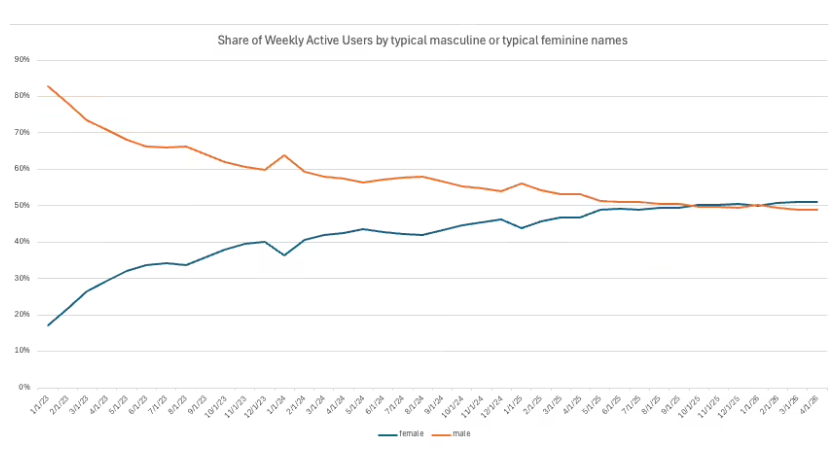
In a striking shift from its early days, ChatGPT now counts more women among its users than men. Recent OpenAI data reveals female users have crossed the 50% threshold, representing nearly half a billion people globally. The AI tool's total user base is approaching 1 billion while the company dramatically expands its computing infrastructure to meet growing demand.

April 17, 2026
ChatGPTAI trendsTechnology adoption
ChatGPT Hits 1 Billion Users as Women Take the Lead
News

ChatGPT Hits 1 Billion Users as Women Take the Lead

OpenAI's latest data reveals a milestone moment—ChatGPT now boasts nearly 1 billion weekly users worldwide. What's catching attention? For the first time, women make up the majority of users at over 50%, flipping the script from early adoption patterns. Meanwhile, behind the scenes, OpenAI's computing power is set to grow nearly tenfold by 2025, fueling smarter AI conversations.

April 17, 2026
ChatGPTAI TrendsTechnology Adoption
Tencent's Latest AI Breakthrough Lets You Build 3D Worlds With a Click
News

Tencent's Latest AI Breakthrough Lets You Build 3D Worlds With a Click

Tencent has unveiled its open-source Huan Yuan 3D World Model 2.0, revolutionizing digital content creation. This cutting-edge AI tool transforms text, images, and videos into fully interactive 3D environments complete with realistic physics. Game developers and digital artists can now generate editable assets that work seamlessly with Unity and Unreal Engine, dramatically simplifying 3D world building.

April 16, 2026
3D modelingAI innovationgame development
MiniMax's MaxHermes: AI That Teaches Itself New Tricks
News

MiniMax's MaxHermes: AI That Teaches Itself New Tricks

MiniMax has unveiled MaxHermes, a groundbreaking cloud sandbox that learns autonomously. Unlike traditional AI tools requiring manual programming, MaxHermes extracts 'skills' from task performance and improves through user feedback. The system combines persistent memory, natural language scheduling, and multi-agent operations to create what might be the first truly self-evolving AI assistant. Powered by MiniMax's latest M2.7 model, this innovation could redefine how we think about AI capabilities in real-world applications.

April 16, 2026
AI innovationMachine learningAutonomous systems
MaxHermes Launches as World's First Self-Learning AI Cloud Sandbox
News

MaxHermes Launches as World's First Self-Learning AI Cloud Sandbox

MiniMax Xiyu Technology has unveiled MaxHermes, a groundbreaking cloud sandbox for AI agents that learns and improves through interaction. Unlike static AI tools, this assistant evolves its skills autonomously, remembering past conversations to deliver increasingly personalized responses. With seamless integration into popular platforms and a pay-as-you-go model, MaxHermes promises to make advanced AI accessible to businesses and individuals alike.

April 16, 2026
AI innovationCloud computingMachine learning