VideoFrom3D Transforms Rough Geometry into Realistic 3D Videos

VideoFrom3D Transforms Rough Geometry into Realistic 3D Videos

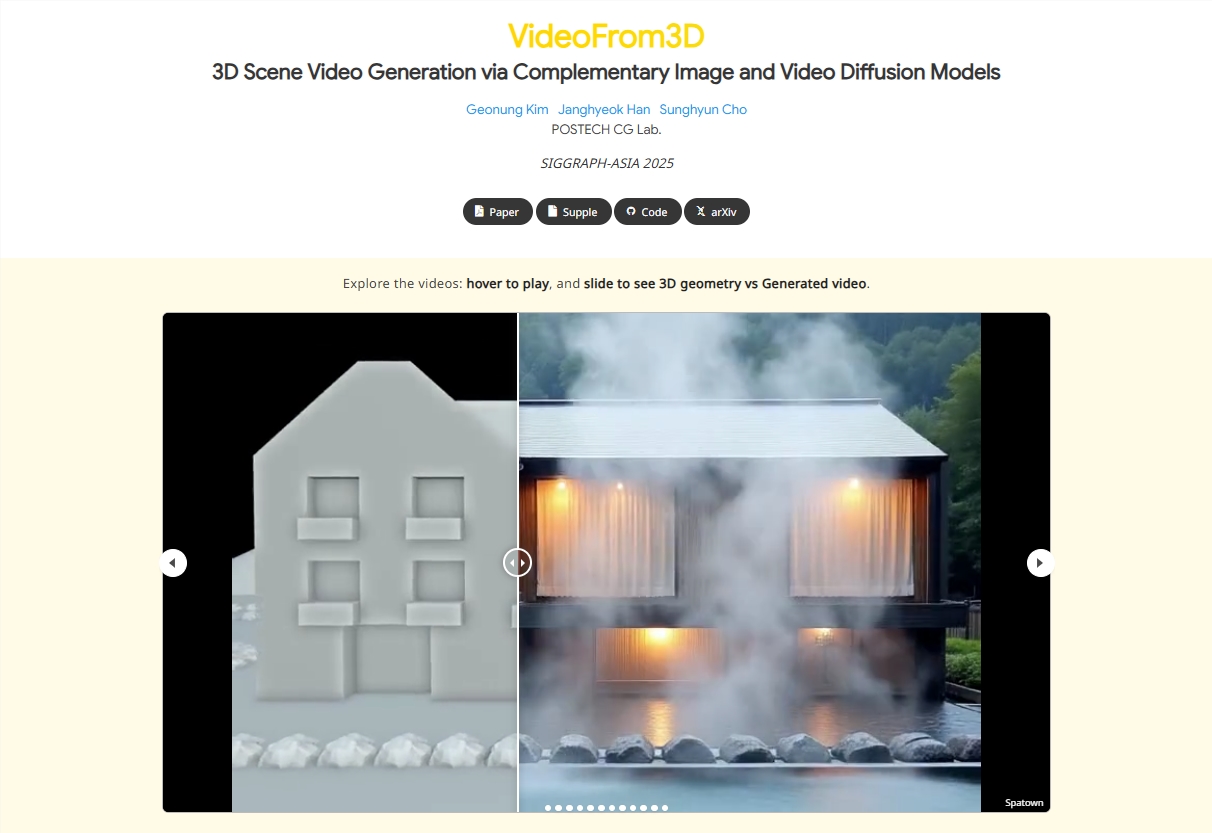
In the rapidly evolving world of AI-driven creativity, VideoFrom3D emerges as a game-changer for 3D graphics design. This innovative framework leverages diffusion models to generate highly realistic and stylistically consistent 3D scene videos from minimal inputs—rough geometries, camera paths, and reference images. By eliminating the need for costly paired datasets, VideoFrom3D democratizes high-quality 3D content creation.
Image

Framework Core: Dual-Module Architecture

The power of VideoFrom3D lies in its dual-module architecture:

  1. Sparse Anchor View Generation (SAG) Module: Uses an image diffusion model to produce high-quality, cross-view consistent anchor views based on reference images and rough geometry.
  2. Geometry-Guided Generative Interpolation (GGI) Module: Leverages a video diffusion model to interpolate intermediate frames, ensuring smooth motion and temporal consistency through flow-based camera control.

This approach sidesteps traditional challenges like visual quality degradation and motion inconsistencies in complex scenes.

Technical Highlights: Zero-Paired Data Strategy

Unlike conventional methods reliant on annotated datasets, VideoFrom3D adopts a "zero-paired" strategy, requiring only:

  • Rough geometry (e.g., simple meshes or point clouds)
  • A camera path
  • A reference image

This innovation lowers barriers for designers and supports diverse applications—from indoor scenes to outdoor landscapes—while maintaining style consistency across views.

Performance and Applications

Benchmark tests reveal that VideoFrom3D outperforms existing models, particularly in dynamic scenes. Its outputs rival professional-grade productions with natural motion and stylistic fidelity.

The framework has far-reaching implications:

  • Film & Special Effects: Accelerates pre-visualization and prototyping.
  • Virtual Reality: Enables rapid scene construction for immersive experiences.
  • Game Development: Streamlines asset creation for indie developers. By reducing reliance on expensive datasets, it empowers small teams to compete with industry giants.

Key Points:

  • Innovation: Combines image and video diffusion models for seamless 3D video generation.
  • Accessibility: Eliminates need for paired datasets, lowering production costs.
  • Quality: Delivers professional-grade outputs with consistent styling and motion.
  • Versatility: Applicable across industries from gaming to architectural visualization.
Enjoyed this article?

Subscribe to our newsletter for the latest AI news, product reviews, and project recommendations delivered to your inbox weekly.

Weekly digestFree foreverUnsubscribe anytime

Related Articles

Ant Group's LLaDA2.0: A 100B-Parameter Leap in AI Language Models
News

Ant Group's LLaDA2.0: A 100B-Parameter Leap in AI Language Models

Ant Group has unveiled LLaDA2.0, a groundbreaking 100-billion-parameter diffusion language model that challenges conventional wisdom about scaling limitations. This innovative technology not only delivers faster processing speeds but also excels in complex tasks like code generation. By open-sourcing the model, Ant is inviting developers worldwide to explore its potential while pushing the boundaries of what diffusion models can achieve.

December 12, 2025
LLaDA2.0Diffusion ModelsAI Innovation
News

Stanford's AI Startup Inception Secures $50M to Rival GPT-5 with Faster Diffusion Tech

A Stanford professor's AI startup, Inception, has raised $50 million in seed funding to challenge giants like GPT-5 with its diffusion-based language model. Their Mercury model achieves blazing speeds of 1000 tokens per second for code generation, promising a more efficient alternative to current autoregressive approaches. Backed by heavyweights including Microsoft and NVIDIA, this innovation could reshape how we build AI systems.

November 10, 2025
AI InnovationDiffusion ModelsTech Startups
Radical Numerics Releases Open-Source 30B-Parameter Diffusion AI Model
News

Radical Numerics Releases Open-Source 30B-Parameter Diffusion AI Model

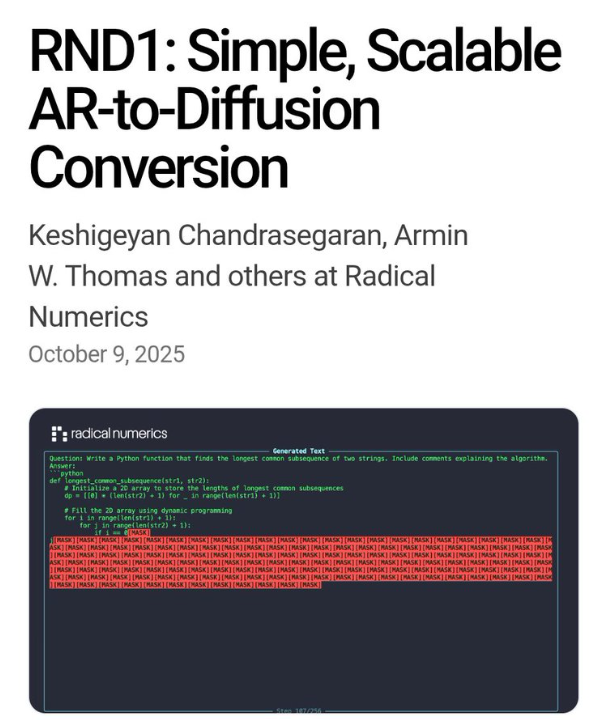
Radical Numerics has open-sourced RND1-Base, a groundbreaking 30B-parameter diffusion language model. The AI architecture leverages sparse expert mixtures and bidirectional attention for efficient parallel generation, outperforming predecessors in benchmarks while enabling faster inference.

October 13, 2025
Diffusion ModelsAI ResearchOpen Source AI
Ant Group's dInfer Boosts Diffusion Model Speed 10x
News

Ant Group's dInfer Boosts Diffusion Model Speed 10x

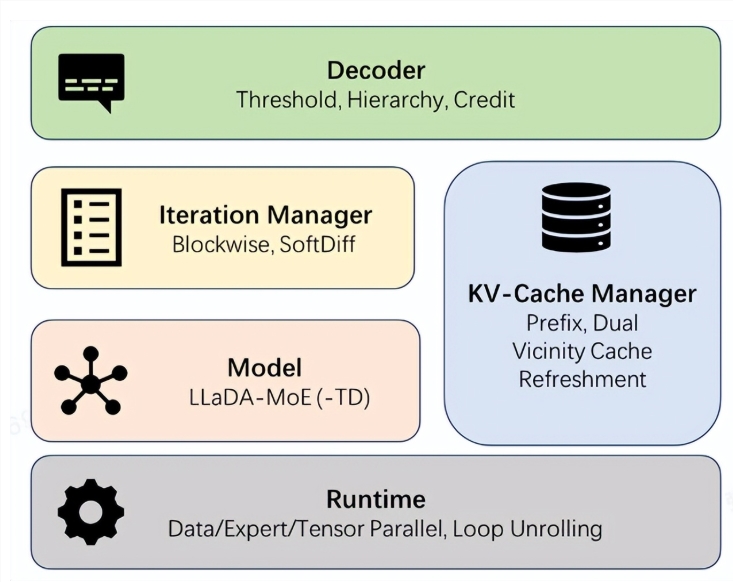
Ant Group has open-sourced dInfer, a high-performance inference framework for diffusion language models that achieves speeds 10.7x faster than NVIDIA's Fast-dLLM. The breakthrough enables 1011 tokens/second generation and outperforms traditional autoregressive models, marking a significant step toward practical AGI applications.

October 13, 2025
dInferDiffusion ModelsAI Acceleration
Shanghai AI Lab Unveils Lumina-DiMOO for Multimodal AI
News

Shanghai AI Lab Unveils Lumina-DiMOO for Multimodal AI

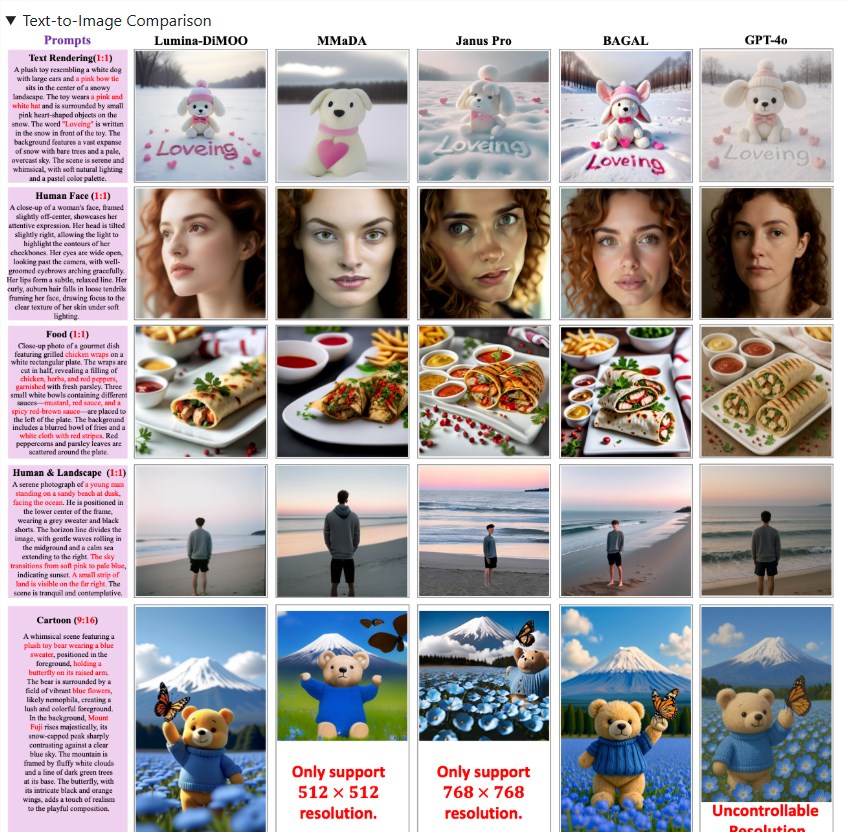
Shanghai AI Lab has introduced Lumina-DiMOO, a cutting-edge multimodal AI model. Utilizing a 'Fully Discrete Diffusion Architecture,' it enhances text, image, and audio processing efficiency. The model excels in generation and understanding tasks, promising broad applications in AI technology.

September 16, 2025
Multimodal AILumina-DiMOODiffusion Models
Tencent's AI Painting Breakthrough Boosts Image Quality 300%
News

Tencent's AI Painting Breakthrough Boosts Image Quality 300%

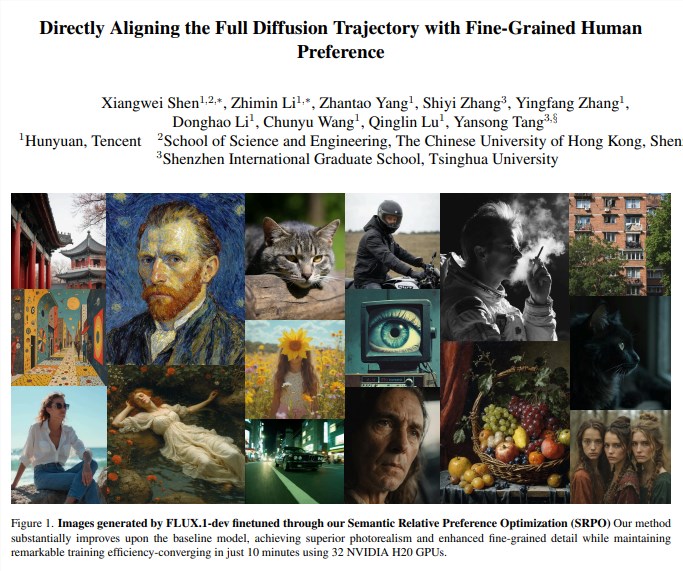
Tencent has unveiled a new AI image generation technique that improves aesthetic quality by 300% using innovative fine-tuning methods. Their 'Direct-Align' and 'Semantic Relative Preference Optimization' approaches address key limitations in current diffusion models, enabling more realistic and customizable outputs without additional training data.

September 16, 2025
AI Image GenerationTencent ResearchDiffusion Models