Radical Numerics Releases Open-Source 30B-Parameter Diffusion AI Model
Radical Numerics Unveils Open-Source Diffusion AI Breakthrough
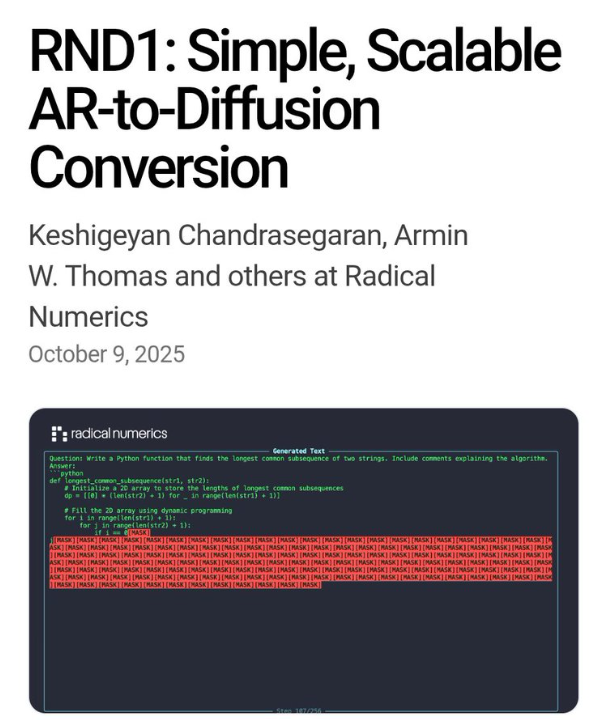
AI research firm Radical Numerics has publicly released RND1-Base, the largest open-source diffusion language model to date. The 30-billion parameter architecture marks a significant advancement in parallel text generation technology.
Technical Specifications
The model features:
- 30B total parameters (3B active via sparse expert mixture)
- Built upon Qwen3-30BA3B autoregressive base
- Trained on 500B tokens using bidirectional masking
- Supports 8M token batch sizes for stability
Performance Benchmarks
RND1-Base demonstrates superior capabilities across multiple domains:
| Benchmark | Score |
|---|
The model outperforms previous open-source diffusion models like Dream-7B and LLaDA-8B while maintaining computational efficiency through selective parameter activation.
Architectural Innovations
Unlike traditional autoregressive models, RND1 treats text generation as a denoising process, enabling:
- Parallel sequence refinement
- Bidirectional attention mechanisms
- Reduced inference latency
The transition from autoregressive to diffusion paradigm was achieved through continuous pre-training with layer-specific learning rates, preserving existing knowledge while adopting new capabilities.
Research Implications
The open-source release includes:
- Complete model weights
- Training methodologies
- Inference code with FlashInfer/SGLang backends
This transparency aims to accelerate community research into post-training optimization and practical applications of diffusion language models.
Future Directions
While demonstrating strong performance, challenges remain in:
- Generalization capability
- Memory optimization Radical Numerics suggests future integration with multi-objective fine-tuning could unlock additional potential.
The team - comprising researchers from DeepMind, Meta, and Stanford - positions this as foundational work toward recursive self-improving AI systems.
Key Points:
- Largest open-source diffusion language model released (30B parameters)
- Achieves state-of-the-art benchmarks while enabling parallel generation
- Complete technical stack made available to research community
- Represents shift toward non-autoregressive AI architectures
- Foundation for future self-improving AI systems