Tencent's WorldCompass Gives AI Models Better Direction
Tencent Takes AI Navigation to New Heights with WorldCompass
Imagine asking your virtual assistant to "book dinner reservations near Central Park, then schedule a taxi for 7:30pm" - only to have it book the taxi first or choose the wrong restaurant district. This frustrating scenario might soon become history thanks to Tencent's latest innovation.
The tech giant's Hunyuan 3D team has unveiled WorldCompass, the first open-source reinforcement learning framework specifically designed to fine-tune world models. These sophisticated AI systems simulate environments and interactions, but until now struggled with complex, multi-step commands.
Solving the 'Lost in Translation' Problem
Current world models rely heavily on initial training data, much like someone memorizing phrases from a travel guide without understanding grammar. When faced with unfamiliar command combinations, they often miss nuances or execute steps out of order.
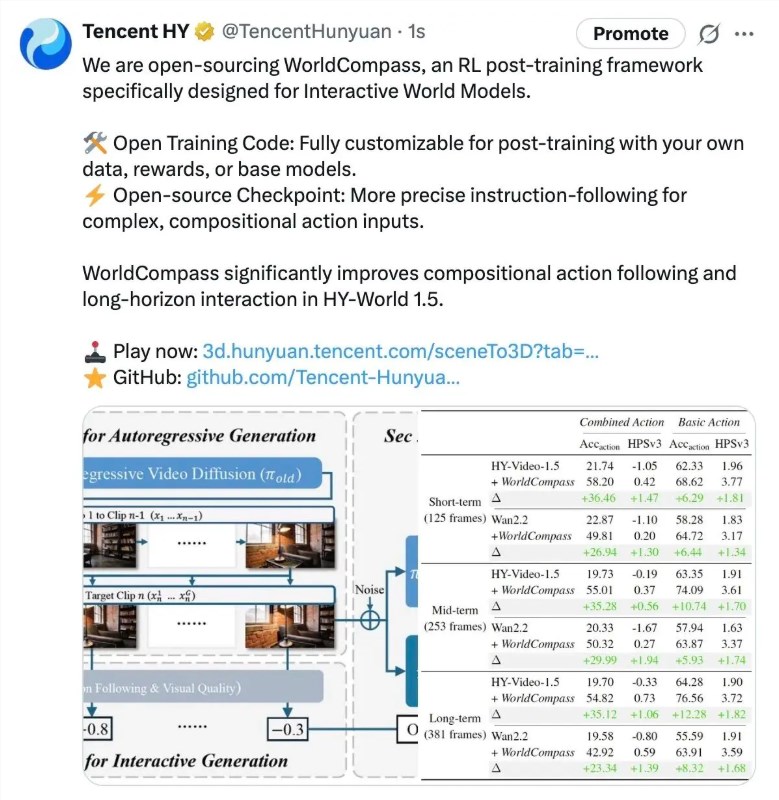
WorldCompass acts as an adaptive navigation system for these models. Through reinforcement learning - where AI learns from trial and error - it helps models better interpret instructions and maintain context across multiple actions. In benchmark tests using the open-source WorldPlay model, accuracy in complex scenarios jumped from roughly 20% to over 55%.
"It's like teaching someone not just vocabulary, but how to have coherent conversations," explains Dr. Liang Chen from Tencent's research team. "The model learns why certain actions follow others based on real-world logic."
Beyond Accuracy: Maintaining Visual Consistency
The framework doesn't just improve action sequencing - it also helps maintain visual coherence during extended simulations. The Human Preference Score (HPSv3), measuring visual fidelity during prolonged virtual explorations, showed significant gains.
This advancement comes as virtual worlds grow more sophisticated across gaming, training simulations, and digital twins for urban planning. Being able to reliably navigate these environments with precise control opens new possibilities.
Open-Sourcing the Future of Virtual Interaction
Tencent has made WorldCompass fully available to developers worldwide, including code and technical documentation. This move aims to accelerate progress toward more responsive virtual assistants, game NPCs that understand nuanced player commands, and training simulations that adapt realistically.
The release signals an important industry shift from simply building bigger models to refining how they interpret and act upon instructions - moving from brute-force computation toward more sophisticated understanding.
Key Advantages:
- Precision Control: Tackles the persistent challenge of inaccurate execution in complex scenarios
- Adaptive Learning: Demonstrates reinforcement learning's power for long-term interaction improvement
- Developer Friendly: Complete open-source package lowers barriers for creating immersive experiences
- Paradigm Shift: Moves focus from pure data scaling to smarter interaction refinement