

Tech Giants Unite to Shape the Future of AI Agents
Tech Titans Launch AI Standardization Effort
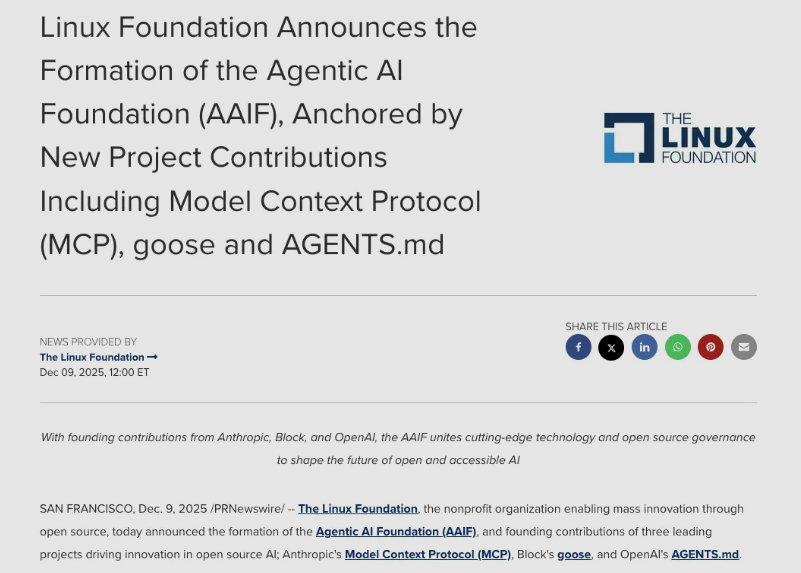
The Linux Foundation has unveiled a groundbreaking initiative that could transform how AI agents interact. Dubbed the AI Agent Foundation (AAIF), this consortium brings together over 30 technology leaders including Google, Microsoft, Amazon, IBM, and OpenAI with a bold mission: to create open, universal standards for AI systems.
The Building Blocks of Interoperability
At the heart of AAIF are three key contributions from founding members:
1. MCP (Model Context Protocol) by Anthropic Imagine a USB-C port for AI - that's essentially what MCP aims to be. This protocol will serve as a universal interface allowing different AI systems to connect and share data effortlessly. Major players like Google and Microsoft have already pledged support.
2. Agents.md by OpenAI Ever struggled with unclear software documentation? OpenAI's contribution standardizes how AI tools are described, making it easier for developers to implement them without guesswork.
3. Goose by Block This open-source agent runs offline - a crucial feature for privacy-conscious applications. It comes with built-in security measures and supports popular developer tools right out of the box.
Governance and Security Priorities
The foundation isn't just about innovation - it's about responsible development too. Hosted by the Linux Foundation, AAIF ensures no single company dominates the standards process. A diverse board including representatives from Anthropic, OpenAI, and major cloud providers will oversee operations.
Security takes center stage in AAIF's roadmap:
- Early 2025: Mandatory authentication protocols to prevent data breaches
- Mid-2025: New safeguards limiting what actions AI agents can perform
- Late 2025: A bug bounty program inviting ethical hackers to stress-test the system
Why This Matters for Businesses and Developers
The implications are profound. Small businesses won't need custom integrations for every AI tool they use. Developers can mix and match components like building blocks rather than wrestling with incompatible systems.
"This could be as transformative as TCP/IP was for the internet," one industry insider noted. "We're talking about eliminating countless hours wasted on making different AIs talk to each other."
What's Coming Next
The foundation has an ambitious timeline:
- First quarter 2025: Official release of core specifications
- Second quarter: Launch of certification program ensuring compliance
- Third quarter: Creation of a marketplace for approved AI components
The race to standardize AI is on, and with these tech giants at the helm, the ripple effects could reshape entire industries.
Key Points:
- Over 30 major tech companies formed AAIF to create universal AI standards
- Three foundational projects address connectivity, documentation, and security
- Roadmap includes strict security measures and certification programs
- Initiative could dramatically lower barriers for businesses adopting AI

