Science Fiction Titans Debate: Can AI Truly Replace Human Storytellers?

The Great AI Writing Debate: Human Soul vs. Machine Intelligence

Science fiction's brightest stars lit up the stage at this year's China Science Fiction Convention with a heated discussion about artificial intelligence's growing influence on literature. The debate between Hugo Award winner Liu Cixin and veteran sci-fi author Wang Jinkang revealed fundamentally different visions for the future of storytelling.

Liu Cixin: Guardian of the Human Touch

"AI can mimic," Liu argued, "but can it truly understand what it means to be human?" The celebrated author of The Three-Body Problem remains skeptical about machines replacing writers. He pointed to literature's emotional core - those intangible qualities born from lived experience that no algorithm can replicate.

Yet even this traditionalist acknowledges technology's relentless march. "We're like blacksmiths watching the industrial revolution," Liu mused. "The question isn't whether to use new tools, but how to preserve what makes our craft human."

Wang Jinkang: Embracing the AI Revolution

Where Liu sees limitations, Wang sees unprecedented opportunity. "Science fiction has always been about pushing boundaries," he countered. "Why should our tools remain stuck in the past?" The veteran writer envisions AI as a collaborator that could help authors construct more intricate worlds and explore concepts beyond human imagination.

Wang demonstrated how current AI models already assist with world-building details - calculating plausible planetary ecosystems or simulating complex futuristic societies. "This isn't replacement," he insisted, "it's liberation - freeing writers to focus on what humans do best: meaning and emotion."

Key Points:

  • Human experience matters: Liu argues AI lacks the lived experiences that fuel meaningful stories
  • Creative augmentation: Wang believes AI can handle technical aspects while humans focus on emotional depth
  • Speed of change: Both authors agree technology is advancing faster than the literary world can adapt
  • New possibilities: Advanced simulation could enable more scientifically rigorous sci-fi worlds
Enjoyed this article?

Subscribe to our newsletter for the latest AI news, product reviews, and project recommendations delivered to your inbox weekly.

Weekly digestFree foreverUnsubscribe anytime

Related Articles

AI Now Outwrites Humans - What That Means for Creativity
News

AI Now Outwrites Humans - What That Means for Creativity

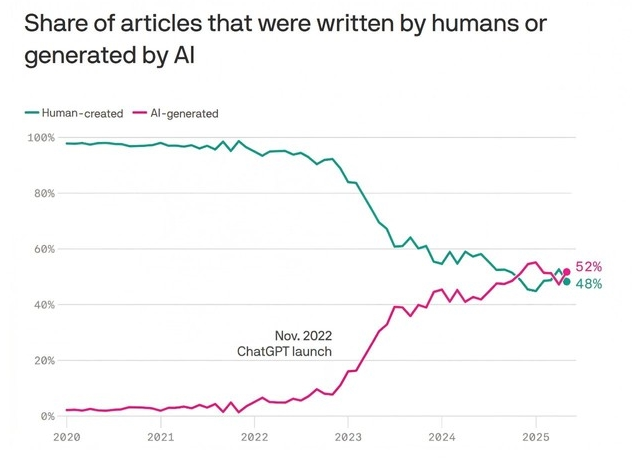
A startling new report reveals AI-generated content has overtaken human writing online. While this showcases technology's rapid progress, experts warn of troubling consequences - from deteriorating creative skills to potential misinformation spirals. The study analyzed 65,000 websites, showing how ChatGPT's launch triggered an AI content explosion that could reshape how we think and create.

April 10, 2026
AI writingdigital creativitycontent creation
News

AI Novels Flood the Market: Can Human Writers Keep Up?

The web novel industry faces an existential crisis as AI tools churn out millions of words daily, outpacing human authors tenfold. While platforms report surging content volumes, critics warn of 'cyber fast food' literature lacking soul. The debate intensifies over whether AI will liberate creativity or replace it entirely.

March 10, 2026
AI writingweb novelsliterary technology
News

Tomato Novel Sees 13-Fold Surge in Submissions as AI Floodgates Open

Online literature platform Tomato Novel reports a staggering 1,302% increase in new book submissions this year, overwhelming editors with AI-generated content. Authors and voice actors share how they're adapting to the AI wave - from tightening review processes to blending human creativity with machine efficiency. The industry faces growing pains as it balances accessibility with quality control.

November 19, 2025
AI writingonline publishingcontent moderation
ChatGPT Ditches Annoying Long Dashes After User Backlash
News

ChatGPT Ditches Annoying Long Dashes After User Backlash

OpenAI CEO Sam Altman announced users can now disable ChatGPT's signature em dashes—a feature many found frustratingly persistent. The update comes alongside GPT5.1's release, offering improved personalization tools. While dashes serve functional purposes in AI writing, their overuse had become a telltale sign of machine-generated content, sparking jokes and complaints across social media.

November 14, 2025
ChatGPTAI writingOpenAI
US Media Giants Block Wayback Machine to Combat AI Scraping
News

US Media Giants Block Wayback Machine to Combat AI Scraping

Major US publishers like The New York Times and Reddit have taken steps to block the Internet Archive's Wayback Machine crawlers, aiming to prevent AI companies from using archived content for training. Ironically, some of these same outlets rely on the tool for investigative reporting. The move has sparked debate between copyright protection and digital preservation, with journalists and technologists divided on the consequences.

April 14, 2026
AI trainingcopyrightdigital preservation
News

Microsoft's Copilot Gets a Brain Upgrade with OpenClaw Integration

Microsoft is reinventing its 365 Copilot with game-changing autonomous capabilities. Led by VP Omar Shahine, a new team is integrating OpenClaw's AI agent technology to transform Copilot from a reactive assistant into a proactive workflow partner. Imagine waking up to find your to-do list already compiled from overnight emails, or watching Excel organize your data before you even ask. This overhaul could fundamentally change how we interact with productivity software.

April 14, 2026
Microsoft365AIproductivityOpenClaw