AI Now Outwrites Humans - What That Means for Creativity
The Rise of Machine-Written Content
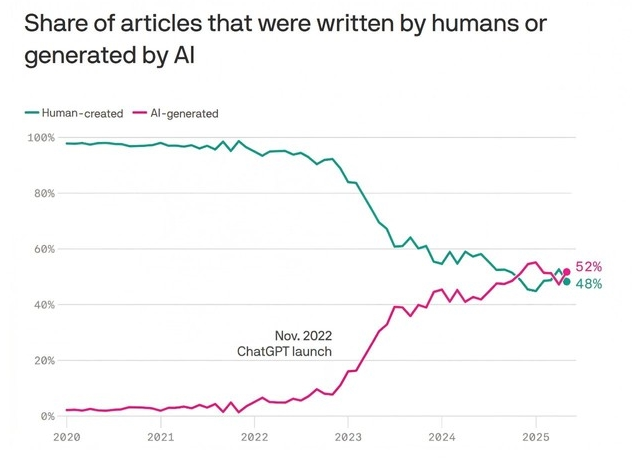
Imagine scrolling through your favorite news site or blog. There's a good chance what you're reading wasn't written by human hands. According to internet research firm Graphite, AI-generated content has officially surpassed human-created material online. Their comprehensive study analyzed 65,000 websites between 2020-2025, revealing a dramatic shift following ChatGPT's 2022 debut.
How We Know It's AI
The study employed Surfer, a sophisticated AI detection tool with an 18-year web data archive. Tracking 3-5 billion updated pages monthly, Surfer can pinpoint AI content with remarkable accuracy. Their benchmark is clear: when human writing comprises less than half an article's content, it gets flagged as machine-generated.
The Hidden Dangers
Industry veterans have long sounded alarms about AI's content dominance. The biggest concern? Large language models risk entering a dangerous feedback loop where they primarily train on their own output. Without fresh human-created material, AI systems might stagnate or even regress, potentially amplifying misinformation problems.
"It's like eating only processed food," explains Dr. Elena Torres, a digital media researcher at Stanford. "When AI feeds mostly on its own content, we lose the nutritional value of original human thought."
Creativity at Risk
The implications extend beyond technology. There's growing evidence that over-reliance on AI writing tools erodes our creative muscles. Just as GPS weakened natural navigation skills, AI assistants may diminish our capacity for independent analysis and original expression.
"We're trading long-term intellectual capital for short-term convenience," warns Dr. James Chen of MIT's Media Lab. "If this trend continues unchecked, we could see a fundamental weakening of human creativity and problem-solving abilities."
What Comes Next?
The report doesn't suggest abandoning AI tools altogether - that ship has sailed. Instead, experts advocate for balanced approaches:
- Maintaining human oversight in content creation
- Investing in creativity education
- Developing ethical guidelines for AI content
- Preserving spaces for purely human expression
As Chen puts it: "The challenge isn't stopping AI, but ensuring it enhances rather than replaces human ingenuity."
Key Points:
- AI dominance: Machine-generated content now exceeds human writing online
- Detection science: Sophisticated tools track AI content across billions of web pages
- Creative erosion: Over-reliance on AI risks dulling human analytical skills
- Quality concerns: Self-referential AI systems may degrade without human input
- Balanced future: Experts call for ethical frameworks to preserve human creativity