Rat Brain Cells Show Surprising Talent for AI Computing
Rat Neurons Learn to Compute Like AI
In what sounds like science fiction, researchers from Japan's Tohoku University and Future University have successfully trained rat brain cells to perform artificial intelligence tasks. The team's innovative approach combines living neurons with cutting-edge technology to create what they call a "closed-loop reservoir computing" system.
How It Works
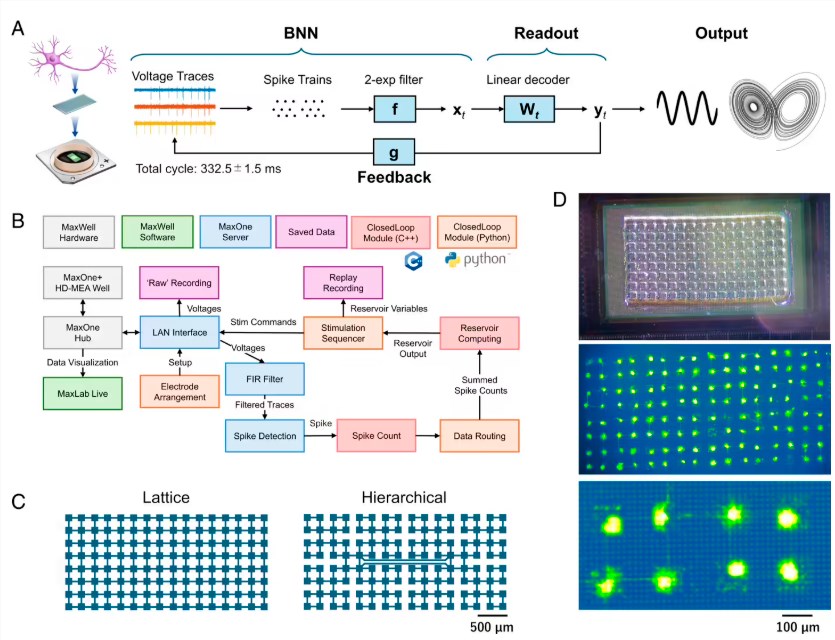
The secret lies in carefully controlling how the neurons connect. Using polydimethylsiloxane (PDMS) microfluidic films, scientists created tiny "apartments" for each neuron cell body, connected by microscopic channels. This setup prevents the cells from forming overly synchronized networks that would be useless for computation.
"Without these physical constraints, the neurons just chatter aimlessly with each other," explains Professor Hidemasa Yamamoto from Tohoku University. "By structuring their connections into grid and hierarchical patterns, we created a system that actually learns."
Impressive Results
The grid network proved particularly adept, generating precise sine, triangle, and square waves of varying durations. Most remarkably, it could approximate the complex three-dimensional patterns of the Lorenz attractor - a classic chaotic system. During testing, the system's predictions matched target signals with over 80% accuracy.
Challenges Ahead
While promising, the technology isn't ready for prime time yet. Researchers noticed performance drops when training stopped, and a 330-millisecond feedback delay limits how quickly the system can adapt to changing signals. The team is now working on specialized hardware to address these issues.
"What excites us most," says Yamamoto, "is that we're discovering living neurons can serve as both biological entities and computational resources. This dual nature opens up incredible possibilities."
Key Points:
- Biological computers: Rat neurons successfully trained to perform AI computations
- Self-learning system: Generates complex waveforms without external input
- Precision engineering: Microfluidic technology controls neural connections
- Future applications: Potential for advanced brain-computer interfaces and prosthetics