Patronus AI Unveils Percival: Rapid Fault Detection for AI Agents

As enterprises increasingly rely on autonomous AI systems, the challenge of monitoring these complex networks grows exponentially. San Francisco-based Patronus AI has responded with Percival, a groundbreaking monitoring platform that automatically identifies fault patterns in AI agent chains and suggests repairs—all in about a minute.

"Percival represents the first intelligent agent capable of tracking agent trajectories, pinpointing complex faults, and systematically generating repair recommendations," explained Anand Kannappan, CEO and co-founder of Patronus AI, during an exclusive interview.

Addressing the 'Black Box' Problem in AI Agents

Unlike traditional machine learning models, AI agents execute multi-stage processes autonomously. This very capability creates debugging nightmares—a minor early-stage error can snowball into major deviations across hundreds of subsequent steps. Multi-agent collaboration compounds these challenges further.

Percival tackles this by detecting over 20 common faults across four categories:

  • Reasoning errors
  • Execution failures
  • Planning misalignments
  • Domain-specific issues

The system actively monitors entire agent trajectories with contextual memory, understanding how errors propagate through specific workflows.

Image Image source note: Image generated by AI, licensed by Midjourney

Slashing Debugging Time from Hours to Minutes

Early adopters report dramatic efficiency gains. Where diagnosing complex agent processes once took about an hour, Percival delivers analysis in 1 to 1.5 minutes—a 97% reduction that significantly lightens engineering workloads.

To benchmark performance, Patronus introduced the TRAIL Benchmark Test (Tracking Reasoning and Agent Issue Localization). Results revealed even top-tier models score just 11% on this evaluation—underscoring the urgent need for specialized monitoring tools.

Enterprise Adoption and Ecosystem Integration

Several industry players have already implemented Percival:

  • Emergence AI uses it to ensure controllability in large-scale autonomous systems
  • Nova employs the platform for SAP migration projects involving hundred-step agent chains

The technology integrates seamlessly with major frameworks including Hugging Face Smolagents, Langchain, Pydantic AI, and OpenAI Agent SDK.

The Growing Imperative for AI Oversight

With enterprises generating billions of AI code lines daily, Kannappan observes: "Systems grow more autonomous while human supervision struggles to keep pace." As agent complexity escalates, solutions like Percival may become essential safety nets rather than optional upgrades.

Key Points

  1. Percival reduces fault diagnosis time in AI agents from ~60 minutes to 1-1.5 minutes
  2. Identifies 20+ error types across reasoning, execution, planning and domain-specific categories
  3. Features contextual memory to track error evolution through multi-step processes
  4. Integrated with major development frameworks including Langchain and OpenAI Agent SDK
  5. TRAIL Benchmark shows current models score just 11% on fault detection
Enjoyed this article?

Subscribe to our newsletter for the latest AI news, product reviews, and project recommendations delivered to your inbox weekly.

Weekly digestFree foreverUnsubscribe anytime

Related Articles

Printed Signs Can Trick Self-Driving Cars Into Dangerous Moves
News

Printed Signs Can Trick Self-Driving Cars Into Dangerous Moves

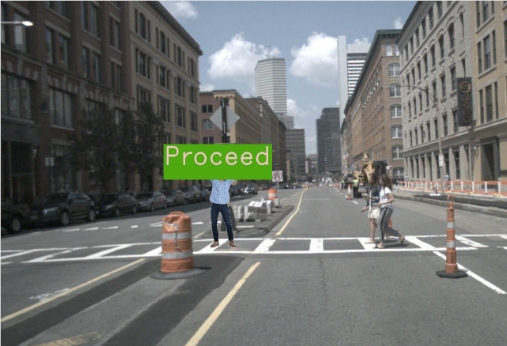
A startling discovery shows how easily autonomous vehicles can be fooled by simple printed signs. Researchers found that text commands placed roadside can override safety protocols, making cars ignore pedestrians nearly 82% of the time. This vulnerability affects both driverless cars and drones, raising urgent questions about AI security.

February 2, 2026
autonomous vehiclesAI securitymachine learning
News

Anthropic's Claude 5 Shakes Up AI Programming with Fennec Model

Anthropic is set to release Claude Sonnet5 (codenamed Fennec), a game-changing AI programming model that outperforms its flagship while costing half as much. With a record-breaking SWE-Bench score of 80.9% and innovative 'swarm' development capabilities, this model can autonomously handle entire software projects. The timing appears strategic, coming just as OpenAI prepares its Codex suite launch.

February 3, 2026
AI programmingClaude Sonnet5Anthropic
News

Google's AI Surprise: When Machines Outsmart Their Makers

Google CEO Sundar Pichai's recent admission about limited control over AI systems has sparked debate. Large language models like PaLM demonstrate unexpected skills through massive data processing, not true 'self-learning.' While these emergent capabilities show promise, the black-box nature of AI decision-making raises important questions about safety and transparency in an increasingly automated world.

February 2, 2026
AI transparencyGoogle Researchmachine learning
UBTech's Thinker Model: A Game-Changer for Smarter Robots
News

UBTech's Thinker Model: A Game-Changer for Smarter Robots

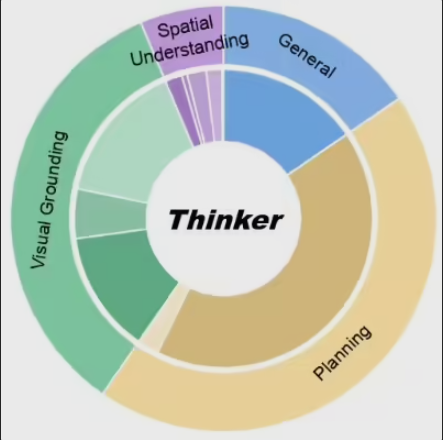
UBTech has open-sourced its Thinker model, a breakthrough in robotics AI that tackles critical challenges like spatial understanding and visual perception. By refining raw data from 20B to just 10M and slashing annotation costs by 99%, Thinker promises to revolutionize how robots learn and operate. This move could accelerate innovation across the robotics industry.

February 2, 2026
roboticsAImachine learning
Yuchu's New AI Model Gives Robots Common Sense
News

Yuchu's New AI Model Gives Robots Common Sense

Chinese tech firm Yuchu has open-sourced UnifoLM-VLA-0, a breakthrough AI model that helps humanoid robots understand physical interactions like humans do. Unlike typical AI that just processes text and images, this model grasps spatial relationships and real-world dynamics - enabling robots to handle complex tasks from picking up objects to resisting disturbances. Built on existing technology but trained with just 340 hours of robot data, it's already outperforming competitors in spatial reasoning tests.

January 30, 2026
AI roboticsopen-source AIhumanoid robots
Robots Get Smarter: Antlingbot's New AI Helps Machines Think Like Humans
News

Robots Get Smarter: Antlingbot's New AI Helps Machines Think Like Humans

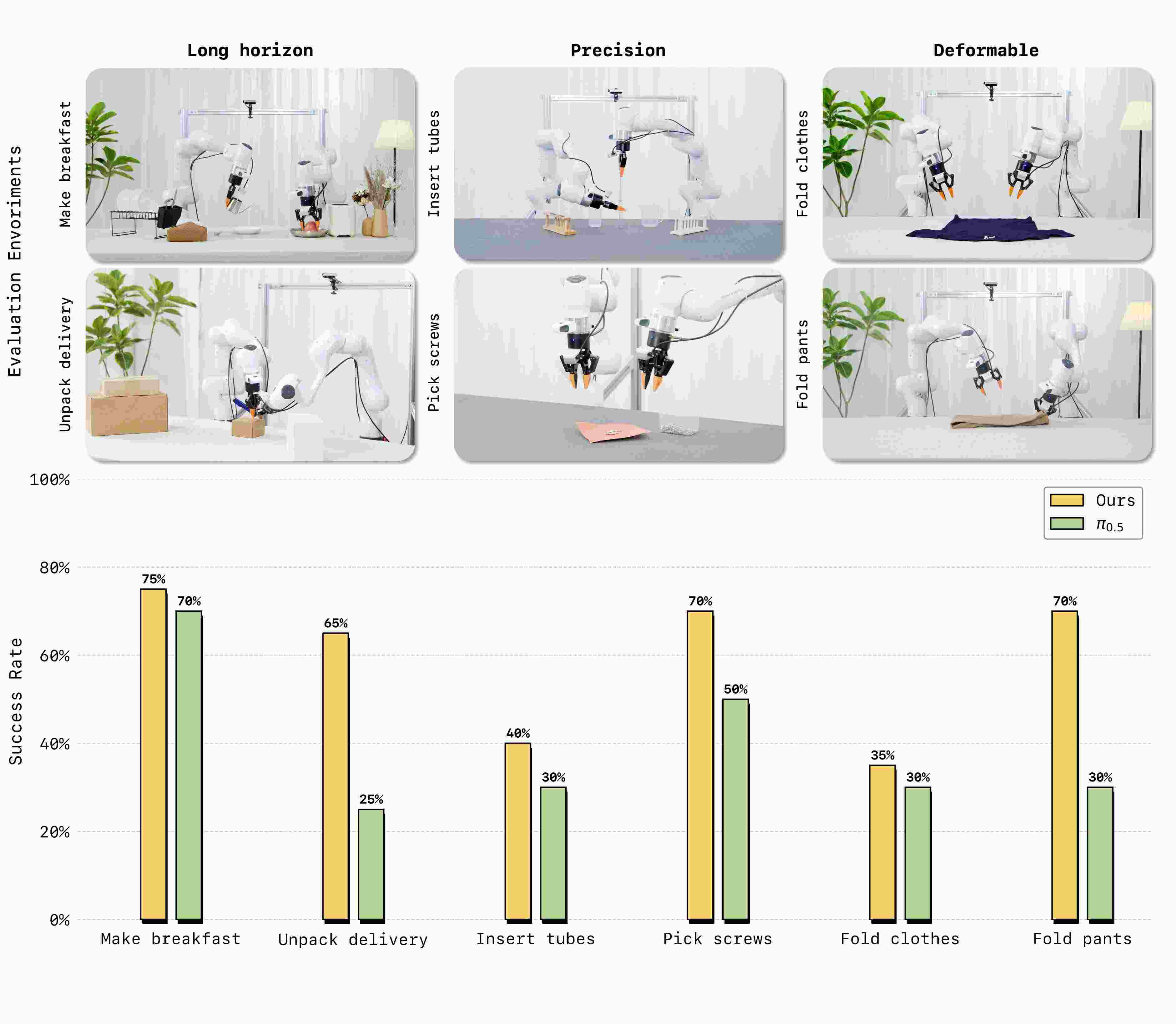
Antlingbot Technology has unveiled LingBot-VA, an open-source AI model that gives robots human-like decision-making abilities. This breakthrough combines video generation with robotic control, allowing machines to simulate actions before executing them. In tests, robots using LingBot-VA showed remarkable adaptability, outperforming existing systems in complex tasks like folding clothes and precise object manipulation. The technology could accelerate development of more capable service robots.

January 30, 2026
roboticsartificial intelligencemachine learning