
NVIDIA Unveils Cosmos Reason to Advance Intelligent Robotics

NVIDIA's Cosmos Reason: A Leap Forward for Robot Intelligence

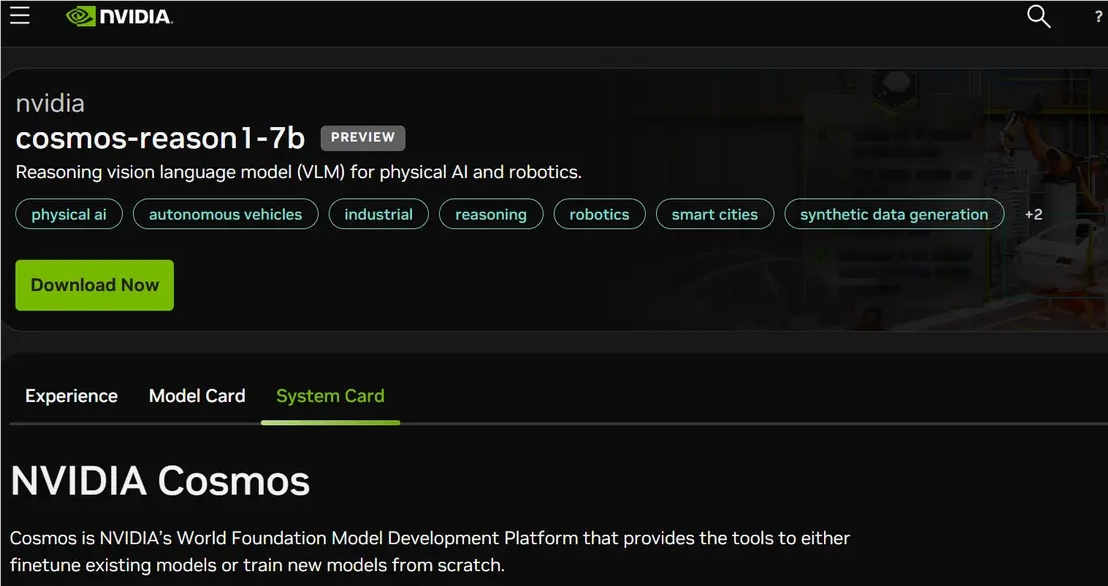
At the SIGGRAPH International Conference on Computer Graphics and Interactive Techniques, NVIDIA showcased groundbreaking technologies for robotics development, headlined by their new open-source physical AI model called Cosmos Reason. With 7 billion parameters, this advanced model significantly improves robots' ability to process visual information and make complex decisions.
Image

Bridging the Gap in Robot Cognition

NVIDIA highlighted that while visual language models like CLIP have revolutionized computer vision tasks such as object recognition, traditional models often falter with multi-step processes or novel real-world situations. Cosmos Reason addresses this limitation through enhanced memory and understanding capabilities, enabling robots to:

  • Perform human-like reasoning
  • Make contextually appropriate decisions
  • Adapt to ambiguous scenarios

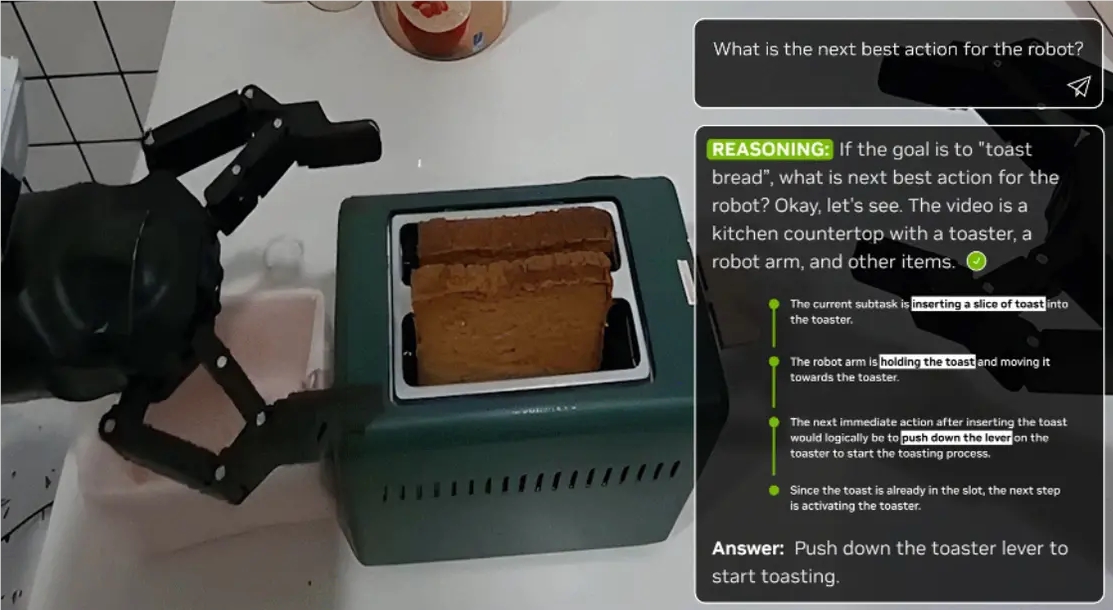
In live demonstrations, a robotic arm running Cosmos Reason successfully identified a "bread + toaster" combination and autonomously decided to place the bread in the toaster—a process NVIDIA calls "robot planning and reasoning."
Image

Expanding Applications Beyond Robotics

The model's potential extends far beyond robotic control systems. Key applications include:

  1. Automated data processing: Organizing and annotating large-scale training datasets
  2. Video analysis: Extracting and analyzing critical information from extensive video footage
  3. Commercial implementations:
    • Uber's autonomous driving data annotation
    • Magna International's automated delivery solutions
    • VAST Data and Milestone Systems' traffic monitoring applications

Enhanced Development Ecosystem

NVIDIA also announced significant updates to its developer tools:

  • Cosmos Transfer-2: Accelerates synthetic data generation for 3D simulations
  • Updated Omniverse SDK: Expanded capabilities for virtual environment creation
  • New neural reconstruction library: Additional resources for AI developers

The company reports that its internal robotics and autonomous driving teams are already utilizing Cosmos Reason for data organization tasks.

Key Points:

  1. 🤖 Advanced Reasoning: Cosmos Reason enables robots to perform complex visual reasoning comparable to human cognition.
  2. 🚗 Commercial Adoption: Major companies are implementing the technology in autonomous vehicles and delivery systems.
  3. 🛠️ Developer Tools: NVIDIA has expanded its ecosystem with new simulation and reconstruction tools.

Enjoyed this article?

Subscribe to our newsletter for the latest AI news, product reviews, and project recommendations delivered to your inbox weekly.

Weekly digestFree foreverUnsubscribe anytime

Related Articles

News

Rili Tech's UEX System Brings AI-Powered Clarity to Industrial X-ray Imaging

Chinese firm Rili Technology has unveiled UEX, a groundbreaking AI system that transforms industrial X-ray imaging. Capable of enhancing 1536×1536 pixel images in just 15 milliseconds, this technology promises to revolutionize quality control in semiconductors, batteries, and automotive manufacturing. The system combines noise reduction, sharpening, and contrast optimization while reducing radiation exposure—a game-changer for production lines demanding both speed and precision.

January 15, 2026
industrial AIX-ray technologyquality control
India's Alpie AI Model Makes Waves - But Is It Truly Homegrown?
News

India's Alpie AI Model Makes Waves - But Is It Truly Homegrown?

A new AI contender from India called Alpie is turning heads with performance that rivals giants like GPT-4o and Claude3.5 in math and coding tests. However, technical analysis reveals it's actually built on a Chinese open-source model, raising questions about innovation versus optimization. What makes Alpie special is its ability to run efficiently on consumer hardware, potentially democratizing AI access for smaller developers.

January 15, 2026
AIMachine LearningIndia Tech
Robots That Learn Like Humans: 1X Unveils Breakthrough AI Model
News

Robots That Learn Like Humans: 1X Unveils Breakthrough AI Model

Robotics startup 1X has introduced its groundbreaking 'World Model' AI system, designed to teach humanoid robots new skills through video observation. Unlike traditional programming, this approach enables robots to continuously evolve their capabilities by analyzing real-world physics and actions. The Neo robot, set for commercial release in 2025, could soon be learning tasks much like humans do - by watching and practicing.

January 14, 2026
roboticsAIlearninghumanoidrobots
News

South Korea secures priority access to NVIDIA's cutting-edge AI chips

At CES 2026, South Korean officials announced NVIDIA's commitment to prioritize delivery of next-generation Vera Rubin GPUs to the country. This strategic move comes as part of a broader partnership that includes supplying up to 260,000 GPUs for South Korea's AI infrastructure development. Officials emphasized how securing advanced chip technology early could give Korean tech firms a crucial edge in global AI competition.

January 13, 2026
NVIDIAArtificial IntelligenceTech Partnerships
MIT's Automated 'Motion Factory' Teaches AI Physical Intuition
News

MIT's Automated 'Motion Factory' Teaches AI Physical Intuition

Researchers from MIT, NVIDIA, and UC Berkeley have cracked a major challenge in video analysis - teaching AI to understand physical motion. Their automated 'FoundationMotion' system generates high-quality training data without human input, helping AI systems grasp concepts like trajectory and timing with surprising accuracy. Early tests show it outperforms much larger models, marking progress toward machines that truly understand how objects move.

January 12, 2026
computer visionAI trainingmotion analysis
News

Motional shifts gears with AI-powered driverless taxis coming to Vegas

After facing setbacks in its autonomous driving ambitions, Motional is pivoting to an AI-first strategy. The Hyundai-Aptiv joint venture plans to launch fully driverless taxis in Las Vegas by 2026, following employee trials later this year. CEO Laura Major reveals how new machine learning approaches aim to make the technology more adaptable and cost-effective.

January 12, 2026
autonomous vehiclesartificial intelligencefuture mobility