
Microsoft's New Open-Source Voice Model Talks Almost as Fast as You Think

Microsoft's Speech Breakthrough: AI That Keeps Up With Conversation

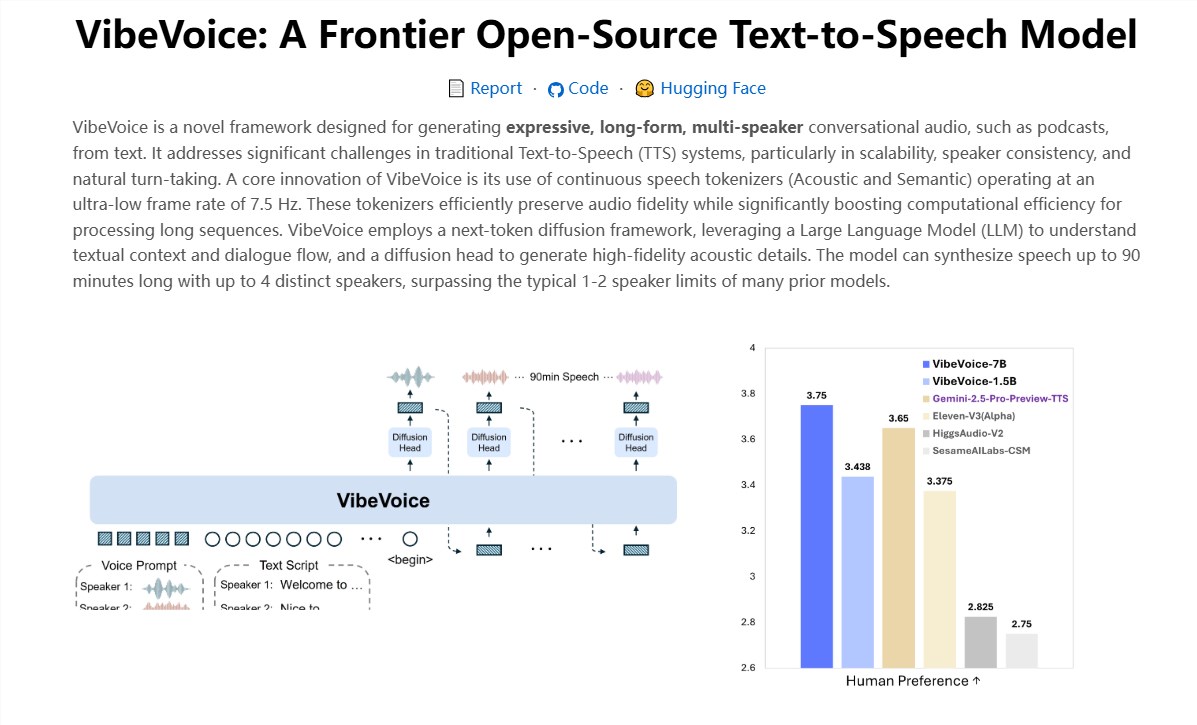
In a move that caught the open-source community off guard, Microsoft recently unveiled VibeVoice-Realtime-0.5B - a text-to-speech model so responsive it feels like talking to a person rather than software. Image
Blink-and-you'll-miss-it speed
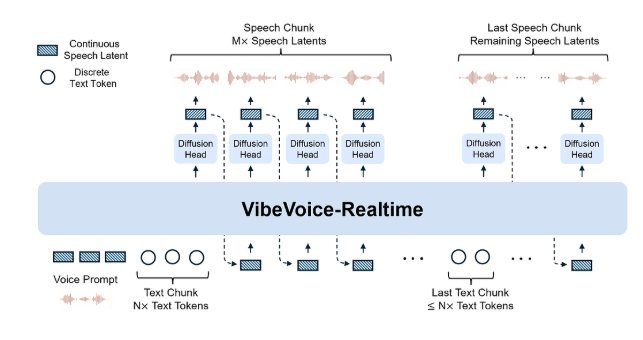
What sets this model apart is its jaw-dropping 300ms response time. To put that in perspective: while traditional TTS systems make you wait 1-3 seconds (enough time to second-guess what you just typed), VibeVoice starts speaking before you've finished your thought. Early testers describe the experience as "uncanny" - like having an ultra-fast reader looking over your shoulder.

Marathon performer
Don't let its compact size fool you (at just 0.5 billion parameters). This workhorse can generate 90 minutes of flawless audio without the robotic stutters or unnatural pauses that plague many voice systems. Community members have already stress-tested it with entire chapters of dense sci-fi novels like "The Three-Body Problem," with the model maintaining perfect composure throughout. Image
Party of four
Where VibeVoice truly shines is its ability to host what amounts to an AI dinner party - seamlessly managing up to four distinct character voices simultaneously. Imagine a podcast where the host remains calm while one guest gets animated, another cracks jokes, and a third occasionally backtracks with apologies. The transitions feel organic, with no confusing voice bleed or emotional whiplash.

Emotional IQ
The model doesn't just read words - it understands context. Encounter "I'm sorry" and it adopts an apologetic tone; see "That's amazing!" and it perks right up. Even subtle cues like "I'm very angry" trigger appropriate vocal changes (lower pitch, quicker delivery) without any manual tagging required.

Room to grow
While its English performance rivals commercial products, the Chinese implementation still struggles slightly with polyphonic characters and light tones. Microsoft has promised a China-optimized version soon.

Surprisingly portable
Despite its capabilities, VibeVoice runs happily on modest hardware - consuming under 2GB of VRAM and operating in real-time on standard laptops. Developers are already embedding it in everything from local AI assistants to real-time translation apps.

Available now on HuggingFace and GitHub under MIT license (meaning free for commercial use), this could become the go-to voice for offline applications. Some creative users have already married it with large language models for true end-to-end conversations, while others built "type-and-speak" tools for messaging apps.

Key Points:

  • Lightning response: 300ms latency makes conversations feel natural
  • Long-haul champion: Flawless 90-minute readings without fatigue
  • Social butterfly: Manages four distinct voices simultaneously
  • Emotionally intelligent: Detects and expresses text sentiment automatically
  • Device-friendly: Runs on laptops and edge devices with minimal resources

Enjoyed this article?

Subscribe to our newsletter for the latest AI news, product reviews, and project recommendations delivered to your inbox weekly.

Weekly digestFree foreverUnsubscribe anytime

Related Articles

OpenClaw Hits 280K Stars with Major AI Agent Upgrade
News

OpenClaw Hits 280K Stars with Major AI Agent Upgrade

The open-source AI agent platform OpenClaw just rolled out its biggest update yet, now fully supporting GPT-5.4 and introducing game-changing features like memory hot swapping. With over 280,000 GitHub stars, the project is evolving from experimental framework to production-ready 'agent OS.' Developers can now create smarter, more persistent AI assistants that remember conversations and work seamlessly across platforms.

March 9, 2026
AI AgentsOpen SourceGPT-5
NVIDIA's Jensen Huang Calls OpenClaw the Defining Software of Our Time
News

NVIDIA's Jensen Huang Calls OpenClaw the Defining Software of Our Time

At the Morgan Stanley conference, NVIDIA CEO Jensen Huang made waves by declaring OpenClaw the most significant software release today. The open-source project achieved in three weeks what took Linux three decades - becoming history's most downloaded open-source software. Huang outlined his 'five-layer cake' theory of AI infrastructure and explained how agentic AI like OpenClaw creates unprecedented computing demands.

March 6, 2026
Artificial IntelligenceTech InnovationOpen Source
News

Microsoft's Bing Video Creator Gets Major Upgrade with Sora 2 and Sound

Microsoft has supercharged its Bing Video Creator tool by integrating OpenAI's advanced Sora 2 model, bringing dramatic improvements to AI-generated videos. The free service now produces more realistic visuals with better scene coherence and - for the first time - automatically generates matching soundtracks. While keeping its generous free tier, Microsoft has added safeguards like watermarks and digital credentials to identify AI content.

March 6, 2026
AI videoMicrosoftOpenAI Sora
News

Windows 12 Arrives Late 2026: AI Takes Center Stage in Modular Makeover

Microsoft's Windows 12 is set to debut late next year with groundbreaking changes. The new OS embraces modular design through CorePC architecture, allowing customized installations for different devices. AI becomes deeply integrated as Copilot evolves from assistant to system core, while hardware requirements jump with mandatory NPU chips - potentially leaving older PCs behind.

March 4, 2026
Windows12AIcomputingMicrosoft
News

Microsoft's AI Push Sparks 'Microslop' Backlash as Community Censors Criticism

Microsoft faces growing user frustration over its aggressive integration of AI features into Windows 11, with critics dubbing the company 'Microslop' - a blend of Microsoft and 'slop' referring to poor-quality content. The tech giant's attempt to ban the term in its official Discord community backfired spectacularly, leading to creative workarounds from users and ultimately forcing Microsoft to silence entire channels. While Microsoft claims these measures address spam attacks, many see it as avoiding deeper concerns about system stability versus flashy AI features.

March 4, 2026
MicrosoftAIbacklashWindows11
OpenAI's Stealth Move: Building a GitHub Rival That Could Shake Up Coding
News

OpenAI's Stealth Move: Building a GitHub Rival That Could Shake Up Coding

OpenAI is quietly developing its own code hosting platform, potentially setting up a clash with Microsoft-owned GitHub. The project, still in early stages, stems from frustration with GitHub's reliability issues. What makes this intriguing? Microsoft is OpenAI's biggest investor, turning this into a delicate dance between partners and competitors. The new platform could integrate AI coding tools like Codex, offering smarter automation than traditional repositories.

March 4, 2026
OpenAIGitHubMicrosoft