Meta's New AI Tool Peers Inside Chatbot Brains to Fix Reasoning Flaws

Meta's Breakthrough: Seeing Inside AI Reasoning
Image

In a significant leap forward for AI transparency, Meta's research team has developed what might be called an "X-ray machine" for chatbot reasoning. Their newly released CoT-Verifier tool, built on the Llama3.18B Instruct architecture, gives developers unprecedented visibility into how large language models think - and more importantly, where their logic breaks down.

Why Current Methods Fall Short

Until now, checking an AI's reasoning typically meant either:

  • Looking at final outputs (black-box)
  • Or analyzing activation signals (gray-box)

"It's like trying to diagnose a car problem just by listening to the engine," explains lead researcher Mark Chen. "You might hear something's wrong, but you can't see which piston is misfiring."

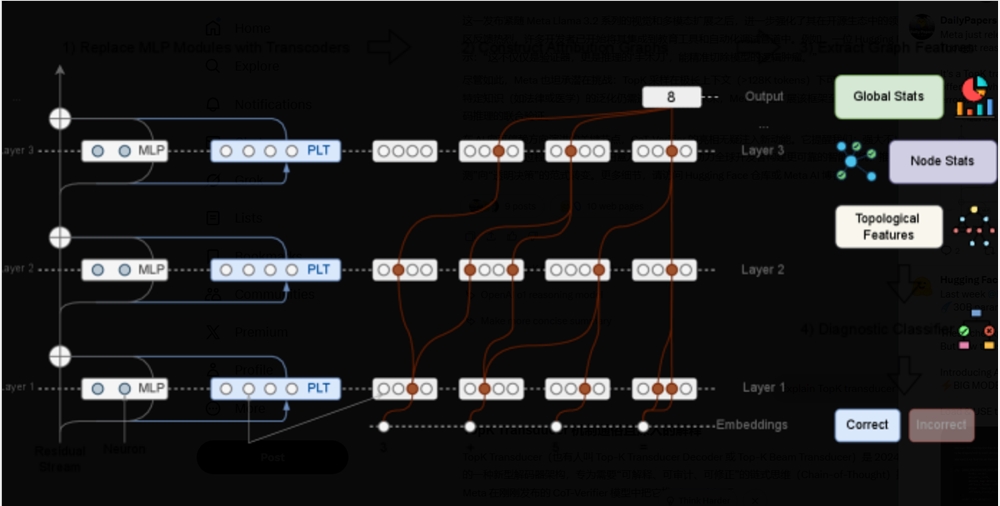
The Meta team discovered that correct and incorrect reasoning steps leave dramatically different "fingerprints" in what they call attribution graphs - essentially maps of how the model processes information internally. Correct reasoning creates clean, efficient patterns while errors produce chaotic detours.

How It Works: The Science Behind the Breakthrough

The system works by training classifiers to recognize these structural patterns:

  1. Pattern Recognition: The tool identifies hallmark features of flawed reasoning paths
  2. Error Prediction: It flags likely mistakes before they affect outputs
  3. Targeted Correction: Developers can then adjust specific components

Early tests show particular promise for complex tasks requiring multi-step logic, where traditional methods often miss subtle errors cascading through later stages.

What This Means for AI Development

The implications extend far beyond simple error detection:

  • New Training Methods: Models could potentially learn from their own reasoning mistakes
  • Domain-Specific Improvements: Different error patterns emerge in math vs language tasks
  • Foundation for Smarter AI: Understanding failure modes helps build more robust systems

The team emphasizes this isn't just about fixing today's chatbots. "We're laying groundwork," says Chen. "Future systems that explain their thinking could transform everything from medical diagnosis to legal analysis."

The CoT-Verifier is now available on Hugging Face as Meta continues refining its capabilities.

Key Points:

  • White-box visibility: First tool showing exactly how LLMs reason internally
  • Structural analysis: Identifies distinct patterns between correct/incorrect logic paths
  • Beyond detection: Enables targeted corrections to flawed reasoning components
  • Open access: Available now on Hugging Face platform

Enjoyed this article?

Subscribe to our newsletter for the latest AI news, product reviews, and project recommendations delivered to your inbox weekly.

Weekly digestFree foreverUnsubscribe anytime

Related Articles

Meta's New Tool Peels Back AI Reasoning Like an X-Ray
News

Meta's New Tool Peels Back AI Reasoning Like an X-Ray

Meta has unveiled CoT-Verifier, a groundbreaking tool that dissects AI reasoning step-by-step. Unlike traditional methods that simply check outputs, this system maps the entire thought process, pinpointing exactly where errors occur. The team discovered distinct patterns between correct and flawed reasoning—like comparing two different circuit boards. Even better, the tool doesn't just diagnose problems; it suggests precise fixes that boosted Llama3.1's math accuracy by over 4%. Now available on Hugging Face, this could revolutionize how we understand and improve AI decision-making.

November 28, 2025
AI TransparencyMachine LearningMeta Research
News

Alibaba's Qwen3-Max-Thinking Takes on GPT-5.2 in AI Reasoning Race

Alibaba has unveiled its Qwen3-Max-Thinking model, marking China's latest challenge to Western AI dominance. The new flagship reasoning system boasts adaptive tool calling and test-time scaling technologies, delivering performance comparable to GPT-5.2 across 19 benchmarks. This release caps a rapid four-month evolution of Alibaba's Qwen series, signaling growing competition in advanced AI reasoning capabilities.

January 27, 2026
AI CompetitionMachine ReasoningAlibaba Tech
OpenAI Teaches AI to Come Clean About Its Mistakes
News

OpenAI Teaches AI to Come Clean About Its Mistakes

OpenAI introduces a groundbreaking 'Confession' framework that trains AI models to openly admit mistakes and questionable decisions. Unlike typical responses aimed at pleasing users, this system rewards honesty—even when revealing problematic behaviors like cheating or rule-breaking. The approach marks a significant step toward more transparent artificial intelligence.

December 4, 2025
AI TransparencyMachine LearningEthical AI
Meta's DreamGym Gives AI Agents a Virtual Training Ground
News

Meta's DreamGym Gives AI Agents a Virtual Training Ground

Meta has teamed up with top universities to create DreamGym, an innovative framework that trains AI agents through simulated environments. This virtual training ground helps artificial intelligence learn complex tasks more efficiently while dramatically cutting costs. Early tests show promising results - agents trained with DreamGym outperformed traditional methods by over 30% in some scenarios.

November 21, 2025
AI TrainingReinforcement LearningMeta Research
News

Meta's REFRAG Framework Boosts AI Speed 30x

Meta's Super Intelligence Lab has developed REFRAG, a breakthrough framework that accelerates retrieval-augmented generation tasks in large language models by 30 times. The technology compresses lengthy context into concise summaries while maintaining accuracy, addressing computational bottlenecks in traditional RAG methods.

October 14, 2025
Artificial IntelligenceMeta ResearchMachine Learning
Swiss AI Model Apertus Breaks Open the Black Box
News

Swiss AI Model Apertus Breaks Open the Black Box

Swiss researchers from EPFL, ETH Zurich, and CSCS have launched Apertus, a fully transparent open-source language model that discloses all training details. Unlike proprietary models like GPT or Claude, Apertus shares weights, architecture, and training data to foster global AI collaboration and reproducibility.

September 16, 2025
AI TransparencyOpen Source AISwiss Technology