Meta's DreamGym Gives AI Agents a Virtual Training Ground

Meta's New Virtual Gym Trains Smarter AI Agents

Imagine trying to teach someone basketball by only letting them play in championship games. That's essentially how we've been training many AI systems - throwing them into complex real-world scenarios with little preparation. Meta aims to change this with DreamGym, a groundbreaking framework developed alongside researchers from the University of Chicago and UC Berkeley.
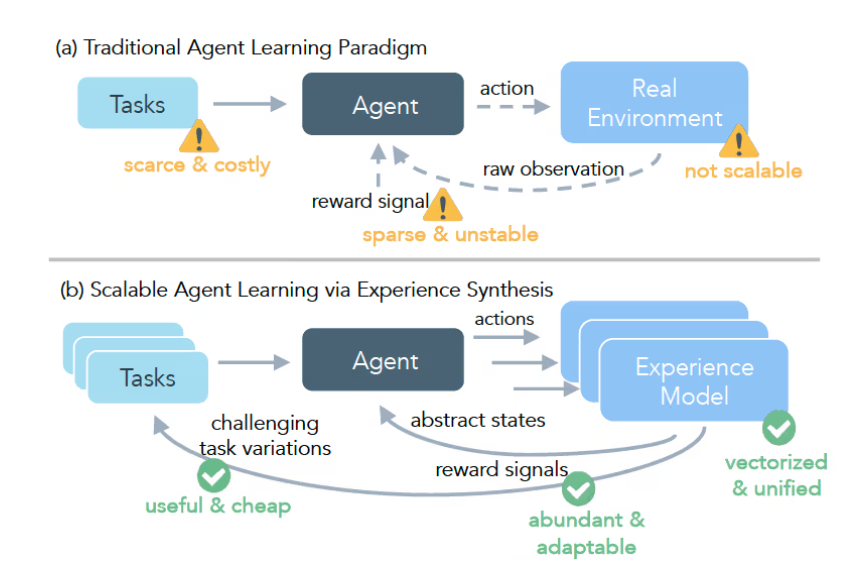
Image

Why Traditional Training Falls Short

Training large language model agents through reinforcement learning faces significant hurdles:

  • Costly mistakes: Real-world training often requires expensive hardware and creates risks
  • Sparse feedback: Like getting only one grade at semester's end instead of regular quizzes
  • Expert dependence: Human oversight drives up costs and slows progress

DreamGym tackles these challenges head-on by creating sophisticated virtual training environments where AI can safely learn from mistakes.

How DreamGym Works Its Magic

The framework operates like a personal trainer for AI agents:

  1. Virtual playground: The "reasoning-based experience model" converts real environments into text simulations
  2. Memory bank: An "experience replay buffer" stores lessons learned to guide future decisions
  3. Adaptive challenges: The "curriculum task generator" constantly adjusts difficulty based on performance

Together, these components create a virtuous cycle of learning where agents progressively tackle harder problems.

Real-World Results That Impress

The research team put DreamGym through rigorous testing across multiple domains:

  • E-commerce platforms
  • Sensory control systems
  • Actual web interactions

The standout success came in WebArena environments, where DreamGym-trained agents achieved success rates more than 30% higher than conventional methods. Perhaps most remarkably, the system matched the performance of popular algorithms while relying solely on synthetic interactions - potentially saving millions in data collection costs.

Key Points:

  • 🏋️‍♂️ Virtual training ground: DreamGym creates safe simulations for AI learning
  • 📈 Adaptive difficulty: Tasks automatically scale to challenge growing skills
  • 💰 Cost effective: Reduces need for expensive real-world trials
  • 🏆 Proven results: Outperforms traditional methods across multiple benchmarks

Enjoyed this article?

Subscribe to our newsletter for the latest AI news, product reviews, and project recommendations delivered to your inbox weekly.

Weekly digestFree foreverUnsubscribe anytime

Related Articles

News

Tencent's AI Push Gains Momentum as Top Scientist Tianyu Peng Joins Hunyuan Team

Tencent has made another strategic hire in its AI talent race, bringing on Tianyu Peng as Chief Research Scientist for its Hunyuan multimodal team. The Tsinghua PhD and former Sea AI Lab researcher will focus on advancing reinforcement learning capabilities within Tencent's flagship AI model. This move signals Tencent's continued commitment to competing at the forefront of multimodal AI development.

February 3, 2026
TencentAI ResearchReinforcement Learning
Ant LingBot's New World Model Brings AI Training to Life
News

Ant LingBot's New World Model Brings AI Training to Life

The Ant Lingbo team has unveiled LingBot-World, an open-source interactive model that creates realistic digital environments for AI training. This breakthrough allows robots and autonomous systems to learn through virtual trial-and-error before facing real-world challenges. With features like 10-minute memory retention and real-time interaction at 16FPS, it's like giving AI a playground where the physics actually make sense.

January 29, 2026
AI TrainingRoboticsSimulation Technology
Meta's New Tool Peels Back AI Reasoning Like an X-Ray
News

Meta's New Tool Peels Back AI Reasoning Like an X-Ray

Meta has unveiled CoT-Verifier, a groundbreaking tool that dissects AI reasoning step-by-step. Unlike traditional methods that simply check outputs, this system maps the entire thought process, pinpointing exactly where errors occur. The team discovered distinct patterns between correct and flawed reasoning—like comparing two different circuit boards. Even better, the tool doesn't just diagnose problems; it suggests precise fixes that boosted Llama3.1's math accuracy by over 4%. Now available on Hugging Face, this could revolutionize how we understand and improve AI decision-making.

November 28, 2025
AI TransparencyMachine LearningMeta Research
Meta's New AI Tool Peers Inside Chatbot Brains to Fix Reasoning Flaws
News

Meta's New AI Tool Peers Inside Chatbot Brains to Fix Reasoning Flaws

Meta AI Lab has unveiled a groundbreaking tool that lets developers peer inside AI reasoning processes like never before. Built on Llama3 technology, their CoT-Verifier identifies exactly where chatbots go wrong in their chain of thought - and suggests fixes. Unlike traditional black-box methods, this white-box approach analyzes the structural differences between correct and incorrect reasoning paths, offering new ways to improve AI logic.

November 28, 2025
AI TransparencyMeta ResearchMachine Reasoning
Tesla's Secret Lab Uses Human Data to Train Optimus Robots
News

Tesla's Secret Lab Uses Human Data to Train Optimus Robots

Tesla's Palo Alto lab employs 'data collectors' wearing camera-equipped helmets to record human movements for training its Optimus robots. Despite Musk's ambitious goal of producing 5,000 units by year-end, demonstrations reveal sluggish performance, often relying on remote control.

November 5, 2025
TeslaOptimusRobotics
Microsoft Unveils Agent Lightning: AI Framework for LLM Training
News

Microsoft Unveils Agent Lightning: AI Framework for LLM Training

Microsoft has introduced Agent Lightning, an open-source reinforcement learning framework designed to enhance large language model performance. The system captures agent behavior without altering existing architectures, streamlining training processes for tasks like text-to-SQL and math QA.

October 30, 2025
AI FrameworksReinforcement LearningLarge Language Models