ManimML: AI Animation Tool Simplifies Transformer Visualization

ManimML: Bridging the Gap in AI Visualization

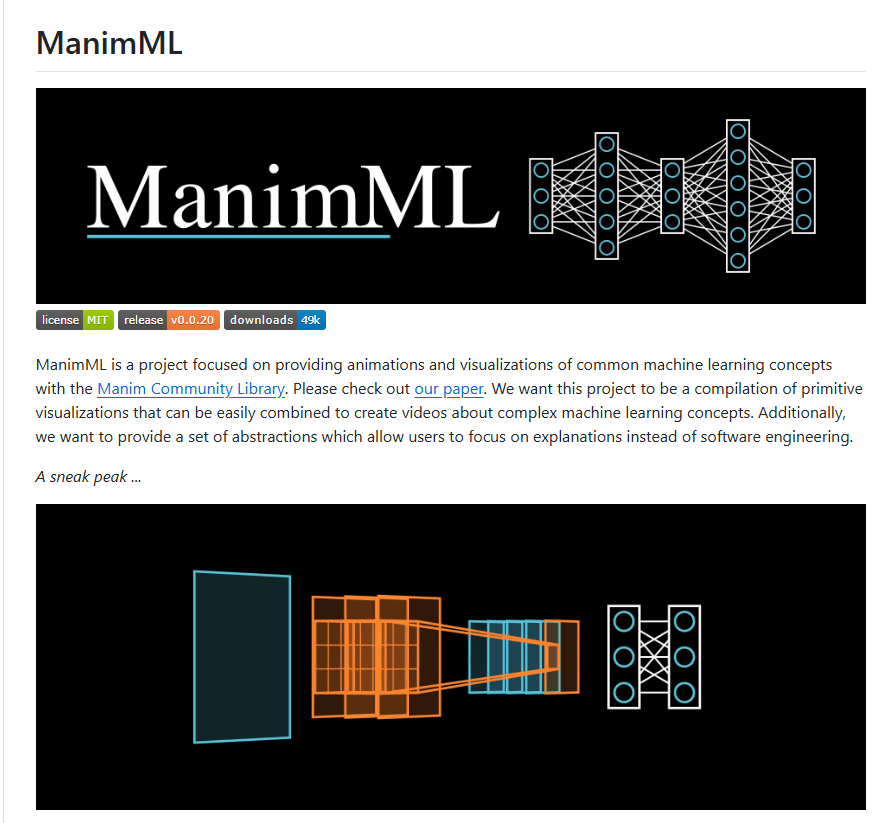
With artificial intelligence advancing rapidly, explaining complex models like the Transformer architecture has become a critical challenge. ManimML, an open-source animation library built on Python, is addressing this issue by turning abstract machine learning concepts into dynamic visualizations.

A New Standard for Technical Communication

Developed as an extension of the Manim community edition, ManimML specializes in creating animations for neural network architectures. Its capabilities extend beyond static diagrams—it produces interactive teaching materials that show algorithms in action. This approach has proven particularly valuable for illustrating:

  • Transformer models
  • Convolutional Neural Networks (CNNs)
  • Forward/backward propagation processes
Image

Intuitive Design for Maximum Impact

The library's breakthrough lies in its user-friendly interface modeled after popular deep learning frameworks like PyTorch. Developers can generate professional animations with just a few lines of code:

# Sample ManimML code for Transformer visualization
transformer = NeuralNetwork([
    InputLayer(),
    AttentionLayer(),
    OutputLayer()
])
transformer.animate_forward_pass()

Remarkably, users can even generate custom animations by simply providing a GitHub repository link and natural language descriptions to the AI-powered system.

Industry Adoption and Recognition

Since its launch, ManimML has achieved significant milestones:

  • 1,300+ GitHub stars
  • 23,000+ PyPi downloads
  • Hundreds of thousands of social media views for demo videos The tool received the Best Poster Award at IEEE VIS2023, cementing its reputation in the visualization community. Academics increasingly incorporate ManimML-generated content into research papers and conference presentations.

Transforming AI Education

The implications for education are profound:

  1. University lecturers use it to demonstrate algorithms dynamically
  2. Online course creators enhance engagement with animated examples
  3. Technical writers simplify complex concepts for broader audiences As the open-source community continues to expand ManimML's capabilities, it's poised to become an essential tool in democratizing AI understanding.

Key Points:

  • Visualization breakthrough: Makes complex AI architectures accessible through animation
  • Low barrier to entry: Python syntax familiar to ML practitioners reduces learning curve
  • Proven adoption: Strong traction in both academic and developer communities
  • Educational potential: Set to revolutionize how AI concepts are taught at all levels

Enjoyed this article?

Subscribe to our newsletter for the latest AI news, product reviews, and project recommendations delivered to your inbox weekly.

Weekly digestFree foreverUnsubscribe anytime

Related Articles

News

Tencent Unveils SkillHub: A Game-Changer for China's AI Developers

Tencent has launched SkillHub, a specialized AI community tailored for Chinese developers. With over 13,000 AI skills readily available, this platform tackles common pain points like slow downloads and language barriers. It's not just about quantity—SkillHub offers curated rankings and full Chinese support to streamline development. As Tencent integrates these tools into popular apps like Tencent Docs, they're betting big on making AI more accessible nationwide.

March 12, 2026
AI DevelopmentTencentChinese Tech
Xie Saining's Team Unveils Solaris: A Breakthrough in Multi-User Video AI
News

Xie Saining's Team Unveils Solaris: A Breakthrough in Multi-User Video AI

Xie Saining's research team has launched Solaris, the world's first multi-user video world model, powered by Kunlun Wanzhi's Matrix-Game2.0. This innovative technology enhances player interaction in environments like Minecraft, outperforming previous solutions. The release coincides with a major funding milestone for Xie's AI company, AMI, highlighting the growing importance of world models in advancing artificial general intelligence.

March 11, 2026
AIMachine LearningVirtual Worlds
News

AI Pioneer Yann LeCun Secures $1 Billion for His Next Big Bet

Yann LeCun, the Turing Award-winning AI researcher, has raised over $1 billion for his new venture Advanced Machine Intelligence. The startup aims to move beyond today's language models by developing systems that can truly reason and understand the physical world. With backing from major investors, LeCun's company could reshape industries from robotics to healthcare.

March 10, 2026
Artificial IntelligenceTech StartupsMachine Learning
OpenClaw's Game-Changing Update: GPT-5.4 Support and Smarter AI Agents
News

OpenClaw's Game-Changing Update: GPT-5.4 Support and Smarter AI Agents

The open-source AI project OpenClaw just dropped its biggest update yet, bringing native GPT-5.4 support that outperforms competitors like Claude Code. The 2026.3.7 version introduces revolutionary 'memory hot-swapping' technology, solving long-standing fragmentation issues in smart agents. From coding to stock analysis, this update transforms OpenClaw from a developer's toy into a true virtual employee that never stops working.

March 9, 2026
AI DevelopmentOpenClawGPT-5
News

Mac Mini's Hidden Power: How Engineers Unlocked AI Training on Apple's M4 Chip

In a surprising breakthrough, engineers have cracked open Apple's Neural Engine capabilities, revealing that Mac Minis can do far more than just run apps. By reverse-engineering the M4 chip with Claude AI's help, researchers discovered these compact machines can efficiently train AI models - challenging the need for expensive GPU setups. The findings show energy efficiency up to 80 times better than professional-grade hardware, potentially democratizing AI development.

March 9, 2026
Apple SiliconAI HardwareMachine Learning
Google's Gemini 3.1 Flash-Lite: Faster, Smarter, But Pricier
News

Google's Gemini 3.1 Flash-Lite: Faster, Smarter, But Pricier

Google DeepMind unveils Gemini 3.1 Flash-Lite, boasting impressive speed and intelligence gains over its predecessor. While processing over 360 tokens per second with quick response times, the model shines in complex tasks like scientific reasoning. However, these improvements come at a cost - pricing has nearly tripled, signaling a shift in the AI market towards premium performance.

March 4, 2026
AI DevelopmentGoogle DeepMindMachine Learning