
HKU and Meituan Boost AI Math Skills with CodePlot-CoT

HKU and Meituan Breakthrough: AI Solves Math Problems Through Code Visualization

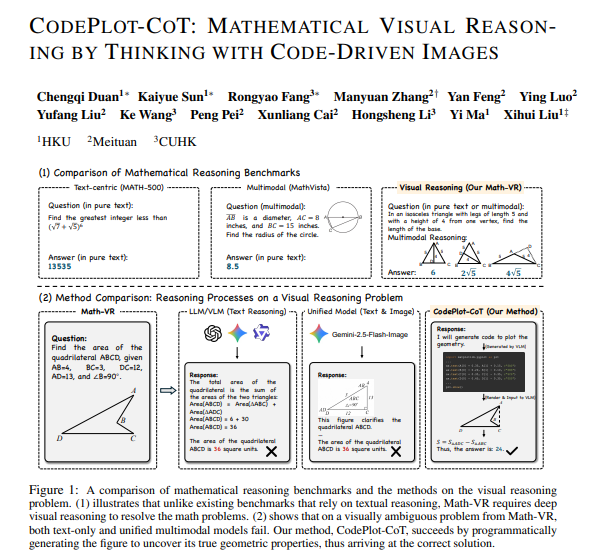
Large language models have historically struggled with mathematical geometry problems, despite excelling in text-based tasks. A new collaborative study from the University of Hong Kong (HKU) and Meituan presents CodePlot-CoT, an innovative solution that bridges this gap through code-driven visual reasoning.

The Core Challenge

Traditional AI models like GPT-4.1 and Gemini-2.5-Pro falter when faced with problems requiring geometric visualization or function graphing. While proficient in textual reasoning chains, these models lack the precision needed for mathematical graphics where angles, ratios, and positions must adhere to strict geometric constraints.
Image

The CodePlot-CoT Solution

The research team developed a paradigm shift:

  1. Code Generation: Instead of attempting direct image creation, the model writes executable plotting code (e.g., Python's Matplotlib)
  2. Precise Rendering: The code executes in a Python environment to generate accurate diagrams
  3. Integrated Reasoning: The model incorporates these code-generated visuals back into its problem-solving chain

This approach leverages AI's existing programming strengths while avoiding unreliable pixel-level image generation.

Key Technical Components

The project introduced two critical innovations:

  1. Math-VR Dataset: A comprehensive collection of 178,000 bilingual math problems (81% geometry-focused) requiring active drawing alongside reasoning
  2. MatplotCode Converter: A specialized tool converting mathematical figures into precise plotting code, outperforming commercial models in fidelity tests

Image

Performance Breakthroughs

The results demonstrate significant improvements:

  • 21% performance boost on Math-VR benchmark compared to base models
  • Even advanced closed-source models like Gemini-2.5-Pro still fail on one-third of test problems without this approach The findings suggest that scaling model size alone cannot solve visual math reasoning - precise code-driven methods are essential.

Implications for AI Development

The success of CodePlot-CoT suggests:

  • Future multimodal systems should prioritize programmatic precision over human-like visualization
  • Applications extend beyond mathematics to engineering design and scientific computing where accuracy is paramount The team has open-sourced all datasets, code, and pre-trained models to accelerate further research.

Key Points:

  • Traditional AI struggles with geometric precision in math problems
  • CodePlot-CoT replaces unreliable image generation with executable plotting code
  • New Math-VR dataset requires active drawing alongside problem-solving
  • Method delivers 21% performance improvement over conventional approaches
  • Open-source release enables broader adoption across AI community
Enjoyed this article?

Subscribe to our newsletter for the latest AI news, product reviews, and project recommendations delivered to your inbox weekly.

Weekly digestFree foreverUnsubscribe anytime

Related Articles

News

DeepSeek Finds Smarter AI Doesn't Need Bigger Brains

DeepSeek's latest research reveals a breakthrough in AI development - optimizing neural network architecture can boost reasoning abilities more effectively than simply scaling up model size. Their innovative 'Manifold-Constrained Hyper-Connections' approach improved complex reasoning accuracy by over 7% while adding minimal training costs, challenging the industry's obsession with ever-larger models.

January 4, 2026
AI ResearchMachine LearningNeural Networks
News

Meta's AI Shakeup: LeCun Questions New Leader's Credentials

AI pioneer Yann LeCun didn't mince words about Meta's new AI chief Alexandr Wang, calling him inexperienced in research leadership. The criticism comes as Zuckerberg reshuffles Meta's AI team following disappointing performance. LeCun reveals deep divisions over Meta's AI direction while launching his own venture focused on alternative approaches.

January 4, 2026
MetaArtificial IntelligenceTech Leadership
GPT-5 Makes Math History With First Independent Proof
News

GPT-5 Makes Math History With First Independent Proof

In a landmark moment for AI research, GPT-5 has independently solved a complex mathematical problem without human guidance. Swiss mathematician Johannes Schmitt revealed the breakthrough, noting the AI employed creative techniques from unexpected areas of algebraic geometry. The achievement validates predictions by mathematician Terence Tao while sparking debates about AI's role in academic research and the need for new attribution standards in scientific publishing.

December 23, 2025
AI ResearchMathematicsMachine Learning
Claude Opus4.5 Shatters AI Endurance Records
News

Claude Opus4.5 Shatters AI Endurance Records

Anthropic's flagship AI model Claude Opus4.5 has set a new benchmark in long-duration task processing, maintaining effectiveness for nearly 5 hours on complex challenges. While the achievement marks progress toward AI that can handle extended projects, experts caution about limitations in the testing methodology.

December 22, 2025
AI ResearchMachine LearningArtificial Intelligence
News

Twitter Spat Sparks Breakthrough: Xie's Team Unveils Game-Changing AI Tool

What began as a heated Twitter debate about self-supervised learning models has blossomed into a significant academic breakthrough. Xie Saining's team transformed online discussions into iREPA - an innovative framework that boosts generative AI performance with just three lines of code. Their research overturns conventional wisdom, showing spatial structure matters more than global semantics for image generation quality.

December 17, 2025
AI ResearchComputer VisionMachine Learning
News

When More AI Agents Don't Mean Better Results

A groundbreaking study from Google and MIT turns conventional wisdom on its head - adding more AI agents doesn't always boost performance. While parallel tasks like financial analysis saw 81% improvements, sequential processes like Minecraft planning suffered up to 70% drops. The research reveals surprising thresholds where coordination costs outweigh benefits, challenging how we design multi-agent systems.

December 15, 2025
AI ResearchMulti-Agent SystemsMachine Learning