DeepSeek's Memory Boost: How AI Models Are Getting Smarter

DeepSeek's Breakthrough Makes AI More Efficient
Image

Imagine an assistant who keeps forgetting simple facts and has to look them up repeatedly - that's essentially how today's AI models operate. DeepSeek's new Engram module changes this by giving artificial intelligence something resembling human memory.

Solving AI's Forgetfulness Problem

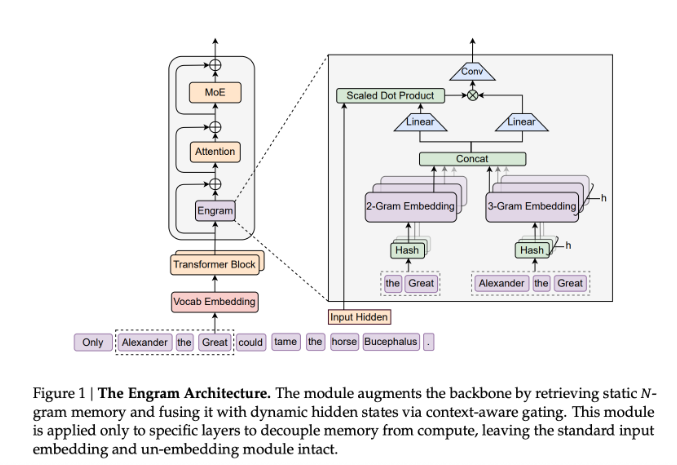
Traditional Transformer models waste energy recomputing the same information over and over. "It's like rebuilding your grocery list from scratch every time you go to the store," explains one researcher familiar with the project. The Engram module solves this by creating specialized memory lanes for frequently used knowledge.

Unlike similar systems that try to replace existing architectures, Engram works alongside them. It modernizes old N-gram techniques into a scalable lookup system that operates at lightning speed - retrieving information in constant time (O(1) complexity for tech-savvy readers).

Real-World Performance Gains

The DeepSeek team put Engram through rigorous testing using massive datasets containing 262 billion tokens. The results turned heads:

  • Models dedicating 20-25% of their capacity to Engram showed significantly improved accuracy
  • Both the 27-billion and 40-billion parameter versions outperformed conventional models across various benchmarks
  • The system excelled particularly in mathematics, coding tasks, and general knowledge tests

The innovation shines brightest when handling long documents. With context windows stretching to 32,768 tokens (about 50 pages of text), Engram-equipped models maintained impressive accuracy in finding specific information - like locating needles in digital haystacks.

Why This Matters Beyond Benchmarks

What makes Engram special isn't just better test scores. By offloading routine memory tasks, the system effectively gives AI models deeper thinking capacity without requiring more computing power. It's akin to freeing up mental RAM so the system can tackle tougher problems.

The technology could lead to:

  • More responsive chatbots that remember your preferences
  • Faster research assistants capable of handling lengthy documents
  • Reduced energy consumption for AI services

The DeepSeek team continues refining Engram, but early results suggest we're witnessing an important step toward more efficient artificial intelligence.

Key Points:

  • Memory Upgrade: Engram creates specialized pathways for storing common knowledge while preserving reasoning capacity
  • Better Performance: Tested models showed improvements in mathematics (GSM8K), general knowledge (MMLU), and coding tasks
  • Long Document Mastery: The system maintains accuracy even when processing texts equivalent to 50+ pages
  • Energy Efficient: Same computing power delivers smarter results by eliminating redundant calculations


Enjoyed this article?

Subscribe to our newsletter for the latest AI news, product reviews, and project recommendations delivered to your inbox weekly.

Weekly digestFree foreverUnsubscribe anytime

Related Articles

Chinese Researchers Teach AI to Spot Its Own Mistakes in Image Creation
News

Chinese Researchers Teach AI to Spot Its Own Mistakes in Image Creation

A breakthrough from Chinese universities tackles AI's 'visual dyslexia' - where image systems understand concepts but struggle to correctly portray them. Their UniCorn framework acts like an internal quality control team, catching and fixing errors mid-creation. Early tests show promising improvements in spatial accuracy and detail handling.

January 12, 2026
AI innovationcomputer visionmachine learning
Fine-Tuning AI Models Without the Coding Headache
News

Fine-Tuning AI Models Without the Coding Headache

As AI models become ubiquitous, businesses face a challenge: generic models often miss the mark for specialized needs. Traditional fine-tuning requires coding expertise and expensive resources, but LLaMA-Factory Online changes the game. This visual platform lets anyone customize models through a simple interface, cutting costs and technical barriers. One team built a smart home assistant in just 10 hours - proving specialized AI doesn't have to be complicated or costly.

January 6, 2026
AI customizationno-code AImachine learning
Falcon H1R7B: The Compact AI Model Outperforming Larger Rivals
News

Falcon H1R7B: The Compact AI Model Outperforming Larger Rivals

The Abu Dhabi Innovation Institute has unveiled Falcon H1R7B, a surprisingly powerful 7-billion-parameter open-source language model that's rewriting the rules of AI performance. By combining innovative training techniques with hybrid architecture, this nimble contender delivers reasoning capabilities that rival models twice its size. Available now on Hugging Face, it could be a game-changer for developers needing efficient AI solutions.

January 6, 2026
AI innovationlanguage modelsmachine learning
Tencent's New Translation Tech Fits in Your Pocket
News

Tencent's New Translation Tech Fits in Your Pocket

Tencent has unveiled HY-MT1.5, a breakthrough translation system that brings powerful AI capabilities to mobile devices. The lightweight 1.8B version delivers near-instant translations while using minimal memory, perfect for smartphones. Meanwhile, the more robust 7B model excels at complex translations for enterprise use. What makes these models special? They combine massive training with human feedback to handle everything from technical jargon to cultural nuances - all while preserving document formatting.

January 5, 2026
machine translationAI modelsmobile technology
News

Google DeepMind Forecasts AI's Next Leap: Continuous Learning by 2026

Google DeepMind researchers predict AI will achieve continuous learning capabilities by 2026, marking a pivotal moment in artificial intelligence development. This breakthrough would allow AI systems to autonomously acquire new knowledge without human intervention, potentially revolutionizing fields from programming to scientific research. The technology builds on recent advances showcased at NeurIPS 2025 and could lead to fully automated programming by 2030 and AI-driven Nobel-level research by mid-century.

January 4, 2026
AI evolutionmachine learningfuture tech
Tencent's New AI Brings Game Characters to Life with Simple Text Commands
News

Tencent's New AI Brings Game Characters to Life with Simple Text Commands

Tencent has open-sourced its groundbreaking HY-Motion 1.0, a text-to-3D motion generator that transforms natural language into lifelike character animations. This 10-billion-parameter model supports popular tools like Blender and Unity, making professional-grade animation accessible to more creators. While it excels at everyday movements, complex athletic actions still need refinement - but for game developers, this could be a game-changer.

December 31, 2025
AI animationgame developmentTencent