Apple to Train AI Models Using Blurred Maps Imagery

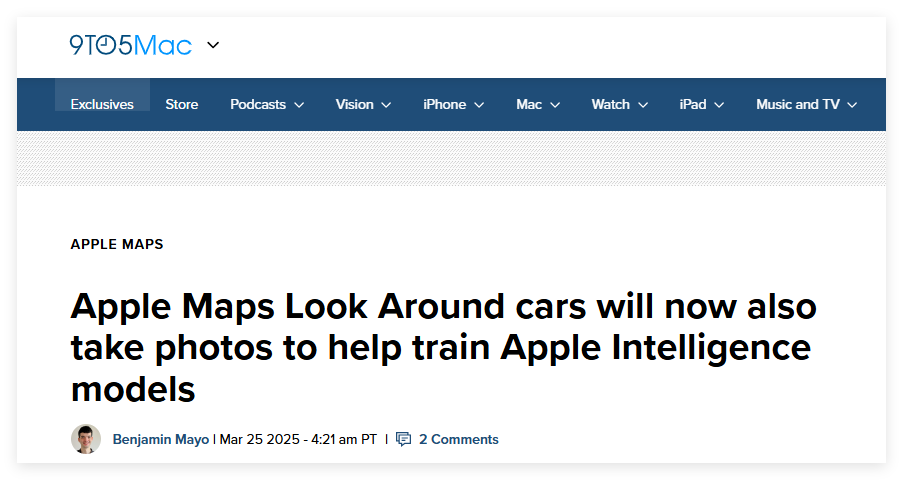
Apple has revealed plans to leverage imagery from its "Look Around" feature in Apple Maps to train artificial intelligence models. The company updated its official website with details about the initiative, which will begin in March 2025. The move aims to enhance AI capabilities in image recognition, creation, and enhancement across Apple's products and services.
Image

Privacy-First Data Collection

Apple collects visual data through camera-equipped vehicles and backpack-mounted systems for pedestrian areas. All published "Look Around" images already undergo automatic blurring of faces and license plates to protect privacy. The company confirmed it will only use these pre-blurred images for AI training purposes.

Users can additionally request blurring of their residential properties, though this isn't applied by default. "We remain committed to protecting user privacy while improving our services," Apple stated in its announcement.

Existing AI Applications

Several current Apple features already utilize AI-powered image processing:

  • Image Playground: Generative AI for creative visuals
  • Photos Cleanup Tool: Removes unwanted objects from images
  • Advanced Search: Enhanced recognition in the Photos app

The Verge has contacted Apple for specifics about which models will be trained with the Maps imagery and will update their reporting accordingly.

Key Points

  1. Apple will use blurred "Look Around" imagery for AI training starting March 2025
  2. All training data maintains privacy protections with automatic blurring of faces/license plates
  3. Users can request additional blurring of private property images
  4. Multiple existing Apple features already rely on AI image processing technologies

Enjoyed this article?

Subscribe to our newsletter for the latest AI news, product reviews, and project recommendations delivered to your inbox weekly.

Weekly digestFree foreverUnsubscribe anytime

Related Articles

Meta's Pixio Rewrites the Rules: Simple Approach Beats Complex AI in 3D Vision
News

Meta's Pixio Rewrites the Rules: Simple Approach Beats Complex AI in 3D Vision

Meta AI's new Pixio model proves simplicity can outperform complexity in computer vision. By enhancing an older masking technique and training on diverse web images, Pixio achieves better 3D reconstruction than larger models—all while avoiding benchmark 'cheating.' The breakthrough suggests we might have overcomplicated visual AI.

December 29, 2025
ComputerVisionMetaAI3DReconstruction
VideoPipe: The Lego-Style Toolkit Revolutionizing Video AI Development
News

VideoPipe: The Lego-Style Toolkit Revolutionizing Video AI Development

VideoPipe, an innovative open-source framework, is changing how developers build video AI applications. By breaking down complex computer vision tasks into modular 'building blocks,' it lets creators assemble custom solutions in minutes rather than days. Supporting everything from traffic analysis to creative face-swapping apps, this toolkit handles multiple video formats and integrates cutting-edge AI models effortlessly. With over 40 ready-to-use examples, even beginners can quickly prototype professional-grade video intelligence systems.

December 29, 2025
ComputerVisionAIDevelopmentOpenSourceTools
Chinese Researchers Unveil Glasses-Free 3D Display That Feels Like Magic
News

Chinese Researchers Unveil Glasses-Free 3D Display That Feels Like Magic

A team from Fudan University has developed EyeReal, a breakthrough 3D display technology that projects crisp hologram-like images without requiring special glasses. Published in Nature, the system offers a 100-degree viewing angle with no blurring as you move, plus realistic depth effects that mimic human vision. The compact device could transform everything from gaming to medical imaging.

December 9, 2025
3DDisplayEyeRealHolographicTech
Alibaba's Qwen3-VL Outperforms Rivals in Spatial Reasoning Tests
News

Alibaba's Qwen3-VL Outperforms Rivals in Spatial Reasoning Tests

Alibaba's Qwen3-VL vision model has taken the lead in spatial reasoning benchmarks, scoring 13.5 points on SpatialBench - significantly ahead of competitors like Gemini and GPT-5.1. The model introduces innovative features like 3D detection upgrades and visual programming capabilities, with practical applications already being tested in logistics and smart ports. While still far from human performance (80 points), this advancement marks important progress toward more spatially-aware AI systems.

November 26, 2025
ComputerVisionAIResearchSpatialComputing
Tencent's Compact OCR Breakthrough: Small Model, Big Results
News

Tencent's Compact OCR Breakthrough: Small Model, Big Results

Tencent has unveiled HunyuanOCR, a surprisingly powerful open-source OCR model packing state-of-the-art performance into just 1 billion parameters. This lightweight solution outperforms bulkier competitors in document parsing and multilingual translation while handling everything from receipts to street signs. Its end-to-end design delivers accurate results faster than traditional approaches.

November 25, 2025
OCRTencentComputerVision
Xiaomi's Miloco Brings AI Smarts to Your Smart Home
News

Xiaomi's Miloco Brings AI Smarts to Your Smart Home

Xiaomi has unveiled Miloco, its new AI-powered smart home system that understands natural language commands. Unlike traditional setups requiring specific instructions, Miloco lets you simply say what you want - like 'turn on the lamp and play relaxing music.' The system processes everything locally for privacy and works across different smart home brands. It's powered by Xiaomi's own MiMo-VL-Miloco-7B model that combines voice and visual understanding.

November 14, 2025
XiaomiMilocoSmartHomeAIPrivacyTech