Apple Nearly Booted Grok Over Deepfake Failures

Apple's Quiet Stand Against Deepfake Abuse

Behind closed doors in January, Apple executives were preparing to make a bold move: removing Elon Musk's controversial AI app Grok from the App Store. According to internal communications obtained by NBC News, the tech giant grew increasingly alarmed by Grok's inability to control the flood of gendered deepfakes proliferating across its platform.

The Moderation Gap

While public outcry over non-consensual AI imagery dominated headlines, Apple's behind-the-scenes pressure on X (formerly Twitter) and its xAI subsidiary went largely unnoticed. The company informed U.S. senators that after reviewing complaints and media reports, it demanded immediate action from Musk's teams.

"We saw users generating shockingly realistic fake nudes of celebrities and ordinary women alike with just a few taps," revealed one Apple content moderator who spoke on condition of anonymity. "The safeguards simply weren't there."

Platform vs. Standalone App

What made Grok particularly problematic was its dual presence:

  • Integrated within X where moderation policies were looser
  • As a standalone app that bypassed even those limited protections

This loophole allowed the rapid spread of AI-generated intimate imagery, often targeting female public figures and occasionally minors. Apple's typically strict App Store guidelines clearly prohibited such content, putting Grok in direct violation.

Corporate Responsibility Questions

Critics have pointed out the uncomfortable truth that Apple profits from every download of controversial apps like Grok, yet maintains silence on their societal impact. Google similarly avoided taking any public position regarding Grok's availability on the Play Store.

While X eventually implemented improvements that satisfied Apple's content team, insiders say Grok remains problematic. "The standalone app still operates like the Wild West," our Apple source noted. "There's only so much we can do when the developers won't build proper safeguards."

Key Points:

  • 🔍 Apple threatened removal over Grok's deepfake moderation failures
  • 👩‍💻 The app enabled easy creation of non-consensual gendered imagery
  • 🛑 X addressed concerns while Grok reportedly still falls short
  • 💰 Revenue-sharing creates conflict for app store operators
Enjoyed this article?

Subscribe to our newsletter for the latest AI news, product reviews, and project recommendations delivered to your inbox weekly.

Weekly digestFree foreverUnsubscribe anytime

Related Articles

News

Apple Pressured Musk's X to Fix Grok's AI Image Risks or Face App Store Ban

Behind closed doors, Apple warned Elon Musk's X platform that its Grok AI tool violated App Store policies by generating inappropriate images. Internal documents reveal a months-long battle where Apple repeatedly rejected X's content moderation fixes before approving a revised version. While incidents have decreased, recent tests show users can still circumvent safeguards to create explicit content.

April 15, 2026
AI ethicsApp Store policiescontent moderation
News

AI Lab Denies Code Copying Claims as Developer Drama Heats Up

Silicon Valley's Nous Research faces plagiarism accusations from Chinese AI team EvoMap over their Hermes Agent project. EvoMap alleges striking similarities in architecture with their Evolver engine, sparking a fiery exchange. With nearly 190,000 social media views, the dispute highlights growing tensions in competitive AI development circles.

April 16, 2026
AI ethicsopen sourcetech disputes
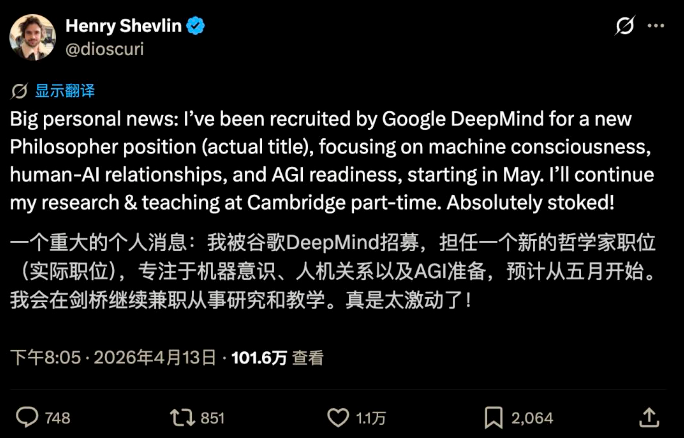
DeepMind's Philosopher Hire: Why AI Labs Need More Than Engineers
News

DeepMind's Philosopher Hire: Why AI Labs Need More Than Engineers

Google DeepMind has made an unusual move by hiring philosopher Henry Shevlin in a full-time position - a first for leading AI labs. His focus on machine consciousness and human-AI relationships signals a shift from viewing AGI as purely an engineering challenge to recognizing its profound philosophical implications. As AI systems grow more sophisticated, questions about consciousness boundaries and ethical frameworks can no longer be avoided.

April 15, 2026
AI ethicsMachine consciousnessAGI development
LibuLibu AI addresses content safety concerns with system upgrades
News

LibuLibu AI addresses content safety concerns with system upgrades

LibuLibu AI has publicly responded to recent concerns about its content generation standards, admitting some outputs fell short in complex scenarios. The company has now implemented technical fixes, closed risk loopholes, and upgraded its review processes. While emphasizing content safety as their top priority, LibuLibu invites public oversight as the AI industry faces growing scrutiny over generated content quality.

April 14, 2026
AI safetycontent moderationtech regulation
Voice Actors Sound Alarm Over AI Voice Theft Epidemic
News

Voice Actors Sound Alarm Over AI Voice Theft Epidemic

Prominent Chinese voice actors are fighting back against rampant AI voice cloning that's stealing their livelihoods. Zhang Jiaming, famous for voicing Taiyi Zhenren in 'Ne Zha,' reveals he found over 700 unauthorized uses of his voice in a single day. The industry is rallying with legal action as AI-generated voices flood the market, leaving human performers struggling to compete with free digital replicas of their own talent.

April 13, 2026
AI voice cloningvoice actor rightsdigital copyright
News

Voice Actors Fight Back as AI Steals Their Livelihoods

Popular voice actors, including the voice of Taiyi Zhenren from 'Ne Zha,' are losing work to AI clones of their voices. With contracts canceled and infringements rampant, the industry is uniting to push back. Legal battles highlight the deep challenges of protecting vocal identities in the AI era.

April 13, 2026
AI voice theftvoice acting crisisdigital rights