
AI Breakthrough Spots Hidden Fatty Liver Risks in Routine Scans

AI Detects Silent Liver Threat in Routine Scans
Image

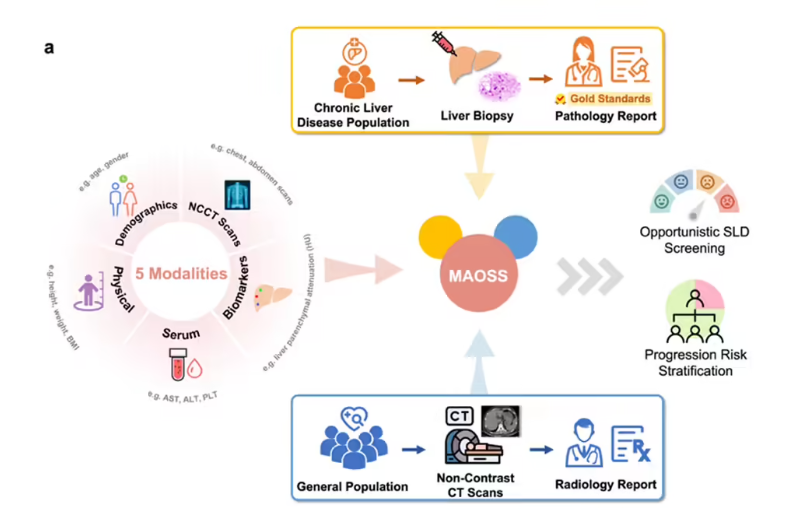
What if your last routine CT scan could have warned you about a ticking time bomb in your liver? That's now possible thanks to MAOSS, an AI breakthrough that spots early signs of fatty liver disease - a condition affecting one in three adults that often goes undiagnosed until irreversible damage occurs.

The Silent Epidemic

Fatty liver disease has quietly become a global health crisis, yet most cases slip through traditional screening methods. "Current approaches miss too many at-risk patients," explains the DAMO Academy team behind MAOSS. "B-ultrasounds lack sensitivity, while specialized tests are expensive and impractical for mass screening."

The consequences are dire: undetected fatty liver can progress to fibrosis and eventually cirrhosis. But here's the game-changer - MAOSS extracts critical warning signs from existing unenhanced CT scans, the kind many people already get during routine checkups.

How MAOSS Works Its Magic

This isn't just another AI promising miracles. MAOSS delivers concrete advantages:

  • Sees What Doctors Miss: By analyzing subtle patterns in liver texture and density, it achieves 90% accuracy in staging liver fat content - outperforming radiologists by nearly 30%
  • Early Warning System: Identifies 52% of high-risk fibrosis cases versus just 17% caught through standard methods
  • Predicts Future Risk: Patients flagged as high-risk have a 45% chance of developing cirrhosis within two years
  • No Extra Costs: Works with existing scan data, requiring no additional tests or expenses

"This represents a paradigm shift," notes one researcher. "We're turning routine imaging into powerful preventive tools without asking patients to do anything differently."

Real-World Impact

The implications are profound for public health. Imagine getting your annual physical and receiving not just a clean bill of health, but actual predictive insights about hidden risks. For primary care physicians, it means catching reversible conditions before they become life-altering diagnoses.

Clinical trials showed MAOSS could particularly benefit:

  • Middle-aged adults with metabolic risk factors
  • Patients with unexplained elevated liver enzymes
  • Anyone with prior inconclusive liver screenings

The technology is already being adapted for use in community hospitals across China, with global applications likely to follow pending regulatory approvals.

Key Points:

  • MAOSS AI analyzes standard CT scans to detect fatty liver disease and fibrosis risk
  • Outperforms doctors with 90% accuracy in clinical trials
  • Doubles detection of high-risk cases compared to traditional methods
  • Predicts cirrhosis risk up to two years in advance
  • No extra costs - works with existing medical imaging data

Enjoyed this article?

Subscribe to our newsletter for the latest AI news, product reviews, and project recommendations delivered to your inbox weekly.

Weekly digestFree foreverUnsubscribe anytime

Related Articles

Health App Ant Afu Joins Forces With CCTV's Healthy Life Program
News

Health App Ant Afu Joins Forces With CCTV's Healthy Life Program

The AI-powered health application Ant Afu has partnered with CCTV's Healthy Life program, marking a significant step in digital healthcare accessibility. With over 10 million daily health inquiries processed, the app connects users to a network of 5,000 hospitals and 300,000 doctors nationwide. Notably, it features virtual consultations with top medical experts through its 'AI Avatars of Famous Doctors' program, bringing specialist care to remote areas.

February 10, 2026
digital healthAI healthcaretelemedicine
News

AI Boosts Breast Cancer Detection Rates in Major Swedish Trial

A landmark Swedish study involving 100,000 women reveals AI-assisted breast cancer screening reduces missed diagnoses by 12%. Published in The Lancet, the research shows AI detected 80% of cancers compared to radiologists' 74%, particularly excelling at spotting dangerous invasive cancers. While promising, experts caution these tools should support - not replace - doctors, and more studies are needed.

January 30, 2026
AI healthcarebreast cancer screeningmedical technology
News

Google's AI leans on YouTube over doctors for health answers

A new study reveals Google's AI search tool favors YouTube videos over professional medical websites when answering health queries. Researchers analyzed over 50,000 searches and found YouTube content appeared most frequently in AI-generated summaries, raising concerns about the reliability of medical information presented with authoritative confidence.

January 26, 2026
AI healthcareGoogle searchmedical misinformation
News

China Mobile and Alipay Team Up to Bring AI-Powered Healthcare and Companionship to Your Phone

China Mobile's new AI call assistant, developed with Alipay, is transforming healthcare access through voice commands. The service connects users with over 5,000 hospitals nationwide without needing to download apps. Additionally, an AI companion feature addresses emotional needs, offering personalized digital friends for lonely users. These innovations showcase how 5G technology is making life easier while tackling both physical and mental health challenges.

January 19, 2026
AI healthcare5G technologydigital companionship
News

Millions Rely on ChatGPT for Medical Advice – But Is It Safe?

Over 40 million Americans turn to ChatGPT daily for health guidance, from deciphering medical bills to self-diagnosing symptoms. While many see it as a helpful ally in navigating the complex healthcare system, concerns grow about its accuracy, especially in mental health advice. The AI tool now handles nearly 2 million insurance questions weekly, but regulators are scrambling to set boundaries as lawsuits mount.

January 6, 2026
AI healthcareChatGPTmedical technology
News

Musk envisions AI doctors and robot surgeons replacing traditional healthcare

Elon Musk has proposed a radical tech-driven alternative to government healthcare systems, combining AI diagnostics through his Grok model with surgical robots like Optimus. While painting an ambitious vision of efficient, affordable medical care available around the clock, experts caution about significant technological and ethical hurdles remaining before such systems could become reality.

December 29, 2025
Elon MuskAI healthcaremedical robotics