AI Breakthrough: GPT-4 Accelerates Cancer Drug Discovery

AI Breakthrough in Cancer Research: GPT-4 Identifies Novel Drug Combinations

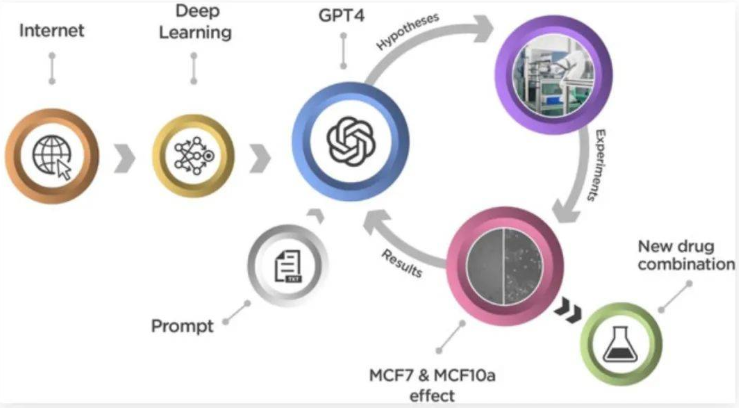
In a groundbreaking study published by the University of Cambridge, large language models (LLMs) have demonstrated remarkable potential in accelerating cancer drug discovery. The research team utilized GPT-4 to generate scientific hypotheses, leading to the identification of promising new treatment combinations for breast cancer.

The AI-Assisted Discovery Process

The research focused on finding effective drug combinations from FDA-approved non-cancer medications that could work synergistically against breast cancer cells. The team established three critical selection criteria:

  1. Exclusion of standard anti-cancer drugs
  2. Preference for compounds targeting cancer cells while sparing healthy tissue
  3. Prioritization of low-cost, already-approved medications
Image

Remarkable Results

Through laboratory validation, GPT-4's proposals yielded extraordinary findings:

  • 12 potential drug combinations identified
  • 3 combinations showed superior synergy scores compared to existing positive controls
  • Subsequent AI-generated proposals revealed 3 additional effective pairs in follow-up testing

The most notable discovery paired simvastatin (a cholesterol medication) with disulfiram (an alcohol dependence treatment). This unexpected combination demonstrated significant anti-cancer potential, showcasing AI's ability to identify non-obvious therapeutic relationships.

Implications for Medical Research

This breakthrough represents several important advancements:

  1. Validation of AI in scientific hypothesis generation
  2. Accelerated drug discovery timeline through computational screening
  3. Cost-effective repurposing of existing medications
  4. Reduced animal testing through intelligent pre-screening

The study's lead researchers emphasize that this approach doesn't replace human scientists but rather augments their capabilities, allowing them to explore more possibilities in less time.

Future Directions

The success of this methodology opens doors for:

  • Application to other cancer types and diseases
  • Integration with molecular modeling systems
  • Development of specialized AI tools for pharmaceutical research
  • Potential for personalized medicine approaches

The research team has made their findings publicly available to encourage broader scientific collaboration in this emerging field.

Key Points:

  • GPT-4 successfully identified novel breast cancer drug combinations from FDA-approved medications
  • The simvastatin-disulfiram combination showed particularly promising results
  • AI-assisted drug discovery can significantly reduce development time and costs
  • This approach demonstrates the potential for repurposing existing drugs for new treatments

The full study is available at: Royal Society Publishing

Enjoyed this article?

Subscribe to our newsletter for the latest AI news, product reviews, and project recommendations delivered to your inbox weekly.

Weekly digestFree foreverUnsubscribe anytime

Related Articles

News

AI-Powered Biotech Startup Chai Discovery Hits $1.3 Billion Valuation

Chai Discovery, an AI-driven biotech firm, has secured $130 million in Series B funding, catapulting its valuation to $1.3 billion. Backed by OpenAI and other prominent investors, the company is revolutionizing drug discovery with its advanced molecular design technology. Their latest Chai2 model shows remarkable progress in creating targeted antibody treatments, potentially transforming how we develop life-saving medications.

December 16, 2025
BiotechnologyAI HealthcareDrug Discovery
Latent Labs Launches AI Model to Revolutionize Protein Design
News

Latent Labs Launches AI Model to Revolutionize Protein Design

Latent Labs has unveiled LatentX, a web-based AI model designed to democratize protein design. The tool, developed by former DeepMind researchers, enables the creation of novel proteins with atomic precision, accelerating drug development. Unlike competitors, LatentX focuses on licensing its technology rather than proprietary drug development.

July 23, 2025
Artificial IntelligenceBiotechnologyDrug Discovery
Ex-Google CEO's Startup Unveils 24B-Parameter AI for Chemistry
News

Ex-Google CEO's Startup Unveils 24B-Parameter AI for Chemistry

FutureHouse, backed by former Google CEO Eric Schmidt, has released ether0, a groundbreaking 24-billion-parameter AI model for chemical reasoning. The open-source system outperforms leading models in accuracy while requiring far less training data, marking a leap forward for scientific AI applications.

June 17, 2025
Artificial IntelligenceChemistry ResearchMachine Learning
Meta Unveils OMol25 Dataset and UMA Model for AI-Driven Chemistry
News

Meta Unveils OMol25 Dataset and UMA Model for AI-Driven Chemistry

Meta has launched OMol25, the largest AI-driven chemistry dataset, alongside the Universal Atom Model (UMA), a general-purpose AI tool for molecular property prediction. These innovations aim to accelerate drug discovery, battery development, and catalyst research by providing faster, more accurate simulations.

May 16, 2025
AI ChemistryMeta ResearchMolecular Modeling
AI Model DiffSMol Accelerates Drug Discovery with 5x Success Rate
News

AI Model DiffSMol Accelerates Drug Discovery with 5x Success Rate

Researchers at The Ohio State University have developed DiffSMol, an AI model that generates potential drug candidates in seconds with a 61.4% success rate—five times higher than previous methods. The open-source tool could revolutionize pharmaceutical research by dramatically reducing costs and development time.

May 13, 2025
AIDrug DiscoveryPharmaceuticals
News

Game-Changer in Eye Care: 'Fuxi Huayan' Shakes Ophthalmology!

The medical world just got a serious upgrade! China has unveiled 'Fuxi Wisdom Eye' (VisionFM), a groundbreaking AI model that not only diagnoses eye diseases but can predict their progression and even assess blood indicators—just from a single eye photo! This revolutionary tech is set to change the game for chronic disease prevention, making waves in hospitals across China and beyond.

October 22, 2024
Fuxi HuayanAI in MedicineOphthalmology